
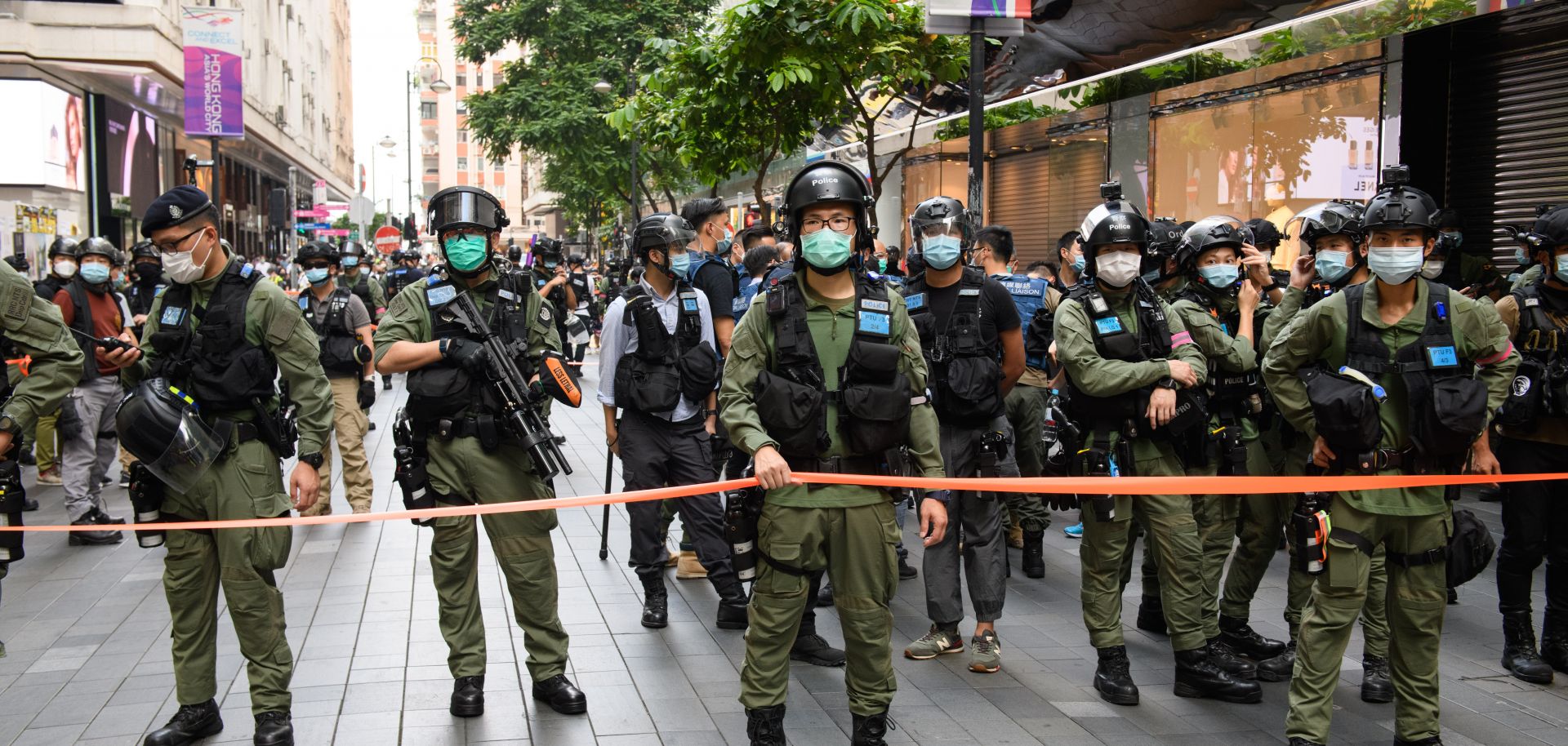
Police cordon off an area during a protest on China's National Day in Hong Kong on Oct. 1, 2020.
The recent crackdowns in Hong Kong using the new national security law will keep pro-democracy forces cautious about overly confrontational protest or political tactics. With activists focused on surviving the city’s newly restrictive environment, Chief Executive Carrie Lam and the pro-Beijing camp will be able to pursue policies and practices that enhance their chances in 2021 elections and shore up mainland China’s foothold in the city and enhance their chances in 2021 elections. On Oct. 1, Hong Kong protesters turned out to mark China’s National Day, heeding calls by activists to defy the city’s COVID-19 ban on demonstrations. However, the turnout was meager compared with past events, with citywide estimates in the low hundreds. Ahead of the protests, mainland Liaison Office Director Luo Huining essentially declared victory and hailed the actions of the National People’s Congress in imposing the new national security legislation for ending the "savage unrest” in Hong Kong. In his statement, Luo also called for enhancing patriotic education for Hong Kong students and civil servants. At a National Day ceremony, Lam also said that protections on national security had ushered a “return to peace.”
- On Oct. 1, police arrested 69 protesters citywide, including two district councilors, primarily on allegations of unlawful assembly. Protesters appeared to adopt deliberately non-confrontational tactics, assembling in smaller groups and then dispersing before police could intervene. Prominent activists such as Joshua Wong did make an appearance at the demonstrations, but in groups smaller than the four allowed by COVID-19 restrictions.
- There were more confrontational tactics, but these were marginal compared with previous protests. Some demonstrators appeared outside of the mainland liaison office. Others chanted pro-independence slogans and there was at least one case of possession of pro-independence leaflets. Protesters in Wong Tai Sin also threw several petrol bombs that started small fires in the street, but caused only minor damage.
- The 2020 turnout pales in comparison to the large and violent protests on the same date in 2019, which saw widespread participation by ordinary Hong Kongers and overshadowed celebrations marking the 70th anniversary of the founding of the People’s Republic of China.
- On Sept. 29, the majority of pro-democracy lawmakers in Hong Kong’s legislature opted not to boycott a controversial extended term due to delayed elections.
In terms of turnout and intensity, protests will not come close to those of 2019, with Hong Kong’s opposition now in a “wait and see” stance. But that does not mean a total end to the unrest in the city. The upcoming legislative council session may bring consideration of controversial legislation that could expand voting to Hong Kongers living in mainland China (which would shore up pro-Beijing chances in 2021 elections), or ban filibustering by lawmakers (which is a key legislative tactic by the minority pro-democracy camp). Such measures and the easing of the COVID-19 pandemic risk once again making city streets the primary site confrontation with authorities. More severe restrictions also risk spurring more radical tactics on the part of disaffected Hong Kongers targeting police, government and/or Beijing-affiliated institutions.
