
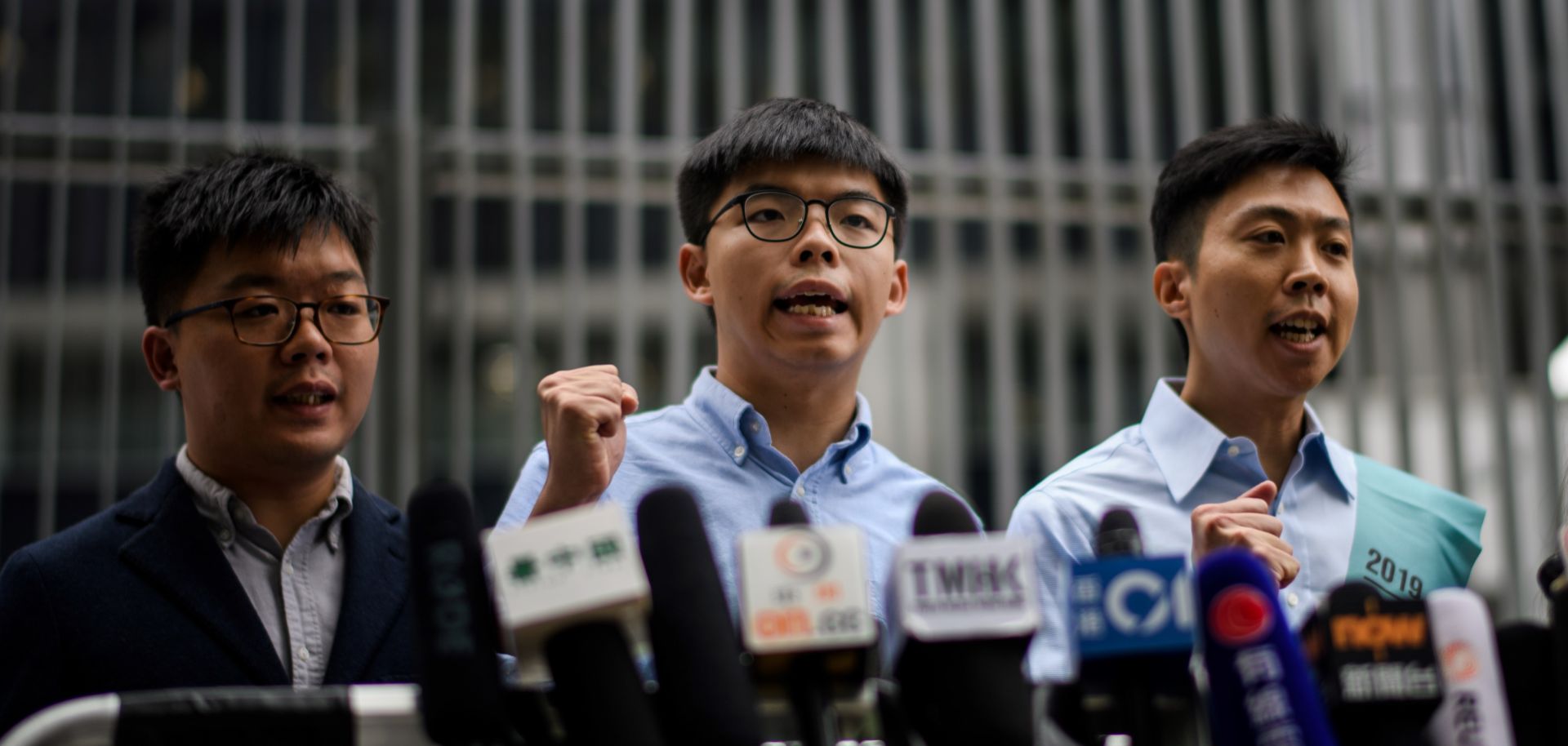
Pro-democracy activist Joshua Wong (center) and Kelvin Lam (right) shout slogans at a press conference outside the Legislative Council building in Hong Kong on Oct. 29, 2019. Wong had been disqualified from running in the Nov. 24 election for the city's district council.
Six months into Hong Kong's divisive political crisis the city's 4.13 million registered voters will have the chance to weigh in on the movement and Hong Kong's broader political environment. Nov. 24, the city is scheduled to hold elections for its district council, the only direct vote its citizens have in an otherwise tightly controlled electoral mechanism. More than 1,000 candidates will stand for election for 452 council seats in a ballot that has traditionally focused on community-level issues. In recent years, the elections have produced a council dominated by pro-establishment groups aligned with Beijing's interests.
This year's elections, coming in the midst of the protest movement that has gained momentum largely as a reaction to Beijing's increasing control over Hong Kong's affairs, could threaten the grip that pro-establishment forces (and, by extension, Beijing) retain on the body. While authorities in Hong Kong and Beijing would rather not see this come to pass, the central government also understands that circumventing the election — whether by postponing or canceling the vote — could be more disruptive than an opposition victory.
One politically significant factor in the district council election is that it could determine as many as 117 of the 1,200 seats on the election committee that will name the city's chief executive in 2022, a body heavily weighted toward pro-establishment forces such that it is almost certain that Beijing's preferences are followed. That fact becomes more significant today given the sharp differences between opposition demands for universal suffrage and Beijing's harder-line position on a controlled electoral mechanism. The local election offers one of the few avenues through which voters could influence Hong Kong's wider political process. While a major victory by the opposition in the district elections is unlikely to result in policy shifts by Hong Kong's authorities, it could further erode the standing of the already embattled Hong Kong government and diminish the electoral prospects of pro-establishment candidates in 2020 legislative elections.
But changing the current composition of the district council would require a reversal of previous political trends. Currently, pro-establishment representatives fill 70 percent of the council's seats, dominating all 18 of the city's districts. Those candidates will likely suffer this time at the ballot box, similar to the election in 2003, when a controversial security bill brought about mass protests and resulted in a huge electoral defeat for those who backed Beijing. But the opposition this time appears divided, with some taking a more radical line on protests and a few espousing a pro-independence agenda. Even if opposition candidates perform well in the district elections, institutional barriers could limit the effect of their victory on the Legislative Council election in 2020 and on the composition of the Election Committee that names the chief executive.
With public sentiment trending against the establishment, some in the opposition have speculated that central authorities could use the deepening crisis and associated violent episodes as an excuse to delay or cancel the elections. But that would certainly inflame protesters and alienate broader Hong Kong society, a reaction that neither the city's leaders nor Beijing wants to see. Additionally, foreign governments and even some businesses regard the district elections as an important gauge of Beijing's tolerance for the democratic process in Hong Kong. Bearing those costs in mind, central government officials have urged the Hong Kong government to hold the election as scheduled, despite the risk of a significant defeat for the pro-Beijing camp. Still, with the drivers of the protest movement largely uncoupled from the political process, the election in itself won't ease the crisis, although a result unfavorable to the opposition or a cancellation could intensify it.
What to Watch as the Elections Unfold
The Security Response: Unrest in conjunction with the vote could take the form of polling station vandalism, voter intimidation or even assaults on people both by pro- and anti-government partisans. Police could decide to take action against protesters or arrest pan-democracy leaders. Any election day violence will raise the chances that voting may be canceled in certain constituencies. That, in turn, would provoke more protests, triggering a greater security response by the Hong Kong authority. Even a smooth election process could result in more disquiet if, for example, accusations of electoral fraud surfaced, or the judiciary or the Hong Kong leadership disqualified elected candidates.
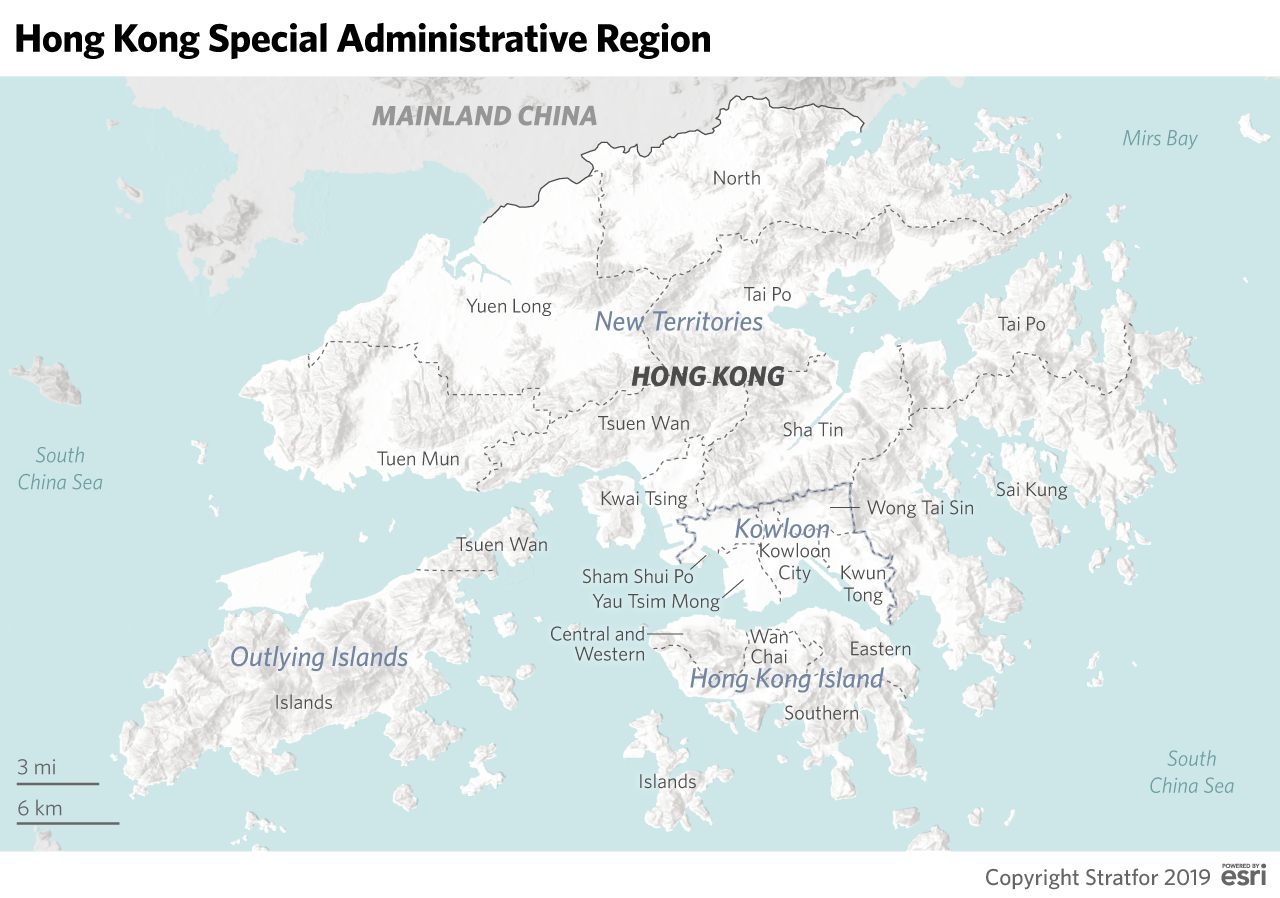
The Turnout and Outcome: Beyond the final result, the number of votes cast will serve an important gauge of public opinion on the protest movement and the authorities in Hong Kong. Signs showing high interest in the balloting include a 12 percent increase in voter registration as compared with the previous electoral cycle. Turnout among younger voters, who generally work against the traditional polity, will be important to monitor.
Election results will determine the power balance among pro-establishment, pan-democracy and so-called nativist movement candidates. A sizable victory by the latter two forces will further weaken the Hong Kong government's ability to set policy. If the opposition captures a majority of seats in the 18 districts divided among Hong Kong/Kowloon and the New Territory, it would net 117 votes in the election to name the city's chief administrator in 2022.
The Response by Beijing: While it's in Beijing's interests to see the election progress smoothly, the question will be how much the central government would be willing to tolerate a significant opposition win. In that eventuality, if the central government sees a threat to its national interests, it could attempt to disqualify the elected officials through legal maneuvers at the risk of deepening the city's political divide and further emboldening protests.
