
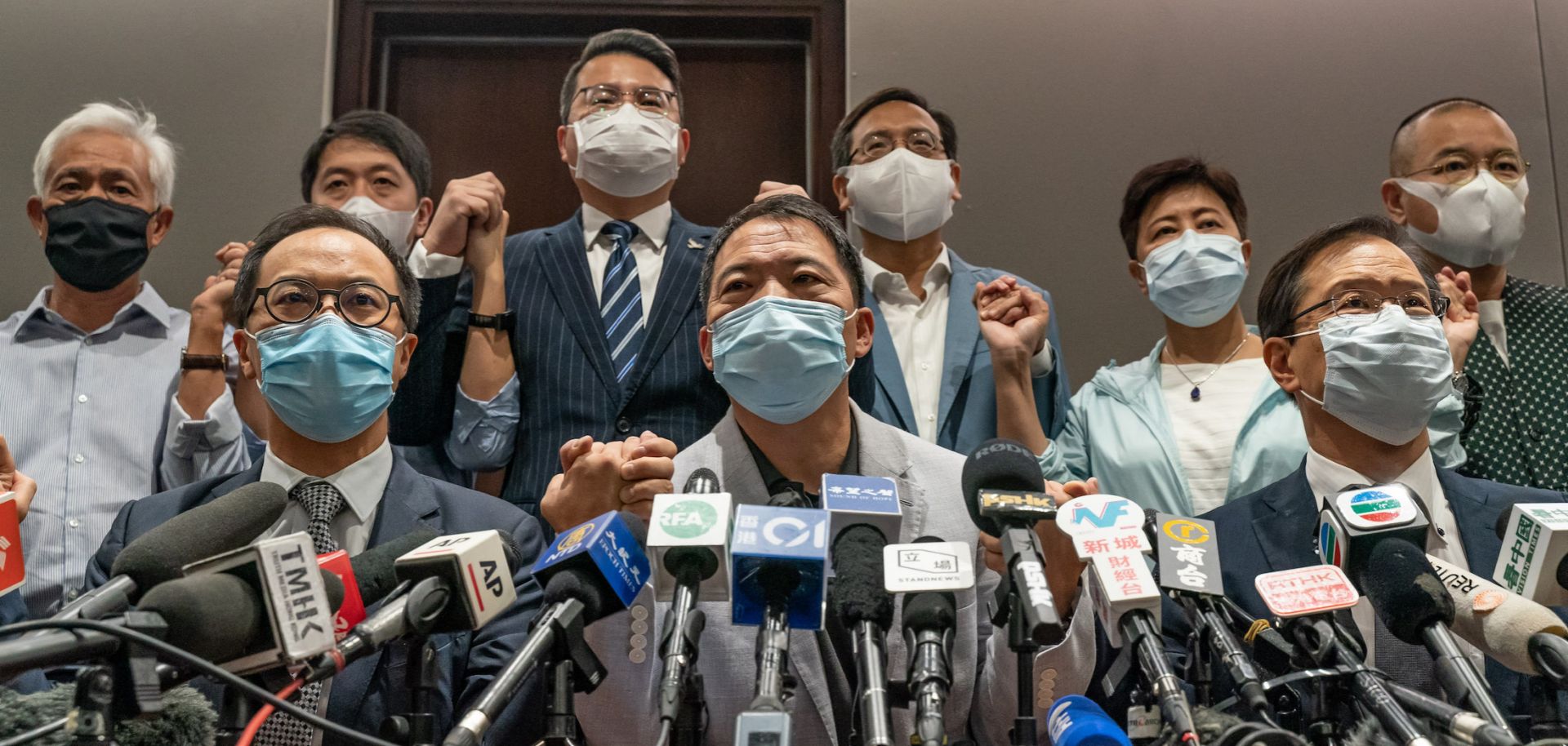
Pro-democracy lawmakers join hands during a press conference at Hong Kong’s Legislative Council after city officials ousted four of their colleagues on Nov. 11, 2020
By leaving the legislature, Hong Kong’s pro-democracy camp has lost its only remaining official platform to express discontent with Beijing's encroachment — setting the stage for a potentially volatile dynamic. However, the threat of the national security law and COVID-19 restrictions will leave many Hong Kongers wary of launching disruptive protests against the government, granting Beijing more freedom to rein in Hong Kong’s political crisis without damaging the city’s status as a global financial hub. On Nov. 11, the 15 remaining pro-democracy lawmakers in Hong Kong's legislature said they will resign from their posts Nov. 12 after authorities disqualified four of their colleagues for allegedly advocating for U.S. sanctions.
- On Nov. 11, China's National People’s Congress Standing Committee (NPCSC) passed a resolution allowing the Hong Kong’s chief executive to expel lawmakers if they took actions deemed against the Hong Kong Basic Law and their oath of allegiance, including advocating for independence, declining to support Chinese assertions of sovereignty over Hong Kong, calling for sanctions or threatening national security. Shortly thereafter, Hong Kong authorities announced the removal of the four pro-democracy lawmakers, retroactively effective to July 30.
- Hong Kong’s pro-democracy camp has since called the move the end of China’s "one country, two systems" policy, arguing that the resolution effectively abolishes the separation of powers under the city's Basic Law by granting the chief executive power over the legislature.
Hong Kong and Beijing see constant disruptions in the legislative council as no longer acceptable, particularly ahead of the early 2021 budget passage process. The current dampened protest environment in the city, along with the uncertain political climate in the United States following the presidential election, may also have given authorities the confidence to make this move without the fear of sparking an unmanageable response from Hong Kongers or the United States. The Chinese government may also be seizing on the opportunity to further clamp down on any potential legislative disruptions in Hong Kong ahead of upcoming events that could raise the risk of high-profile protest activity, including the legislative council elections in September, followed by the 100-year anniversary of the founding of the Chinese Communist Party in July and the 2022 Beijing Winter Olympic Games.
- Moderates and more hardline pro-democracy politicians were already divided on whether to participate in the extended legislative term, with polls of supporters showing an even split that justified moderates remaining.
- Without a legislative majority, the pro-democracy camp had planned on using the extended term to slow the pro-Beijing policy agenda via filibustering tactics. It was also planning to leverage its presence in the legislature as a high-profile platform to highlight the growing encroachment of the mainland into Hong Kong affairs.
- The pro-Beijing camp, however, has been increasingly advocating for official moves to halt such disruptive tactics by the pro-democracy lawmakers since the start of the current session on Oct. 14. On Oct. 23, pro-Beijing lawmaker Alice Mak called on Legislative Council President Andrew Leung to look into whether the pro-democracy camp's tactic of filibustering violated the new national security law. Earlier, Leung had also warned that some pro-democracy discussions in the legislature may not be protected under parliamentary immunity.
The pro-democracy camp now lacks an official foothold in the Hong Kong power structure, with the exception of a large presence in the relatively powerless district councils. The legislative council resignations will help unite the pro-democracy camp by forcing its moderate wing to also operate outside Hong Kong’s official power structure alongside its more radical wing. Without legislative seats, however, the pro-democracy camp has few options for dissent. This will likely spur more Hong Kongers to leave the city altogether, although such an exodus would too be partly blocked off by Beijing. With the more moderate camp now equally marginalized as the radical camp, there will be more energy behind mounting protests as well, though government restrictions will make mobilizing large swaths of the public difficult. More radical, disaffected members of the opposition may, in turn, be among the few to brave street demonstrations, increasing the risk of violence against official targets.
Pro-Beijing lawmakers, meanwhile, will now be free to pass a raft of legislation, potentially including long-term bans on filibustering tactics to shield it against any future opposition disruptions. Following the disqualification of the four lawmakers, Hong Kong Chief Executive Carrie Lam said there would be no by-elections to fill the seats and that the next elections would not take place until the already-planned Sept. 2021 polls. In the meantime, the legislature could also pass laws allowing Hong Kongers in mainland China to vote, as well as potentially more controversial measures such as a robust extradition law and patriotic education. The pro-Beijing camp, however, may first focus most on proving its value to the sharply polarized Hong Kong public by focusing on measures to control the spread of COVID-19 and get the city’s economic growth back on track.
Despite Beijing’s increasing encroachment in Hong Kong, authorities still appear focused on preserving the city’s standing as a global economic hub by prioritizing political stability while preserving business continuity. In response to the recent legislative council development, the United States could impose additional sanctions, though the transition to a new administration under President-elect Joe Biden may make this difficult. Regardless, any new U.S. sanctions would likely target more Hong Kong and Chinese officials, as Washington will remain wary of targeting the city’s major entities or its financial sector. The tightly controlled Hong Kong government and its backers on the mainland are also unlikely to engage in efforts that would jeopardize continuity for foreign businesses, seeking instead to preserve the value of the city as a gateway to China.
- Foreign financial institutions in Hong Kong will face less risk of being squeezed between Beijing and Washington, given recent Hong Kong’s Securities and Futures Commission guidance saying implementing U.S. sanctions would not violate the national security law.
- Hong Kong regulators have also reportedly dropped that would have forced cloud technology providers to agree to a data-sharing scheme granting them access to client information.
- Media outlets and internet/social media platforms, however, still risk getting caught up in the city’s increasingly polarized political environment.
