
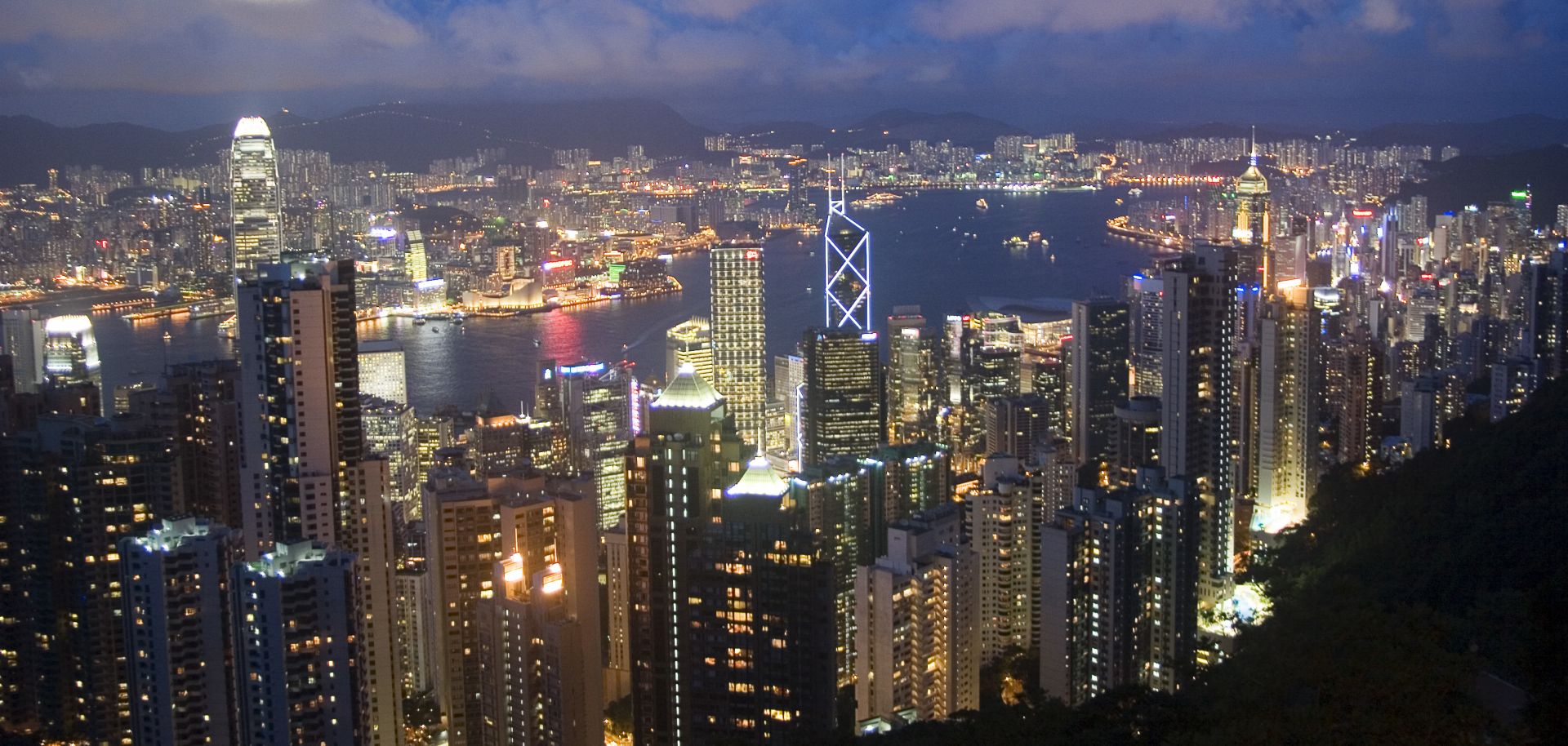
An evening view of the western half of Hong Kong.
U.S. President Donald Trump's expected signature of the Hong Kong Autonomy Act (HKAA) presages a policy challenge for his administration as it seeks to pressure China without further damaging the U.S.-China trade deal. This, combined with the need to avoid creating additional economic uncertainty ahead of the November election, suggests possible new sanctions will not pose an immediate threat to Hong Kong's currency peg to the U.S. dollar.
The Potential for New Sanctions
The HKAA, which passed both houses of Congress unanimously in late June, adds to the thicket of U.S. legislation providing presidential authority to act against China. The HKAA combines "naming and shaming" of targeted individuals and entities with initially discretionary and later mandatory sanctions by requiring the United States to identify within 90 days anyone attempting to undermine China's "one country, two systems" legal regime. Secondary sanctions may be applied to financial institutions conducting business with identified parties. Those include the possibility of restrictions on access to loans from U.S. institutions, preventing banks from being primary dealers in U.S. debt, conducting foreign exchange and banking transactions in U.S. dollars, and penalties on financial executives. The president has the power to block assets and deny U.S. entry to anyone identified under the law, although that would become mandatory one year after the Secretary of State makes the initial identification.
For now, it seems any new U.S. sanctions would likely focus on individuals and not against Hong Kong or China in general. U.S. Secretary of State Pompeo seems especially peeved by Hong Kong-based banks HSBC and Standard Chartered Bank's public support for the national security law, so targeting the executives at these two banks is likely. But with preserving the trade deal the Trump administration's current priority, more aggressive and incendiary action against Hong Kong is possible later this year if China does not step up purchases of U.S. agricultural goods, and/or if Trump's polling numbers continue to slide ahead of the November vote.
Preserving Hong Kong's Dollar Peg
Although China's critics have advocated a range of punitive financial moves against China, taking aim at Hong Kong's global financial role by targeting the city's currency peg is unlikely because it would initiate deeper disruptions in the global financial system. Hong Kong is the fourth-largest foreign exchange market globally, and the Hong Kong Monetary Authority (HKMA) can currently buy and sell U.S. dollars in any international market. Hong Kong's importance as a global financial hub is further underlined by an existing dollar swap line with the U.S. Federal Reserve which it has never used. The 36-year old peg is not infinitely immutable, but keeping it for now attracts capital inflows by minimizing foreign exchange risk, which is a benefit to Beijing since the Chinese yuan is not convertible. In addition, Hong Kong has the world's fourth-largest equity market, which is also the largest source of capital for Chinese firms seeking outside investment and for investors buying stock in mainland companies.
Hong Kong does not need Washington's permission to maintain its currency peg to the U.S. dollar, only sufficient foreign exchange reserves to defend it and underpin the Hong Kong dollar's issuance. At present, foreign exchange reserves are twice the size of the monetary base, and the HKMA has the ability to inject liquidity equal to nearly an additional 60 percent of the monetary base. The peg could be broken by a massive speculative attack, but it has held in the past, including during the 1997 Asian financial crisis. China's central bank could, of course, also provide Hong Kong access to its more than $3 trillion in foreign currency reserves. It is also possible that Trump takes symbolic action by ordering the U.S. Federal Reserve to break its swap line with Hong Kong.
Financial markets, however, have already passed judgment on the unlikelihood of the United States taking on the Hong Kong dollar's peg to its U.S. counterpart, given that the Hong Kong dollar consistently trades at the strong end of its range and that the HKMA routinely buys U.S. dollars. Moreover, 1,300 U.S. firms have a presence in Hong Kong with nearly 280 having regional headquarters there. According to the American Chamber of Commerce in Hong Kong, 70-75 percent of its 180 members have no plans at this time to move either operations or assets out of Hong Kong. In the long term, however, the undermining of Hong Kong's legal protections will ultimately affect its status as a global economic hub by making the city subject to mainland jurisdiction.
What's Next?
In its escalatory actions against Beijing, Washington is likely to adopt a measured approach that carefully balances the pressure it exerts against the risk of further global economic harm that would exacerbate the impacts of COVID-19. The White House will also seek to maintain the facade of a successful U.S.-China trade deal ahead of the November presidential election. In addition to addressing trade issues, the United States will also respond to human rights abuses against the Uighurs in China's Xinjiang Province. The U.S. Treasury Department's recently announced sanctions against China over its actions in Xinjiang could suggest a blueprint for the Trump administration's strategy toward Hong Kong as well.
In late May, Pompeo notified Congress that Hong Kong "does not continue to warrant treatment under United States laws in the same manner as U.S. laws were applied to Hong Kong" before the city's British handover in 1997. That statement alone opens the door to treating Hong Kong similar to the mainland for some purposes, including removing the city's special tariff status granted under the 1992 U.S.-Hong Kong Policy Act. Pompeo's withdrawal of autonomy certification, along with the Hong Kong Human Rights and Democracy Act of 2019, could allow the United States, among other things, to:
- Impose tariffs on Hong Kong exports similar to existing tariffs on U.S. imports from mainland firms.
- Place controls on U.S. exports, especially technology transfers and dual-use goods that have both military and civilian applications.
- Make Hong Kong investment into the United States subject to mandatory filing and review by the Committee on Foreign Investment in the United States, although much of that is already subject to a high level of scrutiny.
- Ban Chinese social media applications, such as TikTok.
- Seek to damage Chinese influence in international financial institutions by restraining Hong Kong's current independent status in organizations such as the World Trade Organization, International Monetary Fund and World Bank.
- Limit certain Hong Kong individuals' access to the United States.
- Penalize foreign financial institutions that do business with certain individuals seen as interfering in Hong Kong's democracy.
- Interfere in clearing and settlement of U.S. dollar transactions by individual financial institutions in Hong Kong.
Any prospective administration under Democratic presidential candidate Joe Biden may place less emphasis on tariffs as a policy tool, but would still undoubtedly take a similar bipartisan approach to China as well due to the broad consensus among U.S. voters and legislators that Beijing takes unfair advantage of its global status and power.
