
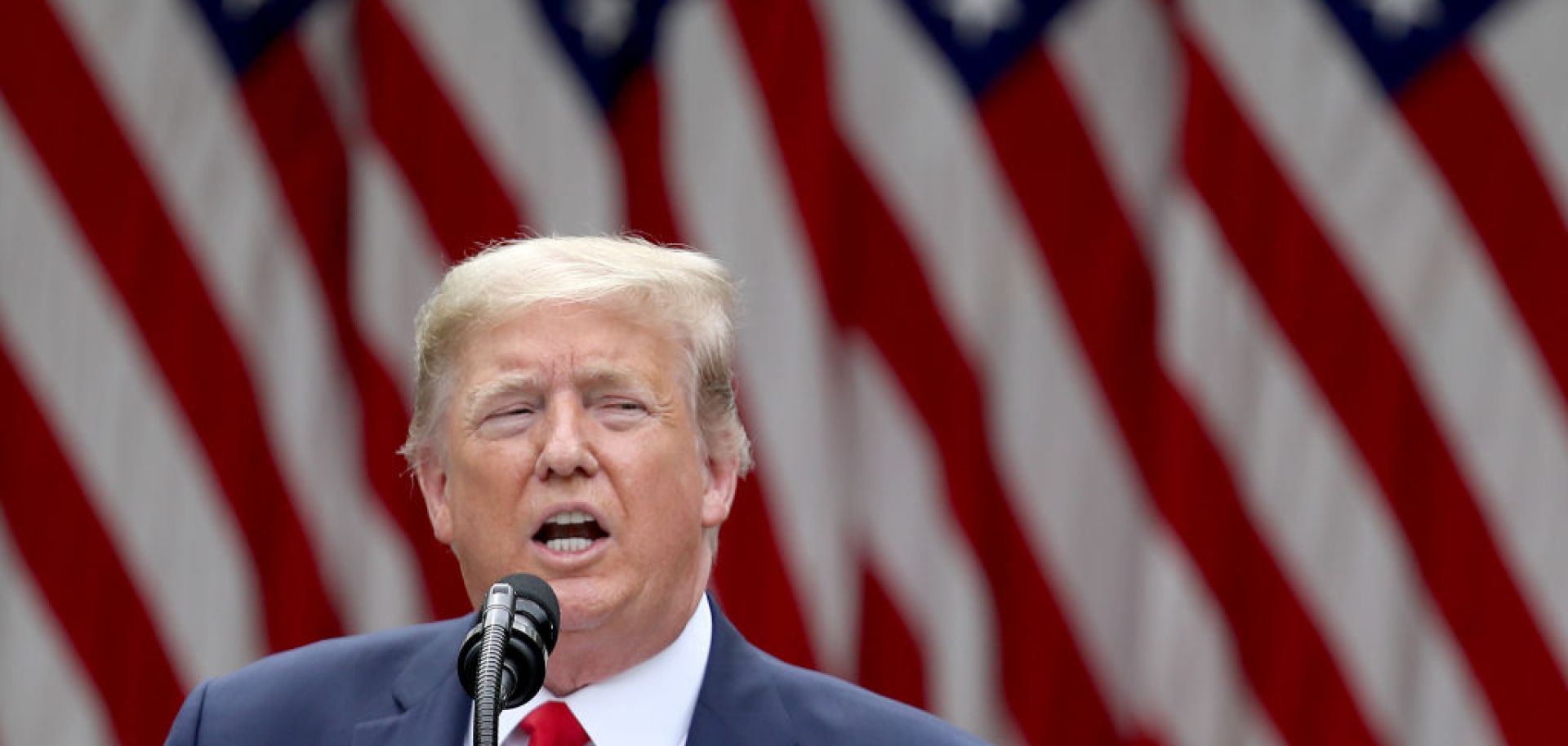
U.S. President Donald Trump speaks about U.S. relations with China at the White House on May 29, 2020.
U.S. President Donald Trump's May 29 announcements adjusting U.S. policy toward China could derail the phase one U.S.-China trade deal if fully implemented, but they are unlikely to deter Beijing's determination to implement new Hong Kong national security legislation — and no matter what, Hong Kong protest activity will increase in the coming months.
During his afternoon press conference, Trump detailed policy changes including a number of immediate measures with regard to China and a more ambiguous list of policy options under consideration regarding Hong Kong. He also announced that the United States will terminate its relationship with the World Health Organization, citing poor management of holding China accountable amid the initial outbreak of COVID-19.
- Trump said the White House will revisit U.S. policy exemptions pertaining to Hong Kong's special treatment as a separate customs and travel territory. Additionally, he discussed potential shifts on extradition agreements, export controls, sensitive dual-use technology, issuing a state department travel advisory and sanctioning officials.
- Trump indicated that the United States will ban Chinese students from military-affiliated colleges in China from U.S. universities.
- The White House will also begin studying ways to highlight to U.S. investors the corporate practices that increase the risks of investing in Chinese companies listed on U.S. exchanges.
Key provisions associated with the policy changes were ill-defined, suggesting internal White House disagreement or an intentional choice to slowly implement the more extreme elements of several policies to avoid roiling markets and to prepare bureaucratic means of enforcing new tariffs. If Washington exercises policy options such as shifting Hong Kong's tariff status under U.S. law, Beijing will likely retaliate with options jeopardizing the current trade war truce.
A more restrictive U.S. visa policy toward Hong Kong, although less inflammatory, would mark an erosion of the city's status as an international business hub. If the United States opts for the less extreme approaches to enacting these measures, Washington may hope to insulate the broader U.S.-China trade issue from the unfolding Hong Kong dynamic. Beijing, however, is likely to retaliate in a tit-for-tat manner to any U.S. measures, for example by limiting U.S. study abroad programs in China to some degree. On visa issues, Beijing may choose to maintain the U.S. visa-free regime in Hong Kong in order to underscore the city's continued "open" status.
Regardless of what the White House decides on Hong Kong, bilateral tensions are set to mount in the coming months. Hong Kong is only one among several triggers for U.S.-China tensions, which include COVID-19, Huawei, the South China Sea and numerous human rights issues. In addition to the actual situation on the ground in Hong Kong, the president's actions toward China will be clearly linked to considerations regarding the November presidential election, with the president eager to burnish his image as tough on China in order to manage the political fallout from COVID-19's damage to the U.S. economy.
For businesses and expatriates in Hong Kong, potential disruptions to operations from U.S. policy changes could accelerate plans to shift to alternative destinations. At the same time, U.S.-China tensions over Hong Kong could see mainland authorities favor foreign competitors over U.S. companies.
- China's legislation on Hong Kong could take weeks or months, leaving ample time for the United States to escalate its response. On May 28, China's National People's Congress approved a bill to impose national security legislation in Hong Kong, kicking off a process in the body's Standing Committee to assemble this legislation before it becomes Hong Kong law.
- China's Foreign Ministry said May 29 that China will implement countermeasures against any U.S. actions related to the Hong Kong national security legislation. Sources said that China may lower or delay its planned imports of agricultural goods from the United States under the phase one trade deal, with a potential for drawdowns in soybean purchases or a declaration of force majeure citing COVID-19.
- The United States is an important, but not a critical, trade partner for Hong Kong. The city exported less than $5 billion to the United States in 2019. Unlike the mainland, Hong Kong has a trade deficit with the United States. Retaliation could hit a larger share of U.S. exports, which amounted to around $31 billion in goods in that year.
- Trump is under intense congressional pressure over Hong Kong and on human rights issues in China, with bipartisan support for such measures. There is currently a bipartisan Senate bill that would call for financial sanctions on foreign nationals responsible for the erosion of Hong Kong's autonomy.
Regardless of U.S. moves, the national security legislation and controversial steps by the city's Legislative Council will fuel protests in Hong Kong next week and for months to come, with sharp oscillations in unrest provoking police crackdowns. Once in place, the national security legislation may have a chilling effect on turnout by more mainstream elements in Hong Kong, leaving those on the extreme to stage more disruptive actions. The law would empower Chinese security agencies to establish a greater presence inside Hong Kong, with the Chinese Ministry of Public Security already saying it will work to "guide and support" Hong Kong police to restore order.
- Hong Kong's legislative council will hold a final vote June 4 on a bill to impose penalties for mockery or misuse of the Chinese national anthem in the city. This would coincide with the anniversary of the Tiananmen Square protests of 1989 and come just before the lifting of COVID-19 social distancing measures in the city.
- Hong Kong's legislative council will hold elections in September that could tip the balance away from pro-Beijing lawmakers to those deeply opposed to the central government's encroachment in the city.
