
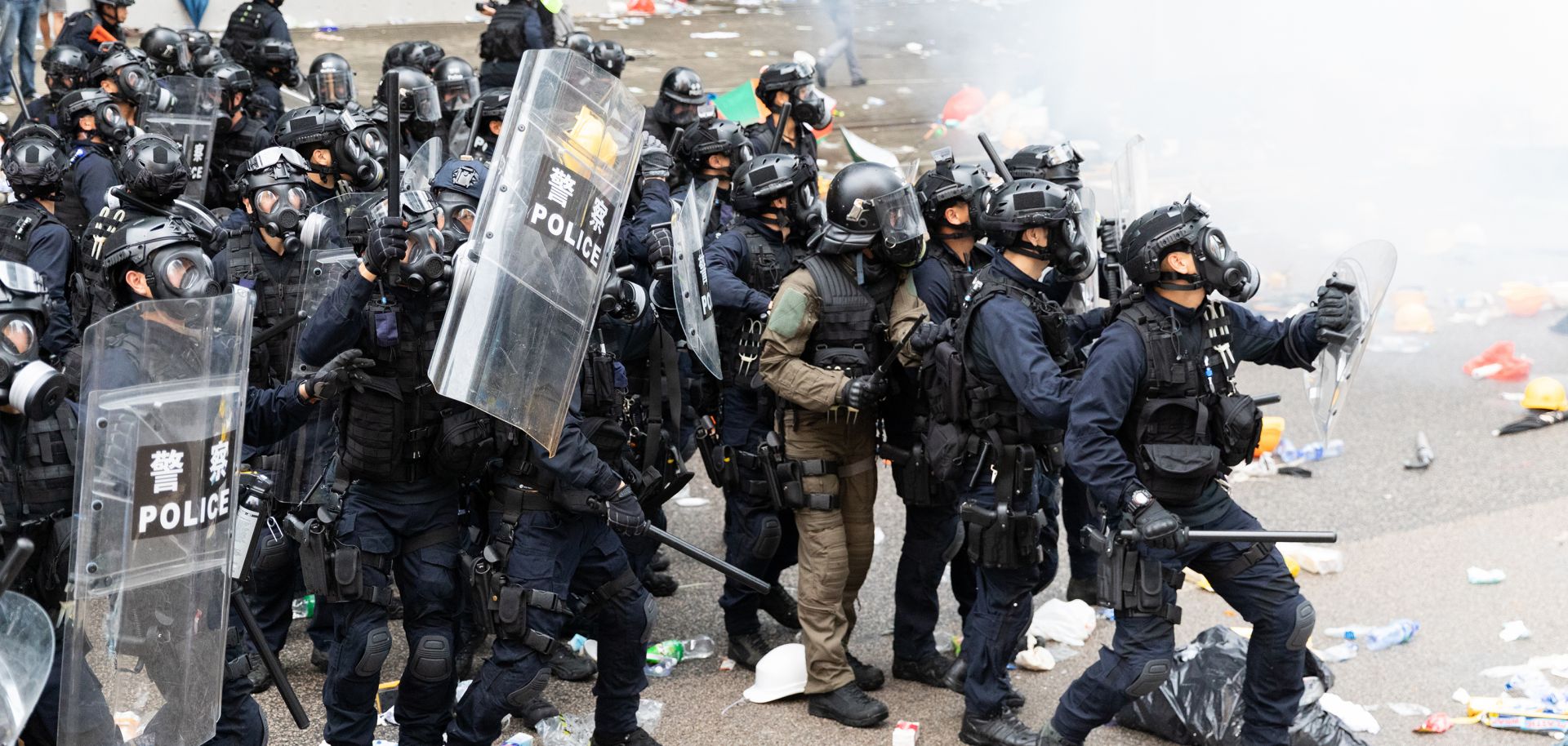
An anti-extradition bill protest in Hong Kong on June 12, 2019.
The Chinese central government's decision to circumvent the Hong Kong legislature and impose long-delayed national security laws in Hong Kong will provide a major rallying point as protests rebound following COVID-19. In terms of U.S.-China relations, an uptick in demonstrations and the high-profile erosion of Hong Kong's autonomy will provide another trigger that could derail the phase one trade deal, although the White House will be careful not to subordinate its China policy to a single issue such as Hong Kong.
China's National People's Congress convened May 22 for its annual gathering, with a representative confirming earlier speculation that congress will consider a proposal to empower its standing committee to draft Hong Kong national security legislation. With the new measures, the Chinese central government intends to increase both local authorities' power to crack down on dissent and its own power to more directly intervene in Hong Kong over the long term.
- The legislation will ban activities that would divide the county, the subversion of state powers and the organization of terrorist activities, measures that will be added to Annex III of the Hong Kong Basic Law.
- While the national security proposal will be passed on May 28 by the NPC, the process of legislative drafting is open-ended and its final implementation timeline within Hong Kong is unclear.
- The May 22 summary of the NPC measures also noted that central government security authorities will set up agencies in the city as needed. In his NPC opening address, Chinese Premier Li Keqiang omitted a usual mention that Beijing would act in compliance with the Hong Kong Basic Law.
The legislation is part of the longer term trend of increasing mainland control over Hong Kong, a trend accelerated by the outbreak of massive protests last year. Beijing's long-term plans to expand its ability to rein in activity in Hong Kong will require a number of steps including everything from national security laws to patriotic education policies and measures permitting extradition from Hong Kong. Each new policy will increase Beijing's grip while also inflaming unrest in Hong Kong. It is apparent now that protests at some level within the city are the new normal, and that local authorities will be unable to fully quiet protests.
- Hong Kong Chief Executive Carrie Lam said May 22 that her government will "fully cooperate" with the mainland's national security law plans and assured Hong Kong citizens the plans would not violate their "legitimate" rights or freedoms, noting that the city was facing a serious security situation.
- Beijing's Hong Kong and Macao Affairs Office issue a statement saying that the shelving of Article 23 for over two decades has left the city in a "defenseless" position by leaving a massive loophole.
As Hong Kong's COVID-19 restriction on gatherings expires on June 4, protesters will take the opportunity to appear in higher numbers on the city's streets, marking the start of a new season of unrest. On top of the high-profile national security legislation, the approach of legislative elections in September will further motivate demonstrators, as would any efforts by the Hong Kong legislative council to put in place any supporting legislation to the National People's Congress plan.
- Hong Kong protesters appeared in a small group on May 22 in Causeway Bay's Times Square to voice opposition to the national security legislation. Hong Kong democracy activists have condemned the mainland legislation as de facto eliminating the One Country, Two Systems approach to Hong Kong-Mainland relations.
- According to unconfirmed leaks, two Hong Kong delegates to the Chinese People's Political Consultative Conference voted against endorsing the national security measures while another abstained out of concern about backlash within the city.
- Hong Kong's legislative council is sharply polarized between pro-Beijing and pro-democracy lawmakers, who even openly scuffled on May 18 over a law that would ban insulting the Chinese national anthem. The September elections could see a strong showing for pro-democracy lawmakers, further threatening the mainland's ability to work through local allies.
- Following the 1997 handover from the United Kingdom, Hong Kong's government was tasked with putting in place legislation to support Article 23 of the Hong Kong Basic Law. Hong Kong authorities, however, have long-delayed doing so due to public backlash, most notably 2003 protests that mobilized hundreds of thousands onto the streets.
In terms of U.S.-China relations, the demonstrations of the past year have sparked mounting calls for the United States to act to prevent the erosion of Hong Kong's autonomy. These national security laws will kick such pressure into high gear. But while the White House's China policy has been confrontational, U.S. President Donald Trump's reelection chances hinge in part upon his ability to deliver on his administration's trade deal pledges, making it more expedient to preserve the phase one trade deal.
Trump will proceed carefully so as to avoid subordinating his overall trade agenda to a single issue such as Hong Kong. If the United States does proceed with sanctions against high-level Chinese or Hong Kong officials, Beijing will respond in a tit-for-tat manner as it has done in recent months with mutual restrictions on journalists. Other issues could derail the trade agenda, however, most notably the White House push to investigate China's role in COVID-19's origins and tensions over Huawei.
- U.S. Sens. Chris Van Hollen, D-Md. and Pat Toomey, R-Pa., said May 22 that they will push for the acceleration of a proposed bipartisan bill to sanction Chinese government officials related to undermining Hong Kong autonomy and hit banks that deal with these officials. The bill would additionally target financial institutions that work with entities that violate the Hong Kong Basic Law.
- Under the U.S. Human Rights and Democracy Act of 2019, Washington must certify that Hong Kong's autonomy is intact by the end of May. On May 21, the State Department issued a statement accusing Hong Kong of neglecting its autonomy commitments under the 1997 British handover agreement. On May 20, U.S. Secretary of State Mike Pompeo said that the certification would be difficult and expressed the White House's concerns about Hong Kong.
- President Donald Trump said the United States will address it "very strongly" if China proceeds with the national security legislation, but noted that full details of the law have not emerged.
- Trump has been circumspect in the past on linking human rights issues in Hong Kong too closely to his trade policy on China, for example signing the Human Rights and Democracy Act with little fanfare in Thanksgiving 2019 after its October passage.
Editor's Note: An earlier version of this article misstated the state represented by Senator Pat Toomey.
