
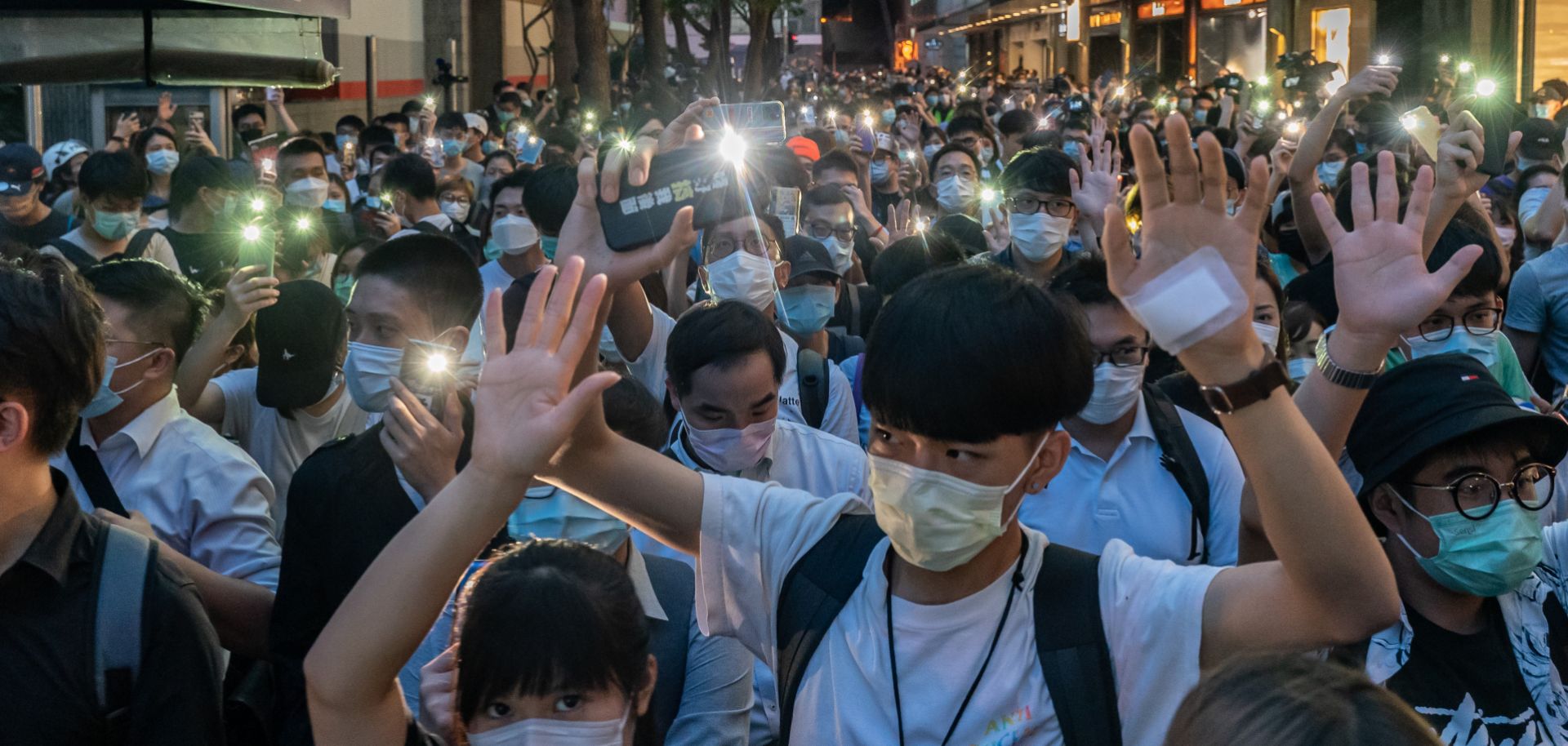
Pro-democracy protesters in Hong Kong shine the flashlights on their cellphones as they take part in a rally on June 9, 2020, marking the one-year anniversary of the massive demonstrations against Hong Kong's extradition bill.
A year after the city's extradition bill prompted more than a million people to take to the streets in June 2019, marking a watershed moment in last year's protests, Hong Kong's political crisis is heating up once again. The next three months in Hong Kong will see protests kick back into high gear as pro-Beijing and pro-democracy camps focus on winning Legislative Council elections planned for September. The central government in mainland China will fast-track its controversial national security laws ahead of the polls to increase control over protestors and politicians, while the regional Hong Kong government will work to fulfill its side of the legislation. The White House, meanwhile, will pressure China to ease back on its encroachment in Hong Kong by possibly stripping away the city's special tariff treatment, but will weigh carefully whether to escalate further to financial measures that would cripple Hong Kong's status as a business hub in a way that decreases U.S. influence.
- On June 18, Hong Kong's COVID-19 social gathering restrictions will expire if not renewed, although the government will retain the powers to reimpose these restrictions until at least August 31.
- In September, the Hong Kong Legislative Council's four-year term will also expire, requiring elections. Pro-Beijing lawmakers have held the majority in the body since the late 1990s and the pro-democracy camp is aiming for a majority, holding its own primary to streamline candidate lists July 11-12. The government has only tentatively set the election date, leaving room for a postponement.
- Sources indicate that as early as August, China's National People's Congress Standing Committee will formulate and pass national security legislation for Hong Kong.
- As the U.S. presidential election campaign season goes into full swing, China's global rise, the origins of COVID-19 and trade relations will also all become key U.S. foreign policy issues from now until November.
The Next Phase of Hong Kong's Political Crisis
Hong Kong's protests will heat up this summer as COVID-19 infection rates and control strategies ease, prompting both the pro-establishment and the pro-democracy camps to escalate confrontation ahead of the September elections. The likely lifting of COVID-19 restrictions will probably result in more frequent street clashes between protesters and police as pro-democracy supporters attempt to maintain protest momentum and public outrage to fuel voter support and turnout. Leaders will likely highlight actions by the central government and maintain staunch opposition to the legislature's pro-establishment agenda in order to underscore alleged central government overreach and complicity between the Hong Kong government and Beijing.
While mainstream leaders advocate moderate and peaceful actions, crackdowns by authorities and increasing frustration with unilateral action by Beijing will probably increase the use of radical tactics by pro-democracy fringe elements, increasing the level of violence beyond what occurred in 2019. Alternatively, if authorities try to extend COVID-19 gathering restrictions, or if new controls are necessary to combat a second wave of infections, it will likely be seen by activists as an attempt to use the pandemic to exert additional political control.
China will probably seek to quickly implement the national security legislation to empower Hong Kong authorities with a policy tool that allows Beijing to avoid heavy-handed intervention into city affairs, while regularizing mainland oversight of the city's internal affairs. China will also likely grant Hong Kong authorities additional tools to suppress protests and pro-democracy politicians. Beijing probably calculates that the enhanced penalties for protest-related violence, arrest and search powers, as well as potentially the ability to make arrests for alleged seditious or secessionist speech, will erode the pro-democracy camp's momentum.
- Chinese officials may assess that the 2019 demonstrations and November district council elections demonstrated that pro-Beijing forces in Hong Kong cannot influence the action of elected Hong Kong institutions over the long term, leading China to propose the national security legislation to avoid having to deploy People's Armed Police Units.
- Beijing contemplated such a military intervention throughout 2019, but avoided the move to prevent a strong global backlash that could jeopardize Hong Kong's status as an internal finance and business hub.
China's intervention and oversight over other elements of Hong Kong's internal affairs will also likely grow, shrinking the space for viable counter actions by the pro-democracy camp and spurring more desperate tactics. The new Beijing-imposed national security law could allow for more expansive powers in banning political candidates for a wide range of actions or foreign links. This would be a deepening of bans conducted during the 2016 election to weed out pro-independence figures — a move that would risk a major street backlash.
- In 2019, Beijing reshuffled the Chinese officials in charge of Hong Kong affairs, bringing in effective hardliners closely aligned to President Xi Jinping. Since that time, Beijing's liaison office has increasingly asserted the right to openly comment on Hong Kong affairs, with city authorities interpreting its role as supervisory over "one country, two systems."
- If the national security legislation extends its ban on secessionism and subversive activity to speech acts, it could also allow for more wholesale crackdowns on protesters and dissident speech, leading to more extreme and radical action by the fringe elements willing to defy authorities. Similarly, terrorism aspects of the bill could be broadly interpreted to encompass numerous acts by protesters.
Protesters Take Their Fight to the Polls
The leadup to the September elections will bring rising acrimony in the city, while an electoral win by the pro-democracy camp would open a period of increasing confrontations within the Hong Kong government that will lead to further efforts by Beijing to circumvent local policymakers. As these events play out within Hong Kong, the central government will be compelled to shape them into its narrative, while the United States will react to try to pressure in favor of the city's autonomy.
Within Hong Kong, the competing pro-establishment and pro-democracy camps will maneuver ahead of the election to secure public support and erode their opponents. The pro-establishment camp alternatively will focus on containing street unrest and demonstrating their effective oversight of the COVID-19 outbreak, while pursuing further fiscal stimulus and economic supports to assist with recovery. The pro-democracy camp will respond by finding opportunities to filibuster and hold the legislative agenda up with demands for concessions, banking on a repeat of the groundswell of support that delivered a landslide victory in November's district council elections. The pro-establishment camp will highlight the dangers of disruptive protests to the city's growth and will use any adverse U.S. actions to place blame on their pro-democracy adversaries. The legislative council will be less high stakes in some ways for the pro-establishment camp, given that in the event of a loss the pro-Beijing elements would still maintain a great deal of institutional power, with the chief executive candidate effectively controlled by Beijing.
The outcome of the election will be a key inflection point for the city, with several potential outcomes:
- If pro-establishment forces lose out in the September elections, central government circumvention of the city's legislative council would become increasingly common as a means of reining in the city and integrating it more closely into the mainland. However, Beijing's allies will maintain the high ground in terms of the power balance in the city through the office of the chief executive, and the pro-democracy camp's approach will not be effective in stopping the gradual encroachment of mainland control.
- For pro-democracy forces, a decisive win in the legislative council in September would give them another platform to air their concerns. However, in terms of tangible power, the body has limitations. This will lead to increasing acrimony in the city as the council potentially wields its power to veto budgets in order to force a confrontation with the chief executive. Afterward, there will be a period of two years before the 2022 chief executive election that will see increasing desperation by pro-democracy political forces.
- If, by contrast, pro-establishment forces manage to maintain or gain ground in upcoming elections, Beijing will feel more comfortable easing back somewhat and relying instead on its allies in the city to forward its agenda.
- Alternatively, if the COVID-19 situation justifies the decision and pro-democracy forces appear poised to sweep the polls, pro-Beijing authorities may delay the September elections altogether citing safety concerns, which would pave the way for a Beijing-appointed interim body. This would be a highly inflammatory action that would spark protest backlash so would only be done in extremity.
For China, the election will bring a key decision point in the broader trend of mainland-Hong Kong relations, and preserving the city's overall business value to the national economy. China's overall national strategy and internal issues will drive it to accelerate the integration of Hong Kong, but the city's continued key financial role in the country will compel a balance between these goals and economic interests. Several factors will drive Beijing to increase its grip on Hong Kong through its own institutions or allies in the city, if they can be relied on:
- In Taiwan, a major loss for the more Beijing-friendly Kuomintang Party and the effective neutralization of the pro-unification wing of the political spectrum has increased pressure on Beijing to assert national unity by exerting authority in Hong Kong ahead of next year's hundredth anniversary of the Communist Party.
- Within China, COVID-19's sustained economic damage and increased unemployment have eroded the Communist Party's legitimacy and will hinder 2020 growth substantially. One means of deflecting political repercussions will be to make progress on key national goals, including securing Hong Kong.
China, however, must still be mindful of eroding Hong Kong's unique economic status, even as it concentrates on tools to tamp down unrest. Although Hong Kong's importance to China has waned over the past two decades, there are no realistic alternatives to the full scope of what the city provides to businesses at this time. China will thus continue to rely on Hong Kong as a gateway for investment into the country amid the mainland's continued maintenance of capital controls and interventions in the city's financial sector, as well as its banking system.
- Upwards of 60 percent of foreign direct investment flowed in and out of China through Hong Kong in 2018.
- In 2019, Hong Kong also accounted for 48 percent of the money raised by Chinese companies in initial public offerings, and provided 25 percent of offshore U.S. dollar funding for Chinese businesses.
Caught in the U.S.'s Crosshairs
Internal Hong Kong-Beijing tensions will also drive U.S. decisions that could have an outsized impact on the city's long-term business hub status. As the U.S. presidential campaign season picks up ahead of the November election, the White House will use its Hong Kong policies as a means of highlighting its hardline push against China, and to pressure China to reconsider imposing greater security and policy control over Hong Kong. Electoral setbacks for the White House in terms of the economy, COVID-19 and domestic protests against police brutality will increase the White House's desire to focus on China as an electoral issue.
The United States is less likely to escalate to financial sector measures, such as limiting Hong Kong's access to dollars, sanctioning major Hong Kong or Chinese banks or invoking the International Emergency Economic Powers Act (IEEPA). Such moves would not only risk raising public ire against the pro-democracy camp in the city ahead of elections, but erode U.S. influence over the city that could then tangibly bite into the city's key economic sectors and status as a business hub. With no hope for Beijing to step back on its national security law, a U.S. reaction is likely to be one that limits damage to U.S. interests in ways that still creates pain for Beijing.
- Washington could enact limited impact options to include extradition treatment changes, visa regulation shifts, a state department travel advisory as well as sanctions on Chinese and Hong Kong officials — all of which will add complexity for businesses and individuals operating in Hong Kong.
- Middle range options would bleed into the trade realm, including export controls, limits on dual-use technology or a full repeal of Hong Kong's special tariff status. While the tangible economic hit to Hong Kong would be relatively limited, removing the special tariff status would risk derailing the U.S.-China phase one trade deal and carry great weight in terms of symbolizing the erosion of the city as a key business hub.
- On the most extreme end of the spectrum, Washington could roll out measures that would limit Hong Kong's access to U.S. dollars or even a nuclear option of using the IEEPA to block investment or transfer of funds to Chinese entities or persons.
- To support its pressure campaign against China over Hong Kong, the United States will work to enlist its allies, most notably the United Kingdom given its status related to the 1997 handover agreement.
Regardless of U.S. actions over Hong Kong, U.S.-China tensions will still mount over issues such as COVID-19 blame, the South China Sea, Chinese tech giant Huawei, Taiwan, trade and human rights issues. Although others are available, Hong Kong's special tariff status is the biggest weapon currently at Washington's disposal to retaliate against Beijing over any of these issues, although others are available. International businesses are likely to face greater pressure to consider the long-term trends emerging in Hong Kong, as changing Chinese policy will likely mean that Hong Kong-based businesses and individuals will face risks similar to those seen inside of mainland China. Amid rising U.S.-China tensions over Hong Kong, American companies operating in the city or in mainland China, as well as British businesses or other allied countries, could face the risk of Chinese retaliation for U.S. actions either overtly linked to Hong Kong or in a more indirect manner.
