
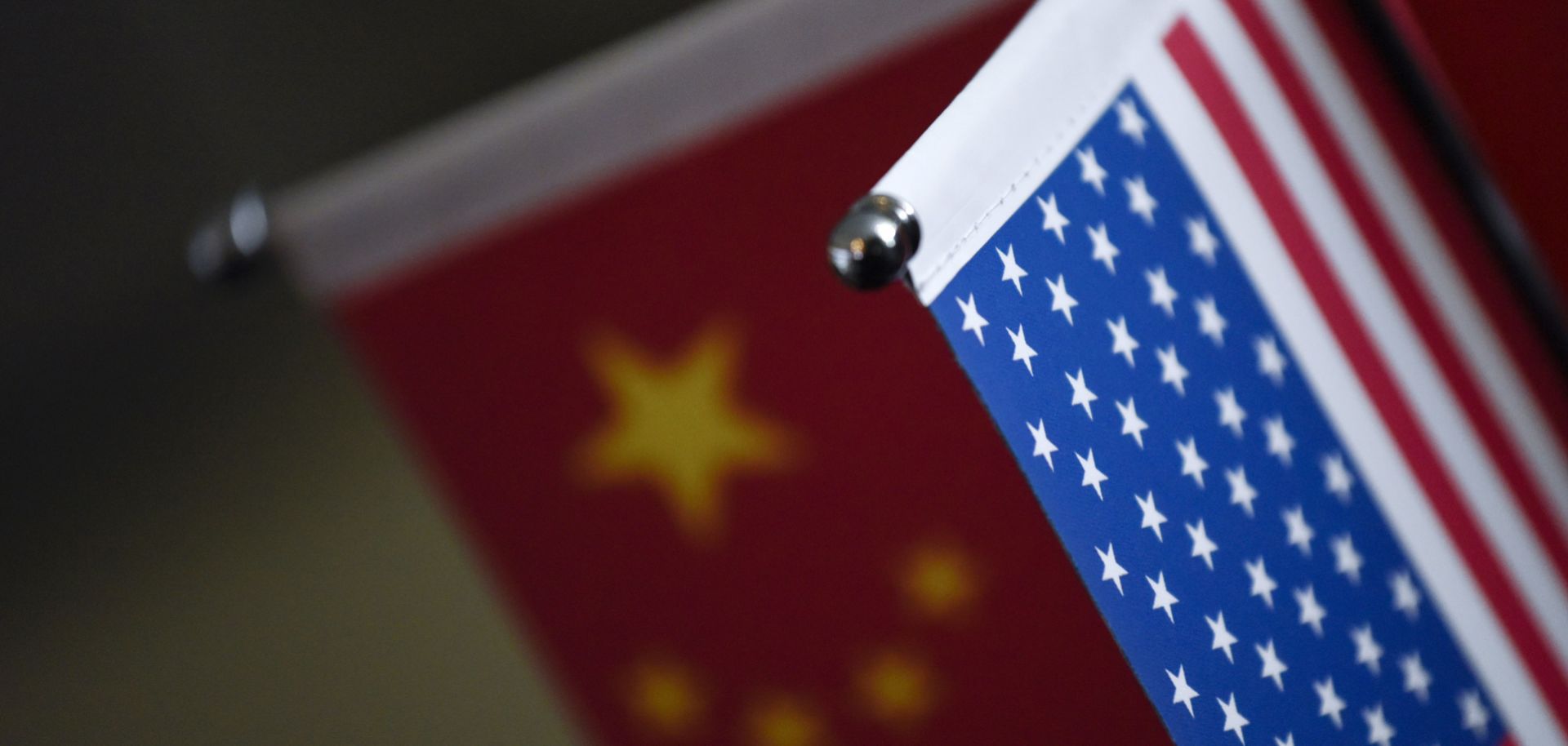
Chinese flags and American flags are displayed at a business in Beijing. Washington and Beijing’s renewed feud over Hong Kong's autonomy is increasing the risk for more tariff hikes and other trade salvos between the world's two largest economies.
Rising bilateral tensions stemming from Beijing's proposed national security legislation for Hong Kong are increasing the risk that the "phase one" trade deal between the United States and China will collapse before the end of 2020. The deal itself may still officially exist, but tit-for-tat escalation on tariffs and trade measures will render it functionally dead. Further retaliation by the United States over the Hong Kong legislation also risks triggering Chinese countermeasures beyond trade policy.
The last six weeks have seen the United States take several significant steps against Chinese officials and in response to Beijing's policies:
- U.S. President Donald Trump has said on several occasions that he will make China "pay" for the COVID-19 outbreak due to Beijing's negligence and lack of transparency, the most extreme being stripping away sovereign immunity from China in COVID-19 cases.
- The U.S. Commerce Department modified its rules for export controls on Chinese telecommunications firm Huawei, as well as Huawei chip design subsidiary HiSilicon, effectively preventing Huawei from using chips it designed.
- The Commerce Department also announced it would place export controls on 33 Chinese entities, including CloudMinds and other AI and surveillance firms, due to human rights violations against Uighurs, ethnic Kazakhs and other minority groups in China.
- The U.S. Senate passed a bill, the Holding Foreign Companies Accountable Act, which, if signed into law, would force Chinese companies to increase transparency if they want to remain listed on U.S. stock exchanges.
- U.S. Secretary of State Mike Pompeo announced that the State Department could no longer certify Hong Kong's political autonomy from China. Shortly after, Trump announced the United States would begin the process of eliminating policy exemptions giving Hong Kong special treatment, including potentially revoking its special customs treatment.
China has retaliated by disrupting commercial ties with the United States, reportedly telling Chinese state-owned enterprises (SOEs) on May 29 to halt imports of soybeans. Rather than cutting off all imports, China appears to have reduced its rate of purchases. Bloomberg reported on June 2 that there were several exceptions to the order, such as when an SOE is buying on behalf of a private company or needs the soybeans to cover their derivative positions. It appears that purchases made the day earlier, when Chinese buyers bought 132,000 tonnes (or metric tons) of soybeans, fell under those conditions.
Trump wants to leverage the metric of sustained agricultural purchases to demonstrate the success of his China policies. This may lead him to cancel the phase one agreement if China doesn't meet the negotiated purchase targets — a risk Beijing appears now willing to accept. Beijing's strategy replays China's actions during trade negotiations in 2019, when it used soybean purchases to pressure Washington. China's 2019 calculus provoked U.S. escalatory responses, ratcheting up the trade war last summer.
- Beijing had hoped that giving Trump a "victory" on trade in 2020 would limit Trump's appetite for escalation against China overall in 2020. But the COVID-19 pandemic and escalation in Hong Kong have since veered that strategy off course.
- Now that the political benefits of remaining in the deal are reduced, the lack of China receiving material benefits is weighing heavier on Beijing's calculus.
- In the phase one deal, the United States cut its 15 percent tariff on a list of Chinese goods worth about $120 billion, but still kept 25 percent tariffs on $250 billion worth of imports unchanged.
Ultimately, President Trump will probably calibrate escalatory actions as he monitors the impact of rising U.S. rhetoric on financial markets heading into the fall campaign season. China, for its part, will probably continue to use import targets as its preferred strategy to respond to U.S. actions, rather than risking longer-term damage to its domestic growth by deploying other levers at its disposal.
However, the trajectory of the U.S. COVID-19 outbreak or further U.S. sanctions in response to Hong Kong developments could precipitate more aggressive Chinese responses. Beijing has long had the ability to disrupt business activities of U.S. companies operating in China, such as through boycotts of American companies, rescinding business licenses and visas, and opening up intellectual property investigations.
- If the United States experiences a significant second wave of COVID-19 infections closer to the November elections, Trump is far more likely to move forward with blaming China on the outbreak and backing more controversial policies to make them "pay" for it. A second-wave outbreak would also limit the economic costs associated with leaving the phase one trade deal in response.
- The United States has been vague about what tangible measures it will make following its announcement to remove Hong Kong's special status treatment. Threats issued by Washington (including in bipartisan legislation) have included automatic secondary sanctions on banks doing business with sanctioned entities over Hong Kong.
