
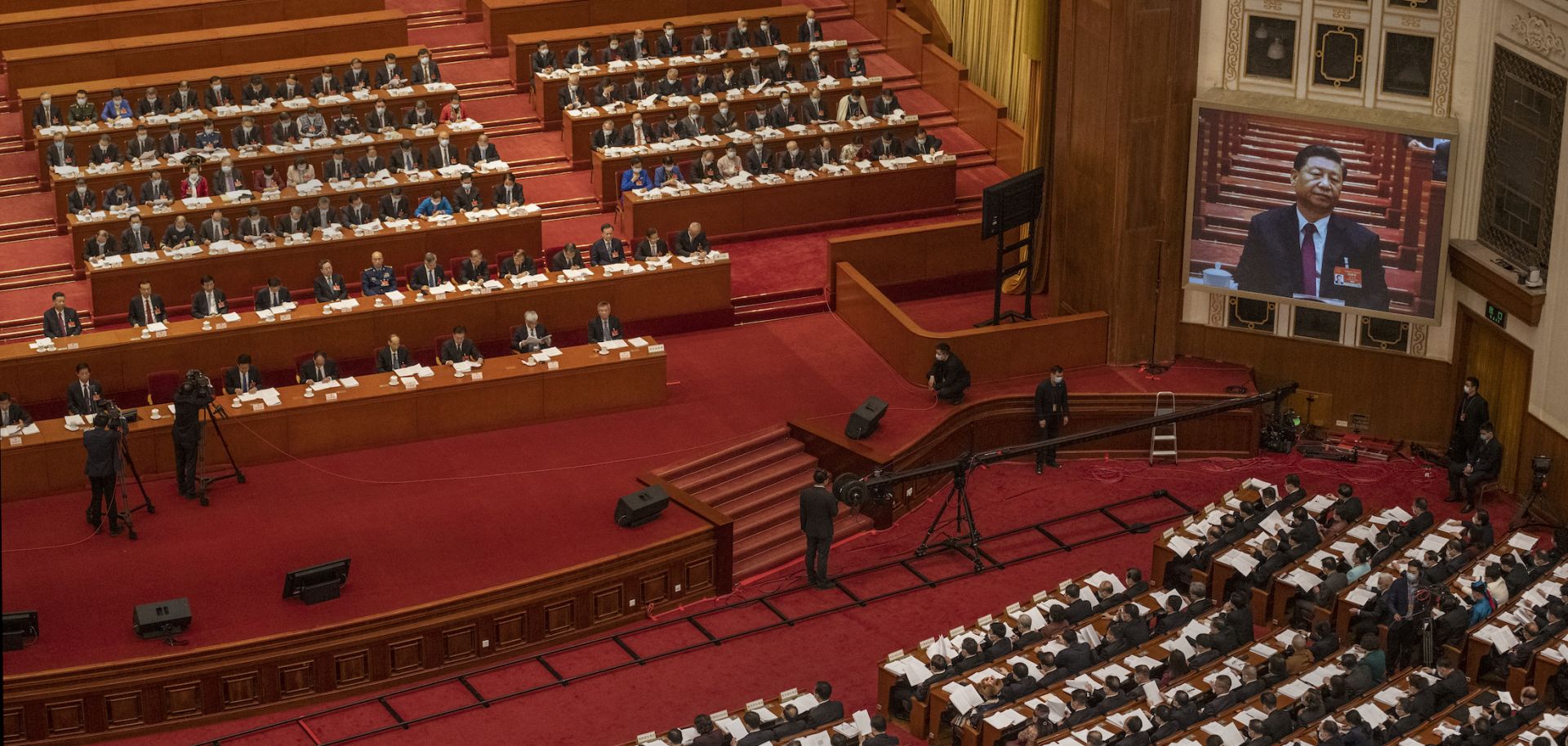
Chinese President Xi Jinping speaks at the opening session of the National People's Congress on March 5, 2021, in Beijing, China.
Extensive Hong Kong electoral reforms risk permanently sidelining the pro-democracy opposition by giving pro-Beijing forces free rein to pursue measures that substantially erode the city’s autonomy and limit unrest. On March 5, electoral changes were introduced in China's National People's Congress as legislators convened a weeklong meeting as part of China’s annual “two sessions” policymaking meetings. Although the full details have not been publicly released, the vice chairman of the NPC Standing Committee, Wang Chen, said the reforms would create a "democratic process with Hong Kong characteristics," noting specifically that the Basic Law provisions on the roles of the city’s chief executive and Legislative Council would be amended. The NPC will vote on the changes on March 11.
- Leaks indicate that the changes would include an expansion of the Chief Executive Election Committee from the current 1,200 to 1,500 seats, stripping the 177 seats held by the District Council, which is currently dominated by the pro-democracy camp.
- Most importantly, the Chief Executive Electoral Committee will reportedly choose a "large share" of Legislative Council members and involve itself in the nomination of candidates — appearing to incorporate a long-rumored, directly appointed component in the legislature.
- The reforms would also include the addition of further seats to the Legislative Council, which would grow from the current 70 lawmakers to 90 lawmakers, while scrapping the current five seats nominated by the district council, which are directly elected with a citywide vote.
- Leaks indicate that Hong Kong’s Legislative Council elections will be delayed once again, with plans to hold them in September 2022.
- The NPC’s two-week annual meeting presents a timely opportunity for the Chinese government to reform the Hong Kong electoral system, given that the Hong Kong chief executive transition is currently one year out, with the Electoral Committee selection process beginning in December. The now likely delayed date of the Legislative Council elections would have been in September 2021, six months out.
While the national security law has been used effectively to target opposition figures, the electoral reforms will allow for systemic suppression of the pro-democracy camp’s power without constant and disruptive high-profile law enforcement actions. Beijing is most concerned about the opposition achieving a majority but it will likely still tolerate a smaller opposition presence in the Legislative Council.
- Although it has been substantially weakened by a crackdown and the mass resignation of pro-democracy lawmakers in the Legislative Council, the opposition still enjoys substantial popularity in Hong Kong and Beijing fears that under the current system it could attain a Legislative Council majority. In 2020, the opposition’s “35-plus” strategy involved using a majority to paralyze the Hong Kong government and force the resignation of the chief executive.
- Beijing is also likely calculating that it can avoid a major backlash, with Hong Kong protests currently at a lull amid COVID-19 restrictions and fears surrounding the national security law. The start of Hong Kong’s COVID-19 vaccination campaign on Feb. 26 adds some urgency to get these reforms in place while the city’s late 2020-to-early 2021 COVID-19 spike is still suppressing public gatherings.
- For Beijing, ensuring that Hong Kong does not emerge as a disruptive force on the national stage is also important ahead of the 100th anniversary of the Chinese Communist Party in July 2021 and Beijing Olympic Games in February 2022.
A continued freeze on Hong Kong politics and the marginalization of the opposition would open the potential for a broader transformation of the city that alters its landscape for foreign business. Beijing still appears intent on preserving Hong Kong as a unique gateway to the mainland market and as a regional financial hub. But a solidly pro-Beijing government and potential reforms beyond electoral issues raise the prospect of altering the city’s judiciary and civil service that could undermine the rule of law in Hong Kong, as well as changes to the media and education environment that could jeopardize foreign operations in these sectors.
- The U.S. reaction to a wholesale transformation of Hong Kong politics would likely include further targeted sanctions on the city. But more substantial actions to limit Hong Kong’s access to U.S. dollars would remain unlikely.
- In terms of the protest reaction, the electoral reforms are more likely to provoke a backlash from the younger and more hardline members of the pro-democracy camp, perhaps including more violent tactics, as opposed to the massive public reaction as seen in 2019. More broadly, the city’s increasingly restricted environment could shift the focus of Hong Kong protests from politics to particular economic issues or grievances, as was seen during the British colonial period.
