
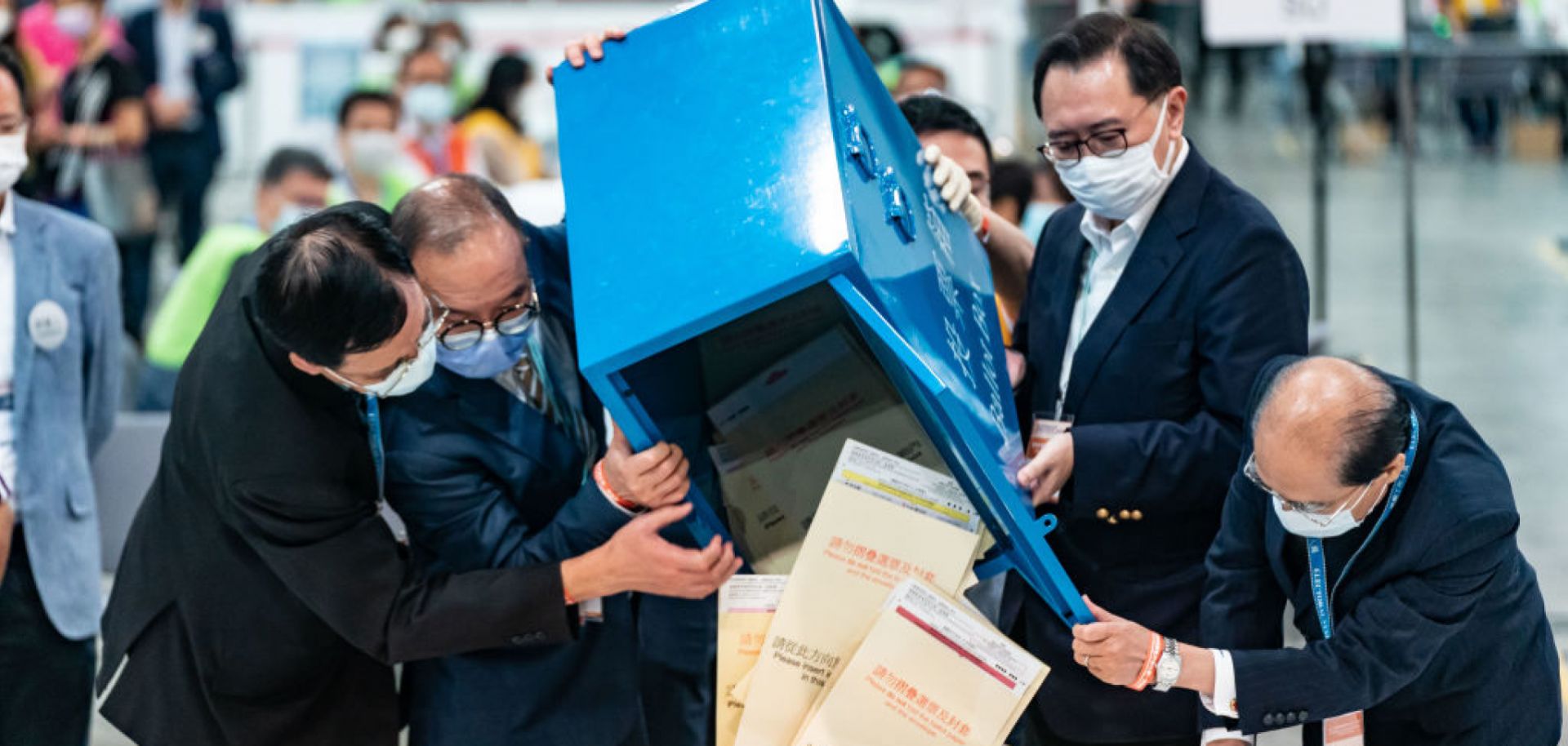
Officials open a ballot box as vote counting starts Sept. 19, 2021, in Hong Kong.
Hong Kong's Legislative Council elections have put the legislature in the hands of pro-Beijing factions, and will accelerate Western sanctions against China. The Dec. 19 LegCo elections saw record low voter turnout at 30% — compared to 58% in the 2016 LegCo elections and 70% in the 2019 District Council elections — and saw 89 out of 90 LegCo seats given to pro-Beijing candidates, with the remaining one given to a centrist candidate. All 11 pro-democracy candidates lost in the geographical constituency portion of the LegCo election, the same candidates that prompted the Hong Kong government to claim this truly was a "diverse" election, despite the "patriots only" selection process designed to weed out candidates less amenable to Beijing. In response, senior officials from the United States, Canada, Australia, New Zealand and the United Kingdom released a Dec. 20 joint statement decrying democratic erosion in Hong Kong, as did the European Union and the G-7.
- This election has been delayed since September 2020 as the Hong Kong government enacted the National Security Law following the massive protests of summer 2019, which saw millions of citizens march in the streets.
- As of Dec. 16, Hong Kong authorities have wielded the National Security Law to convict two Hong Kongers and arrest eight others for urging people not to vote in the LegCo elections.
The LegCo landslide deepens the continued erosion of all branches of the Hong Kong government, while the voter turnout shows democratic abstention as a remaining outlet for protest. Given that 40 of the 90 LegCo seats were selected by the Election Committee, which will also select Hong Kong's next chief executive in March 2022, Beijing's influence over Hong Kong's executive branch is also secure.
- The judiciary's independence has been slower to erode, with the branch continuing to act as a minor limiter on the expansion of police jurisdiction for National Security Law cases, but it is only a matter of time before this branch too aligns with the pro-Beijing government, given the chief executive's power to appoint judges and recent statements from the empowered national security office that the judiciary should reflect China's will. This inevitability is well exemplified by Maria Yuen's withdrawn candidacy from the Court of Final Appeals in June following pro-Beijing legislative pressure and calls earlier in June from pro-Beijing legislators to appoint more non-Western judges and those who have not criticized the National Security Law.
- For dissolved civil society groups and the large portion of Hong Kong citizens who still oppose Beijing's gradual takeover of their city, the record low voter turnout (the lowest since 1995, prior to the handover of Hong Kong to Beijing) represented one of the few remaining avenues for political protest. Calls by exiled pro-democracy leaders and a few local dissenters to forgo the vote may have greatly influenced the low turnout, along with widespread dissatisfaction with the city's rapid pro-Beijing swing since 2019 under Chief Executive Carrie Lam.
- The National Security Law-related arrests for discouraging voting in LegCo elections expand the scope of the main law used to suppress Hong Kong political dissent, with recent charges expanding from conducting actions that "violate the National Security Law" to those that "go against the interests of national security" more broadly. In addition, Security Chief Chris Tang confirmed in September that the list of explicit National Security Law crimes would be broadened in this new LegCo session to include theft of state secrets, treason, sedition and cooperation with foreign political organizations in Hong Kong.
Western sanctions pressure against Chinese human rights abuses will grow as the erosion of democracy in Hong Kong worsens, while the new LegCo will promote Hong Kong's greater regulatory and economic alignment with Beijing. The immediate reaction from Western groups, like the G-7, Five Eyes and the European Union, suggests Western sanctions pressure on Beijing officials in Hong Kong will accelerate, scuttling recent attempts to seek moderate cooperation with Beijing. The legislative takeover also forebodes the slow, but certain, arrival of mainland Chinese laws, like the Anti-Foreign Sanctions Law and the Cybersecurity Law, which officials in Lam's Cabinet have recently confirmed will be applied to the special administrative region. This China-aligned legal and legislative trajectory for Hong Kong will continue to undermine foreign investor sentiment and confidence in Hong Kong as a global financial hub. Lastly, this pliable legislature will support Lam's explicit efforts to increase Hong Kong's economic ties to China (versus the West) — including alignment with Beijing's national development plans — and, to that end, align the region's COVID-19 management policies with Beijing's to expedite border reopening with the mainland.
- The U.S. Treasury announced its intention Dec. 20 to level secondary financial sanctions against any foreign entities conducting business with select Beijing officials in Hong Kong, which Washington has already sanctioned for their role in the territory's democratic erosion.
