
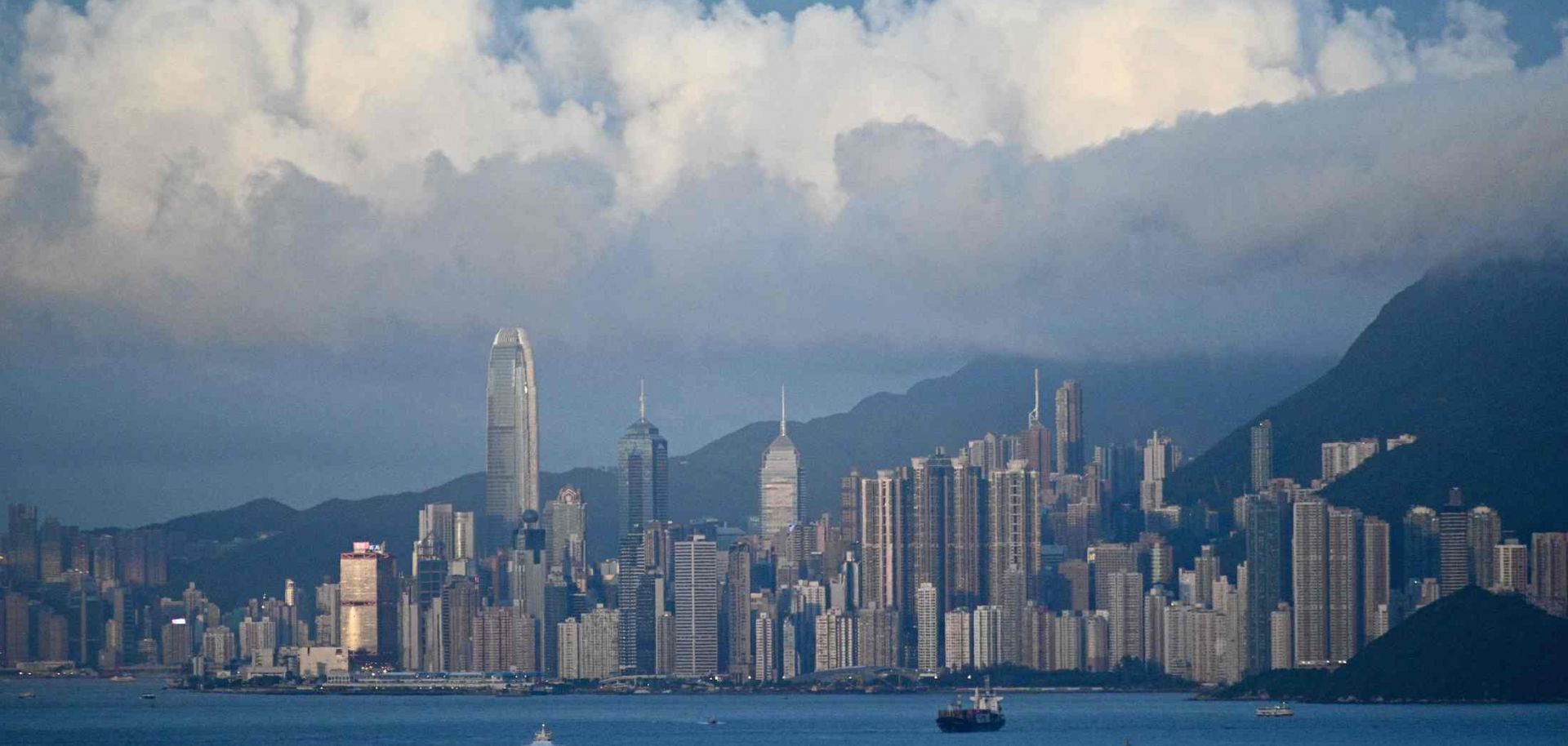
A picture of the Hong Kong skyline taken in June 2019.
Despite China’s ongoing efforts to undermine Hong Kong’s autonomy, new U.S. sanctions indicate that Washington will continue to avoid broader measures against the city’s financial sector or access to U.S. dollars for fear of dramatically escalating tensions with China and damaging U.S. economic interests in Hong Kong. Financial institutions in the city, however, will find themselves increasingly at risk of facing secondary sanctions. On March 16, the U.S. State Department updated its sanctions list under the Hong Kong Autonomy Act, adding 24 individuals involved in either the drafting or enforcement of the city’s controversial national security law. But even after China’s recent passing of sweeping Hong Kong electoral reforms, the latest U.S. sanctions linked to mainland encroachment on the city remain carefully calibrated to a limited set of individuals.
- The U.S. State Department’s list under the Hong Kong Autonomy Act, which was signed into law in June 2020, previously only included 10 individuals. The 24 new additions include 15 members of the National People's Congress Standing Committee, one Politburo member from Hong Kong, a member of the Central Leading Group on Hong Kong and Macau Affairs and seven individuals from both mainland and Hong Kong national security organs.
- The Hong Kong Autonomy Act additions overlap with the individuals that the U.S. Treasury Department’s Office of Foreign Asset Control (OFAC) added to its Specially Designated Nationals list in December 2020, which was linked to then-President Donald Trump’s “Executive Order on Hong Kong Normalization,” and subjected the added individuals to asset freezes and blocked U.S. transactions. The State Department designation, however, reclassified these individuals as Specially Designated Nationals under both the Hong Kong Autonomy Act and the executive order, expanding the penalties to allow secondary U.S. sanctions on financial institutions.
The Biden administration is signaling it will maintain the Trump-era emphasis on Hong Kong ahead of a key U.S.-China meeting. U.S. Secretary of State Antony Blinken and National Security Adviser Jake Sullivan will meet with their Chinese counterparts in Alaska on March 18-19 for what will be the first major bilateral U.S.-China meeting under the Biden administration. The fact that the new sanctions were announced just a day ahead of this meeting indicates that like its predecessor, the Biden administration will continue to emphasize Hong Kong in its relationship with Beijing. Bipartisan support in the United States for a hard-line China policy and Biden’s emphasis on broad, multilateral outreach to Indo-Pacific allies also portend a continuation of U.S.-China tensions under Biden over a range of other issues, including Taiwan, Xinjiang and the South China Sea.
- The March 16 sanctions announcement also follows U.S. moves in recent days to support allies such as Japan and Australia in their efforts to counter China’s regional rise. On March 16, the White House’s Indo-Pacific coordinator, Kurt Campbell, said that U.S.-China relations would only improve if China ended its trade pressure on U.S. ally Australia. Also on March 16, the United States and Japan agreed to hold joint military exercises on Okinawa focused on preparing for contingencies in the Senkaku/Diaoyu islands disputed between China and Japan.
- China has been undeterred by U.S. or international criticism of its electoral reforms in Hong Kong. On March 17, Hong Kong and Macao Affairs Office Deputy Director Zhang Xiaoming concluded three days of consultations with 1,100 prominent Hong Kongers about the new electoral changes. Zhang told reporters that the Chief Executive Election Committee would choose a "larger proportion" of Legislative Council members than those directly elected by geographic constituencies or chosen by functional groups, signaling even tighter control of the legislature.
As the White House targets more individuals tied to Hong Kong’s political crisis, the financial institutions in the city that transact with these individuals will become increasingly at risk of triggering secondary U.S. sanctions. In announcing the new sanctions, Blinken warned foreign financial institutions that they will also be subject to sanctions if they knowingly conduct significant transactions with the added individuals. With these new designations and more likely to follow, financial institutions operating in Hong Kong will need to increase efforts to ensure compliance by examining their existing customers and screening new customers.
- Following the State Department listing, the U.S. government will now have 60 days to submit a report to Congress identifying any financial institutions connected to the added individuals.
- Since the passage of the Hong Kong Autonomy Act last year, financial institutions in the city have reportedly heavily vetted their customer lists for individuals connected to the contentious political developments in Hong Kong, given the dual risks of both triggering U.S. sanctions and having pro-democracy activist assets be targeted by the national security law.
- The U.S. Treasury Department said in December 2020 that it had not identified any banks or financial institutions linked to the 10 individuals designated under the act as part of its mandatory 60-day report.
