
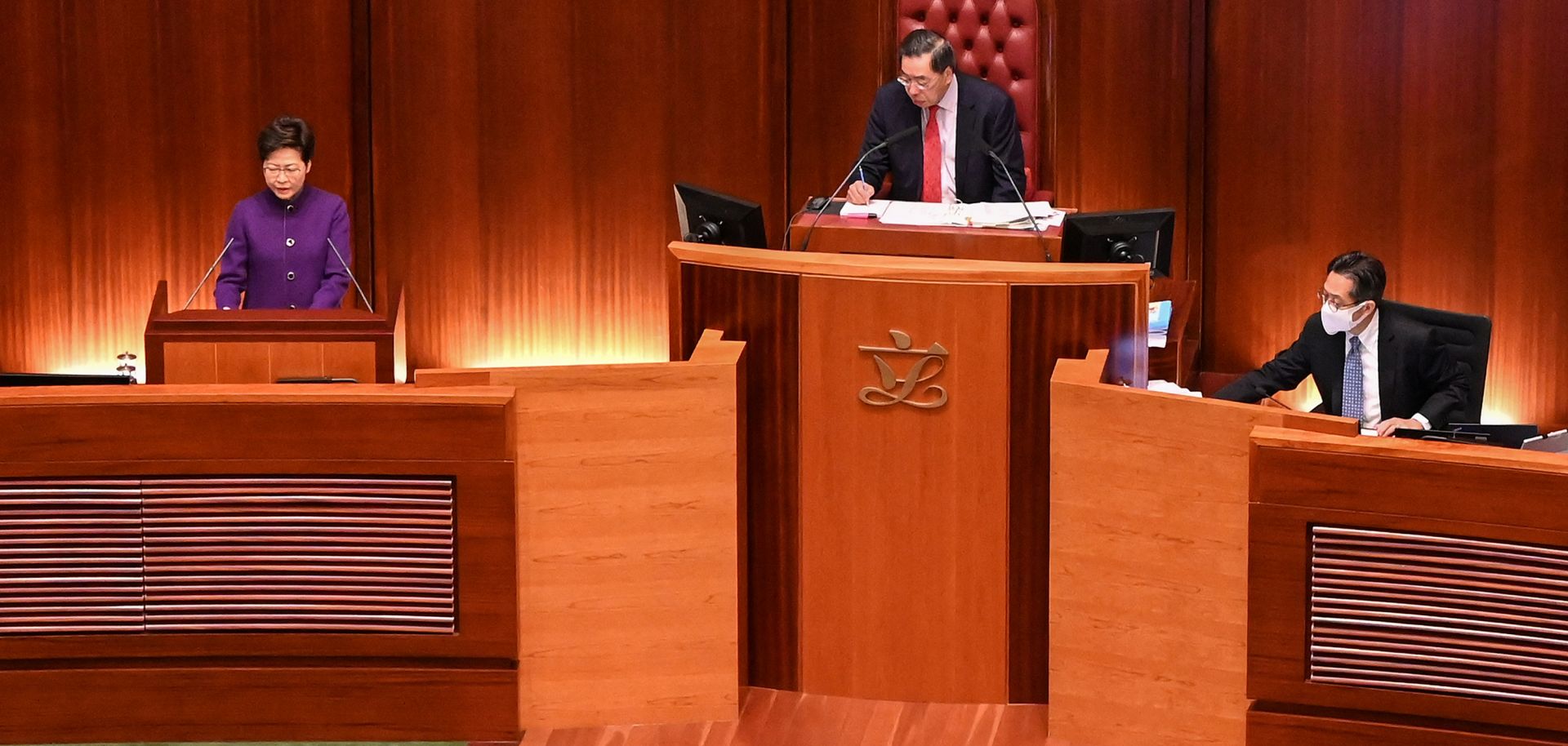
The president of Hong Kong’s Legislative Council, Andrew Leung (center), looks on as Chief Executive Carrie Lam (left) makes an address during the first session of the newly elected legislature on Jan. 12, 2022.
Hong Kong’s likely expansion of the National Security Law will accelerate its transition to de facto mainland Chinese rule and presents security risks to businesses operating in the territory. In her Jan. 12 address to the first session of Hong Kong’s newly elected, pro-Beijing Legislative Council (LegCo), Chief Executive Carrie Lam announced the government would impose new legislation related to Article 23 of the Hong Kong constitution, which is the foundation for the region’s controversial National Security Law (NSL). Lam’s statement can be interpreted as a pledge by the Hong Kong government to expand the crimes covered by the NSL beyond the four current crimes of secession, subversion, terrorism and colluding with foreign forces.
- Hong Kong security forces have used the NSL since its enactment in June 2020 to quash the pro-democracy movement, which organized large-scale protests during 2019-2020 against the erosion of political rights and the imposition of Beijing-style authoritarian rule on Hong Kong, which has enjoyed relative independence from the mainland since 1997.
- Article 23 states that the Hong Kong government must enact laws to prohibit “any act of treason, secession, sedition, subversion, or theft of state secrets,” as well as foreign political activities in Hong Kong or local political bodies from forming connections to foreign political bodies.
- Hong Kong’s Dec. 19 LegCo elections awarded 89 out of the body’s 90 seats to pro-Beijing candidates, all of whom were vetted by the Hong Kong government.
Regardless of which specific crimes are added, the NSL’s expansion will present new risks of surveillance, discrimination in business dealings and civil procedures, and reduced freedom of speech for citizens and businesses in Hong Kong. The expansion of NSL crimes that Lam spoke of may be only piecemeal, with the addition of some crimes preserved for future legislative sessions. But certain Article 23 crimes — including sedition and foreign political influence — are more likely to be added to the NSL, which would grant Hong Kong police greater freedom to investigate such offenses “in the interests of national security,” as well as allow those accused of such crimes to be tried by a jury hand-picked by the pro-Beijing Chief Executive.
- On Dec. 30, Hong Kong authorities charged two former editors from the pro-democracy news outlet Stand News with sedition following a Dec. 29 raid by over 200 police officers of the paper’s newsroom. Authorities also charged Jimmy Lai, founder of shuttered pro-democracy outlet Apple Daily, with sedition on Dec. 28. Prior to 2020, Hong Kong had not leveled sedition charges, which stem from British colonial laws, since the 1960s.
- Since the 2019 Hong Kong protests and the U.S.-China trade war, Beijing has blamed foreign interference for causing not only the unrest in Hong Kong, but the independence movements in Taiwan and the civil unrest in Xinjiang. Beijing has doubled down on these allegations in response to recent U.S. and European sanctions against Chinese officials for democratic suppression in Hong Kong, including Washington’s move to sanction five Hong Kong Liaison Office officials in July
A more powerful NSL will present greater surveillance and discrimination risks to businesses and Hong Kong citizens. To pursue new charges under an expanded NSL, police will increasingly wield online surveillance and surprise raids on local businesses based on suspicion of national security violations. Authorities will also leverage national security concerns to prejudice businesses based on their perceived loyalty, producing the kind of opaque red tape that characterizes the business environment in mainland China. This decreasing space for freedom of speech and increasing political constraints will further hurt foreign investor sentiment about Hong Kong, at least regarding the territory’s ability to provide more economic and corporate freedoms than mainland China.
- The quick turnaround from the Dec. 19 LegCo election to Lam’s Jan. 12 pledge to expand the NSL suggests Hong Kong’s government is quickly moving to both secure political gains (by further silencing dissent) and enforce Beijing’s de facto control over the city’s civil society and business environment under the banner of patriotism.
The expansion of the NSL could also increase public discontent in Hong Kong, which risks further accelerating the territory’s transition to a normal Chinese city governed with heavy Beijing oversight. The NSL has thoroughly squashed overt displays of civil unrest. But the Hong Kong government remains widely unpopular among the region’s citizens, as shown by the record low 30% voter turnout in last month’s LegCo elections compared with the 58% turnout in the 2017 elections. This means more blatant restrictions on personal freedoms have a low (but persisting) possibility of prompting renewed protests. In such a case, Hong Kong’s transition to a Beijing-governed Chinese city would rapidly accelerate as security forces and the government would seek to quickly eliminate all sources of unrest, both domestic and foreign.
