
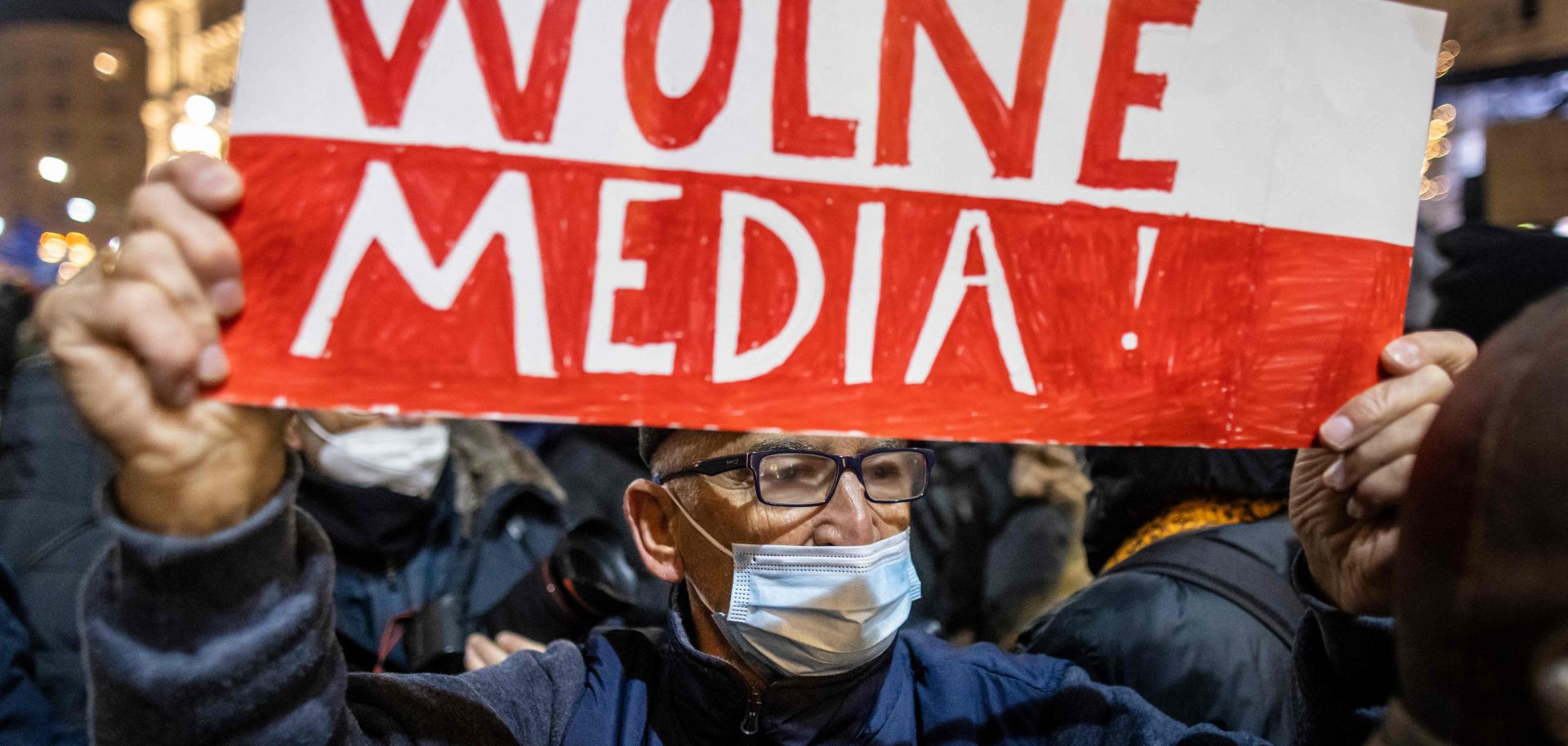
A demonstration against a Polish parliamentary vote seen as impinging on press freedoms Dec. 19, 2021, in Warsaw, Poland.
Efforts by some governments to restrict independent news and civil society organizations can reduce near-term grassroots pressure on companies, but often at the long-term cost of weakening the free flow of reliable information relevant to corporate decision-making, more broadly undermining the business environment. Russia's Supreme Court on Dec. 28 and Dec. 29 ordered the closure of Memorial International and its sister group, Memorial Human Rights Center, two of the country's best known and last remaining civil rights groups. The moves followed a string of similar measures in 2021 that have closed or severely limited the activities of many of the most influential media and political activist groups critical of the government. These have most notably included steps to criminalize all organizations linked to detained opposition leader Alexei Navalny, but have also included various limitations —such as on public activities, website access and online information dissemination — on numerous smaller independent groups. A wide variety of other countries have engaged in similar recent actions:
- Hong Kong pro-democracy media outlet Stand News shut down Dec. 29 after police raided its office and arrested senior staff members. The outlet had been the most influential remaining independent publication in the territory after authorities in June closed Apple Daily and made similar arrests as part of Beijing's expanding control over the territory.
- Nicaragua's parliament, heavily controlled by the ruling party of President Daniel Ortega, voted Dec. 13-14 to outlaw 13 additional nongovernmental organizations, bringing the total number prohibited in 2021 to 57. As part of the government's larger campaign to combat dissent, some of the banned NGOs had links to Ortega's political rivals; others were wholly apolitical.
- Ugandan authorities announced Aug. 20 that they had suspended the operations of 54 NGOs including charities, political activist groups and corruption watchdogs.
Governments rely on a wide range of expansive legal measures when taking these steps, but often invoke controversial so-called "foreign agent" laws or repurpose other regulations to justify their decisions. Although they vary by country, foreign agent laws typically place various operating restrictions on organizations (and in some cases individuals) that receive foreign financing and engage in any sort of political activity. Those labeled as foreign agents are then required to make regular disclosures to authorities and face fines, disbandment and/or criminal penalties for any breaches of the law. Russia's Supreme Court based its recent decisions to close Memorial International and Memorial Human Rights Center on alleged violations of foreign agent laws, the same legal avenue Russian authorities have used to ban many other independent groups and individuals as part of a widespread crackdown on dissent.
- Nicaragua, which modeled its foreign agent law on Russia's, has used the law in its crackdown on NGOs and any other seeming forms of opposition, but also relied on alleged violations of other laws meant to combat criminal and terrorist activities. These have included laws against money laundering, terrorist financing and financing the spread of weapons of mass destruction.
- Hong Kong authorities have used alleged violations of the June 2020 National Security Law meant to combat secession, subversion, terrorism and foreign collusion to justify closing pro-democracy media outlets, accusing their reporting of threatening internal stability and security.
- Ugandan officials justified their recent mass NGO suspension — which is part of a wider campaign targeting political dissent — by saying the groups were not in compliance with a 2016 law regulating their activities, including by supposedly failing to obtain certain permits, file annual returns and audits, and/or register properly.
In some cases, government crackdowns may temporarily alleviate some pressure from local activists on foreign companies. Particularly when authorities target groups fighting government-supported economic development projects and/or those that investigate corruption, some businesses may see at least a near-term decline in protest activity.
- Uganda's crackdown, which activists say has gone beyond NGO suspensions to include larger harassment campaigns, has undermined the work of multiple organizations fighting oil and gas projects by foreign companies.
- Since assuming office in January 2019, the administration of Brazilian President Jair Bolsonaro, who has called environmental NGOs a "cancer," has curtailed the operations of various groups that focus on Amazon deforestation and often target foreign firms in their protest activities. Like others in the region, Bolsonaro's government has also been accused of not doing enough to combat assassinations and threats by criminal groups against environmental campaigners, further chilling activism.
- Belarusian authorities' crackdown following the country's August 2020 presidential election, widely considered fraudulent, has targeted multiple independent news sites. Although driven more by a desire to limit anti-government media, authorities' repression has had the secondary impact of limiting critical coverage of Minsk's Hi-Tech Park, which houses many foreign tech companies.
In the long term, however, restrictions on media outlets and civil society groups can undermine companies' ability to make informed decisions about operating risks in challenging environments. In countries with more authoritarian governments, fewer reliable sources of local information and/or where field sites are in more remote locations, independent news sites and activist groups often play crucial roles in providing reliable information about local conditions, including security threats, corruption risks and other business challenges.
- This has particularly been on display in the past two years in several countries where governments' COVID-19 statistics have been widely viewed as problematic, if not outright false. In some cases, countries have restricted reporting on public health information in order to downplay the threat. This has left foreign businesses with a skewed picture of risks, increasing the importance of private groups' unofficial, but more accurate, reports of the pandemic's local impacts.
- Since taking office in June 2019, Salvadoran President Nayib Bukele has cracked down on independent journalism, most significantly against the outlet El Faro after it first aired allegations in September 2020 — which since appear to have been verified — that Bukele's political party had negotiated with the country's largest gangs to reduce homicides in exchange for various benefits to imprisoned leaders. While Bukele has framed the dramatic decline in the country's official homicide rate as proof that the country is far safer under his leadership, reporting from El Faro and other news outlets has shown that gangs have simply been "disappearing" people instead, thereby artificially lowering the official homicide rate and giving a false impression of improved security.
- Even organizations like charities often seen as uncontroversial, but which have been targeted by various governments for their reports of poor humanitarian conditions and/or foreign links, can also shape companies' judgments about operating in — and sending personnel to — various locations. Since they often have personnel on the ground who report on relevant local conditions such as the reliability of electricity, road safety, and food and water supplies, these groups can provide crucial details that would be challenging if not impossible for businesses to reliably obtain from other sources, especially for risks in remote locations.
Over time, sustained crackdowns on dissent can also undermine a country's broader business climate and expose foreign firms operating there to a variety of local threats, as well as financial, legal and reputational risks in their home countries. When governments broaden their repression beyond sporadic actions targeting individual groups and instead engage in more widespread repression, foreign companies operating in those countries face an even more complex set of calculations and may be deliberately targeted by their host countries if their home countries institute penalties against host countries. The loss of independent voices also means that foreign companies have far fewer sources to determine if local partnerships create compliance risks in their home countries, opening themselves up to potential legal and criminal penalties. In the absence of warnings from local groups that give firms an opportunity to evaluate risks and adjust business relationships, the first notice they receive could instead come from home country law enforcement officials who do not offer an opportunity for remediation.
- Escalating sanctions between Washington and Beijing over China's alleged human rights abuses against the predominantly Muslim Uyghur population in Xinjiang illustrate how foreign firms in China, which was already a complex operating environment, face increasing pressure from both their home and host countries. Adding legal weight to growing reputational considerations, President Joe Biden signed a bill Dec. 30 banning the import of goods from Xinjiang unless companies can prove they were not made with forced labor. But at the same time companies like Intel and Walmart that have taken steps to seemingly comply with the new law have faced significant pushback in China — including threats of consumer boycotts and official investigations — adding to a long list of businesses whose Chinese operations have been threatened over human rights issues.
- In Russia, foreign firms, particularly tech companies, face increasingly frequent and costly fines, with threats to restrict their activities and/or impose criminal penalties, as Washington and Moscow engage in tit-for-tat sanctions against each other's interests. Russian authorities have explicitly linked actions against tech firms to their alleged hosting of online content from Alexei Navalny's now-banned organizations, illustrating how even indirect association with groups targeted in crackdowns can impact foreign companies. Simultaneously, foreign companies must also navigate increasingly complex legal environments in their home countries, where regulators are cracking down on Russian corruption, potentially exposing firms operating there to financial, legal and reputational backlash in the West.
- More generalized crackdowns on political dissent also often have the effect of removing accountability over economic policymaking, meaning a country's business environment can also suffer and harm foreign firms' operations there. For example, despite being widely seen as major emerging markets of interest to foreign businesses, Brazil under Bolsonaro and Turkey under President Recep Tayyip Erdogan have tightened their societal control and pushed out independent economic advisers, leading them to pursue controversial policies that have raised foreign investors' concerns in both countries.
