
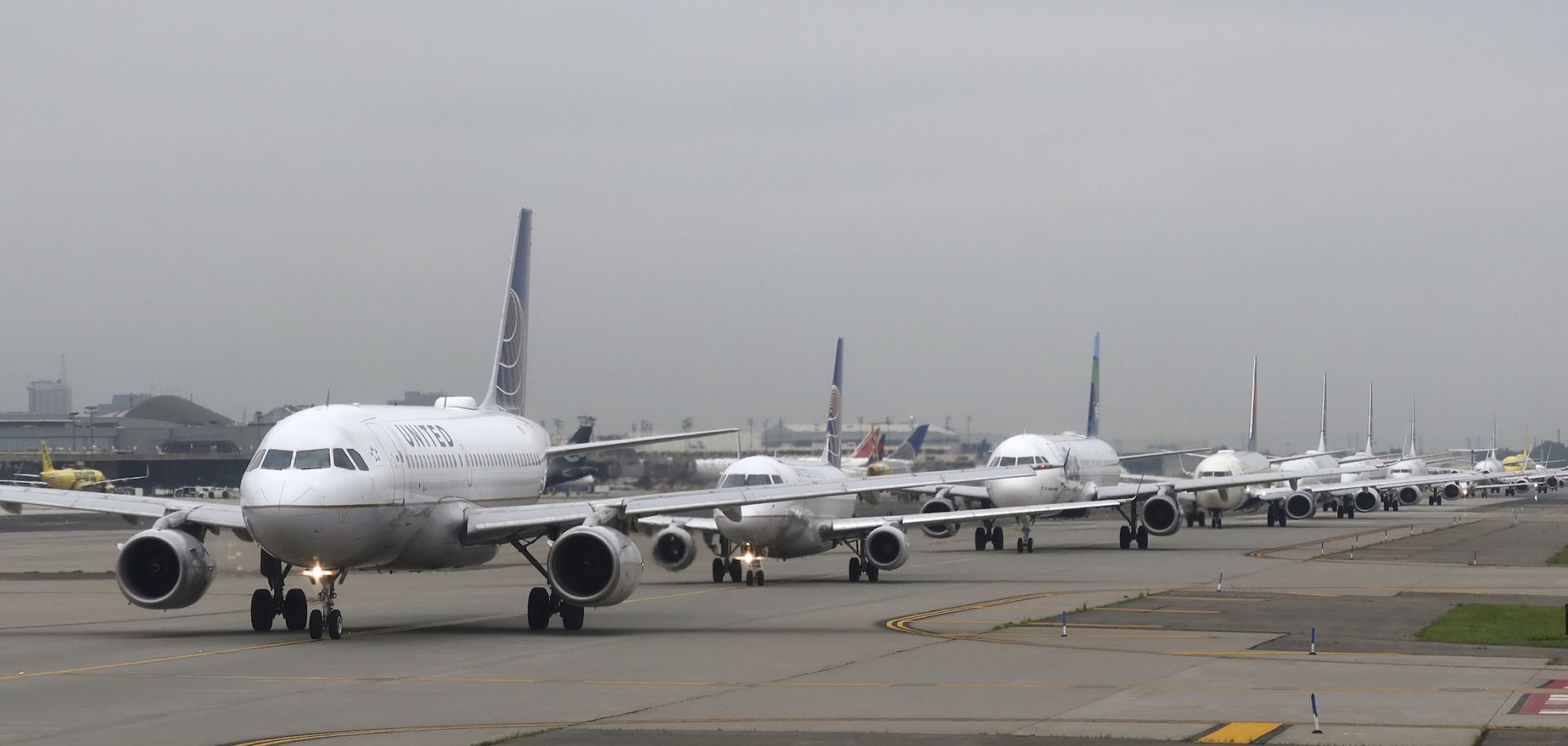
Airplanes await permission to take off at on July 13, 2021, at Newark Liberty International Airport.
Editor's Note: This is part one of a five-part series on the most common threats to travel, updating our previous coverage. After more than a year of restrictions on movement and gatherings, COVID-19 vaccination campaigns are starting to allow at least some societies to resume activities. Travel is among the most impacted activities by COVID-19 and, while the global economic recovery is uneven to say the least, air travel and hotel bookings are showing signs of recovery. While the recent spike in COVID-19 infections due to the spread of the delta variant and associated restrictions remain the single biggest concern for travelers, systemic threats to travelers such as extremist attacks, criminal activity, espionage, protests and cyberattacks will come back into focus as travel picks up. As people once again begin booking flights, checking into hotels and attending conferences in person after a long break, it is important to review the most common threats associated with travel. Stratfor and Threat Lens have long provided coverage and analysis on the threats to air travel, hotels and conferences; now that those activities are becoming more widely possible again, it is time to review the well-established threats associated with them — as well as a few emerging ones, particularly those linked to increased cyber threats. This five-part series will review the extremist, criminal, espionage, protest and cyber threats to air travel, hotels and conferences in parts two, three and four, respectively. Part five will provide a refresher on approaches to personal security while traveling regardless of where you are. Whether traveling for leisure or business, it is important to consider these common-sense security measures to reduce the likelihood of becoming a target.
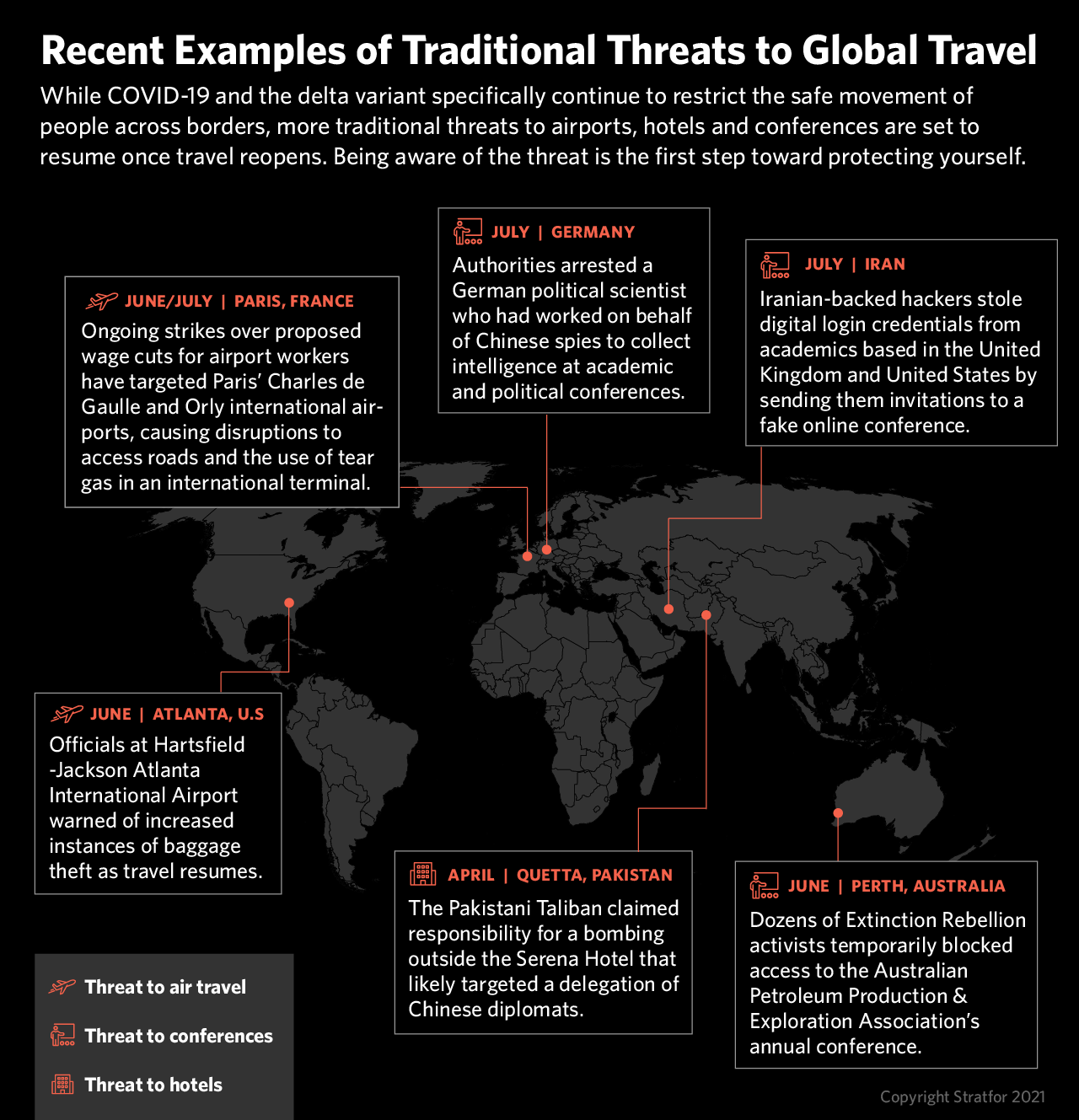
The extremist threat to air travel has declined dramatically over the past two decades since the attacks of Sept. 11, 2001. Increased security measures and proactive counterterrorism efforts have prevented violent attacks on airplanes, but the landside of airport terminals outside of security checkpoints remains a potential target for extremist attacks — and for criminal activity. Criminals have long targeted airports due to their target-rich environments of people with disposable incomes tired from travel and in an unfamiliar environment. Upon arrival, air travelers can expect everything from pickpockets; taxi scams; and, depending on the location, violent ambushes on traffic to and from airports. While the physical threat to air travelers declines dramatically inside security checkpoints, this is no place to let your guard down. Even on the secure side of airports, public Wi-Fi networks are notoriously insecure, and have been exploited by criminal and state-backed actors to spy on travelers. Passing through immigration at an international airport is also a prime opportunity for foreign intelligence collectors to identify attractive targets and even compromise electronic devices they are carrying. Protesters also often target airports and air travel due to the disproportionate disruptions they can cause to a city or entire region by delaying or even shutting down airport operations. While protests are rarely violent, it is important to monitor social unrest at your travel destination to anticipate disruptions to travel plans.
Hotels have similarly been attractive targets for the threats outlined above and generally are even softer targets. While airports — like embassies, office buildings and public event venues — have hardened their security measures to defend against terrorist threats, the very nature of hotels requires them to remain open and hospitable to guests. Despite providing an atmosphere of exclusivity and privilege, hotels are essentially public spaces where violent extremists, criminals and spies know they will be able to find foreign travelers, expatriates and well-connected locals. Even though major international hotel chains and reputable local hotels invest in security to keep guests safe, ongoing incidents highlight the challenges of securing hotels, which have an interest in keeping their buildings welcoming and publicly accessible. Terrorist groups have frequently targeted hotels in order to kill foreigners, embarrass local governments and undermine the confidence of future travelers to the area. Criminals know that both foreigners and wealthy locals alike don't just sleep in hotels but use their facilities in predictable routines that leave them vulnerable to theft — or worse. Similarly, hotels are hives of valuable espionage targets and information for spy agencies attempting to electronically eavesdrop on or physically engage a guest for recruitment. While common areas such as hotel restaurants and lounges are the highest risk areas in a hotel, individual rooms and hotel-provided safes are notoriously easy to break into, affording criminals and spies access to their target's belongings. So while hotels can be havens in particularly high threat areas, it is important that guests do not adopt a false sense of security.
In-person conferences are resuming at a much slower rate than air travel or hotel bookings, but some organizers are at least introducing hybrid models that allow registrants to attend in person or remotely. As companies shift back to in-person work and business travel resumes, convention halls are likely to fill back up with industry conferences and trade shows. Unlike airports and hotels, conferences have rarely been targets for violent, ideologically motivated attacks. But the large contingent of out-of-town visitors with expertise in particular areas (as defined by the event) does make conferences an extremely attractive target for rival companies and intelligence services trying to steal intellectual property and recruit experts to support espionage — often for commercial gain. Protests can also be expected outside controversial conferences, with current threats driven by environmental groups particularly focused on the oil and gas sector and other industries associated with carbon emissions. Finally, as elsewhere, criminals are very aware of conferences and are most likely to target attendees just outside the event center or on their way to hotels or other gathering points.
Travel obviously extends beyond airports, hotels and conferences, so it is important to account for security more broadly during any upcoming trips through general best practices and a mindset that will reduce your profile as a target and better prepare you to respond to trouble. To this end, parts two, three and four of this series will address the particularly pronounced threats around airports, hotels and conferences — given the type of people found in those locations and overlapping target sets for hostile actors ranging from terrorists to spies to hackers. To conclude the series, part five will address more general approaches to personal security while traveling, including strategies for keeping a low profile and not making yourself an obvious target to local threats. Of particular concern, the increasing importance of electronic devices and digital hygiene requires travelers to secure their virtual and physical security. But regardless of the specific threat, situational awareness, both at home and while traveling abroad, is perhaps the most important security measure to mitigate risks. Being conscious of potential threats and being prepared to address them is key to surviving and hopefully avoiding trouble in the first place. Traveling in new environments can be exhausting and disorienting, making it all the more important to develop strategies to maintain awareness while also enjoying your trip.
We are well aware that security is rarely the top priority for people as they travel to visit family, take that well-deserved beach vacation or meet with an important client to close a career-lifting deal. Travelers can, however, ensure that they have a successful and safe trip by considering security from the start and adopting some common-sense practices that reduce the likelihood of being targeted. As COVID-19 and public health concerns surrounding travel recede with the gradual lessening of pandemic-related restrictions, the more conventional threats to travel will resume. Understanding those threats allows travelers to make arrangements and small adjustments ahead of time to reduce the likelihood of disruptions.
