
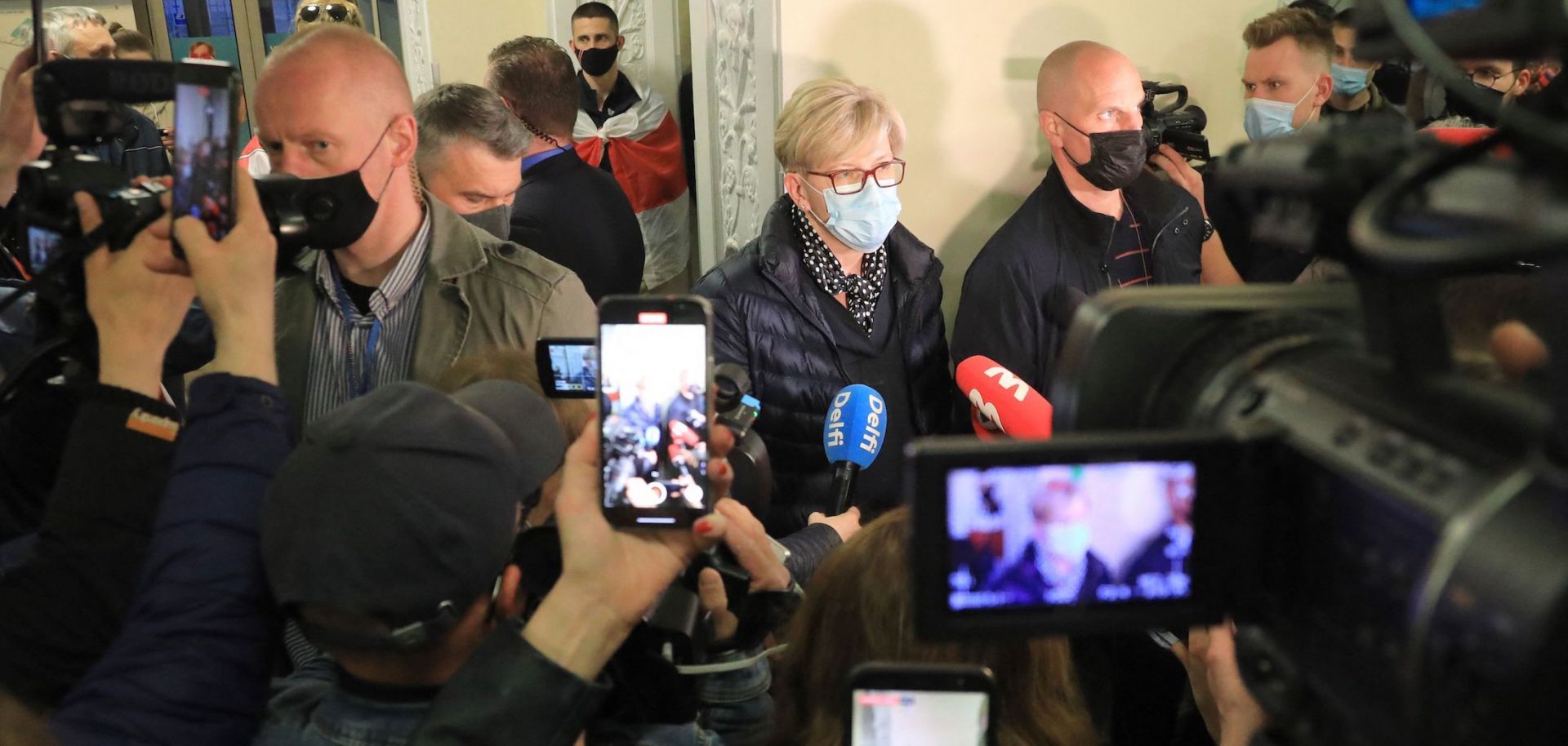
Lithuanian Prime Minister Ingrida Simonyte (center) speaks to journalists in Vilnius on May 23, 2021, about the Ryanair passenger plane that was hijacked and diverted to Minsk, Belarus.
In Belarus, the controversial arrest of a prominent opposition activist will force a Western reaction, but the beleaguered opposition still faces major challenges, likely enabling the Belarusian regime to sustain its power. On May 23, Belarusian authorities arrested the wanted opposition journalist Roman Protasevich after forcing a passenger plane that he was on to divert and land in Minsk, using the pretense of a bomb scare. Protasevich, a former editor of the influential opposition Nexta Telegram channel and news organization, was returning from Athens, where he had been covering a visit by exiled opposition leader Svetlana Tikhanovskaya. The diverted Ryanair flight was headed to the Lithuanian capital of Vilnius, where Protasevich, Tikhanovskaya and a number of other Belarusian opposition figures are based.
- Ryanair said the flight was nearly in Lithuanian airspace before it turned east toward Minsk after Belarusian air traffic controllers notified the plane’s crew of a potential security threat and instructed it to divert. According to Belarusian state media, President Aleksander Lukashenko personally gave the order to send a fighter jet to force the plane to land after authorities reportedly received a threatening email purporting to be from the Palestinian militant group Hamas. The alleged email, however, was sent three days after Hamas reached a cease-fire agreement with Israel to end their latest flare-up in Gaza, raising questions of authenticity.
- Emerging reports also suggest that members of the Belarusian security services surveilled Protasevich in Athens, boarded the flight and tried to convince the crew there was a bomb on board. At least one likely intelligence officer reportedly instigated a fight with crewmembers to insist on the claim’s validity, although it remains unclear if or how this interaction played a role in diverting the plane.
- Six passengers — including Protasevich and his partner, who was also detained — did not return to the plane after Belarusian authorities searched luggage and cleared the flight to continue to Vilnius after a seven-hour delay. This lends credence to the claim that four intelligence officers were on the Ryanair flight and deplaned in Minsk.
The seemingly unprecedented incident adds to the Belarusian government’s expanding crackdown on dissent, which has increasingly targeted journalists in recent months, illustrating Lukashenko feels no compunction for blatant norm-breaking. Protasevich fled Belarus in 2019, but was added to the country’s most-wanted list last fall for supposedly inspiring terrorism and mass unrest during the demonstrations that roiled the country in the wake of the Aug. 9 fraudulent presidential election. At the time, Nexta played a critical role in organizing the anti-government protests. While Protasevich no longer works with Nexta, he’s now the editor of the BGM Telegram channel, whose coverage is equally critical of the Lukashenko regime.
- On May 24, Lukashenko signed into law another package of rules severely restricting civil rights and the free flow of information. These include prohibiting live media coverage of unsanctioned rallies and acting as organizers or participants in any mass events. They also restrict the involvement of foreign individuals or entities in media, prevent media from publishing the results of opinion polls without obtaining permission, and forbid media from posting hyperlinks containing banned information.
- Days before Protasevich’s arrest, Belarusian officials opened a tax fraud case — which is widely seen as politically motivated — against the leaders of the country’s most prominent independent media outlet, Tut.by. Belarusian authorities also detained more than a dozen of its employees (some of whom remain behind bars) temporarily blocked its website and raided the outlet’s newsroom, as well as the homes of various employees.
- Since last fall, human rights groups say Belarusian authorities have detained more than 30,000 people, including several who have been killed and hundreds who have been beaten. In late March, Human Rights Watch said it had identified at least 18 criminal cases against journalists in Belarus, although that figure is now higher.
The West will toughen penalties against Belarus in response to Protasevich’s arrest. The European Union is discussing the incident during a pre-planned special meeting of the European Council, which comprises leaders of the bloc’s 27 member states. Aside from broadening existing travel bans and asset freezes, as well as expelling Belarusian diplomats and calling for an international investigation, EU leaders reportedly will consider whether to ban Belarus’s state-owned airline from landing at EU airports, suspend all flights of EU airlines from entering Belarusian airspace, and suspend ground transit from Belarus into the bloc. The United States and other Western allies like the United Kingdom will consider similar moves as well.
Such measures, however, will not dislodge Lukashenko and are unlikely to reinvigorate the country’s beleaguered opposition movement, further turning Minsk toward Moscow. Any penalties imposed by Western countries face significant challenges that will undermine their effectiveness by:
- Struggling to achieve consensus. Even if certain countries implement some of the proposed penalties on Belarus, the European Union will find it difficult to get all members to agree to a common position — particularly when it comes to the most contentious ideas like prohibiting ground transit from Belarus into the bloc, which are also those that would be most impactful. Russia, meanwhile — Lukashenko’s main backer and the only country that holds significant influence over his actions — has defended the Belarusian president’s handling of the incident. Given its own diverse and ongoing disputes with the European Union, Moscow will look to exploit the situation by drawing Minsk closer to its orbit and will not impose any penalties that would stand a greater chance of changing Lukashenko's calculations. In fact, Russian President Vladimir Putin is scheduled to host Lukashenko later this week for another round of talks on strategic cooperation.
- Offering little help in spurring renewed mass protests to pressure Lukashenko. Despite high-profile attempts, so far this year Belarusian opposition leaders have been unable to revive mass protests. While further Western sanctions will refocus global media attention on Belarusian protesters, who may be temporarily emboldened, they will not undo the broad crackdown on dissent that has stymied mass action. Just last week, Lukashenko signed a law creating a legal loophole to remove liability from security officers who use force against protesters, demonstrating the level of intimidation demonstrators face.
- Failing to address splits in the Belarusian opposition movement. So far this year, two opposition leaders announced plans to form their own political parties, while reports have emerged of major divisions in Tsikhanovsyaka’s broad movement. While the renewed international focus on Belarus may temporarily lift activists’ morale and encourage at least temporary unity, it will not reconcile opposition leaders’ underlying strategic divergences in how to approach Lukashenko, nor their personal disagreements, which will continue to undermine the coordination seen during last year’s mass protests.
- Failing to meaningfully alter Lukashenko’s calculus. Since unveiling a constitutional reform process designed to maintain his power, Lukashenko has only doubled down on actions to sustain his and his allies’ influence, and there are no indications he plans to surrender control. Most recently, he changed the country’s succession plan to make it easier to hand power to the Belarus National Security Council, where Lukashenko’s son wields significant influence, in cases of emergency. Lukashenko has also called on the council, which is filled with staunch loyalists, to take on greater political and security roles in national affairs.
