
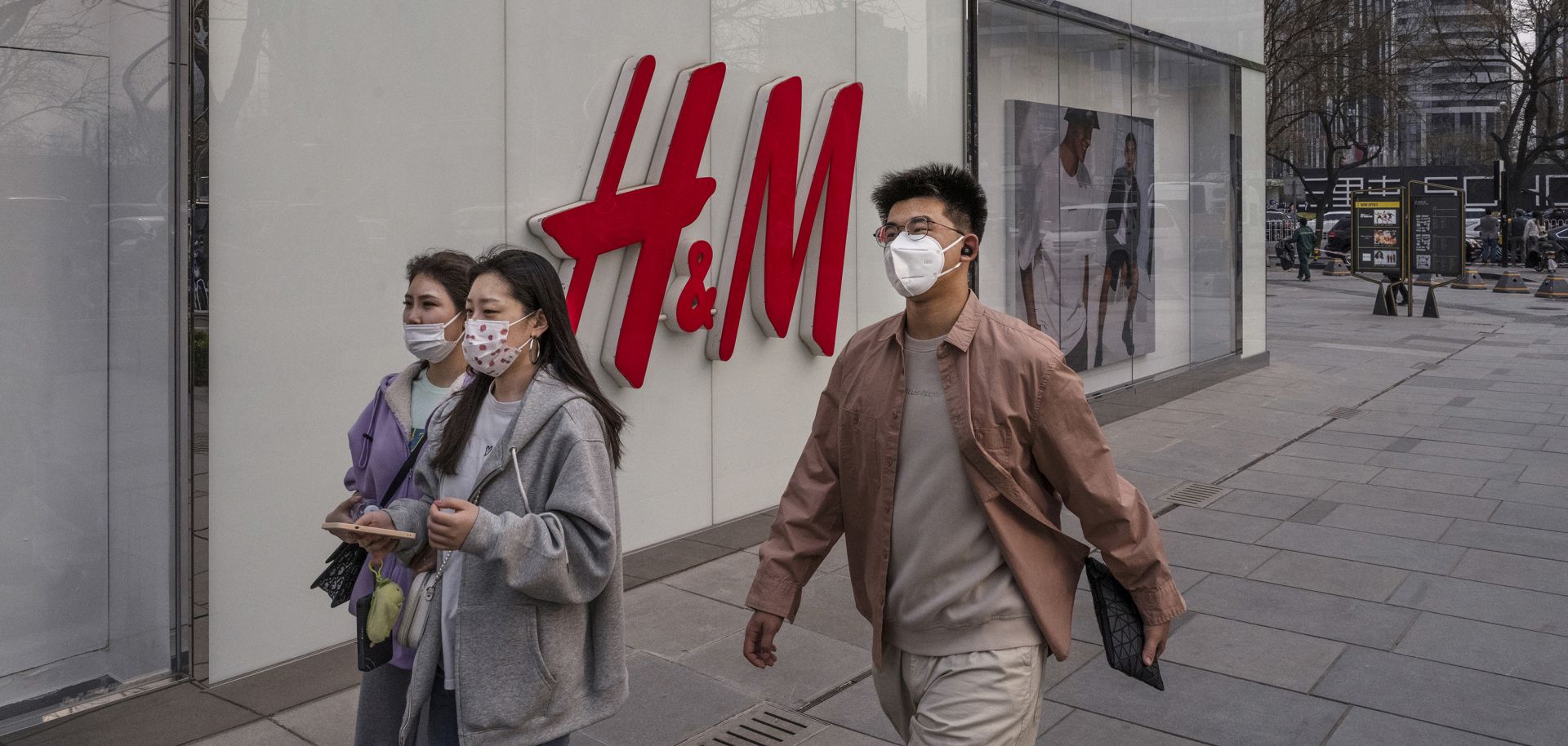
People walk past an H&M store in Beijing, China, on March 25, 2021.
In China, a nationalist social media campaign has gained momentum and state support, revealing Beijing’s intent to punish the United States, United Kingdom, European Union and Canada, which could force certain foreign firms to sacrifice access to China, a key market for future growth. On March 24, the Chinese Communist Youth League (CYL), a nationalist youth organization under the Communist Party, rebuked Swedish clothing company H&M on March 24 via the Chinese microblogging site Weibo for protesting Xinjiang cotton. Since then, state media outlets People’s Daily, CCTV and Global Times have also all condemned foreign firms for interfering in Chinese political matters by suggesting human rights or labor abuses occur in Xinjiang.
- People’s Daily singled out Nike, Adidas, New Balance and Burberry (all U.S., British, or German firms), as well as the Better Cotton Initiative (BCI), a non-profit with 219 member firms that promotes responsible cotton sourcing.
- On March 22, the United States, the European Union, the United Kingdom and Canada imposed coordinated sanctions on four Chinese officials for alleged human rights abuses in Xinjiang. China responded that same day with sanctions against the European Union.
For most companies under scrutiny, the biggest impact of this coercive media campaign is bad press in China. But a select few are already experiencing business setbacks, with more likely to follow if Beijing maintains this campaign. With state media and government ministries now co-opting the media campaign started by CYL nationalists, Chinese celebrities and e-commerce platforms will feel immense social and political pressure to distance themselves from targeted firms.
- Chinese celebrities and local H&M brand ambassadors Huang Xuan and Victoria Song recently ended their contracts with the clothing company. As of March 25, Nike, Adidas, Calvin Klein and Converse have also lost Chinese celebrity endorsements.
- All of H&M's major e-commerce storefronts in China were inaccessible as of March 24. As online sales made up almost 45% of China’s nationwide retail sales in 2020, this blockage will immediately impact H&M revenues in China. Storefront deactivation could heavily impact Western firms more exposed to the Chinese market than H&M (China is H&M’s fourth-largest market).
- Nike’s shares have dropped over 5% on the New York Stock Exchange as of March 25, while shares of Chinese fashion brands Xinjiang Sayram Modern, Septwolves and Heilan jumped 5-10% on the Shanghai and Shenzhen stock exchanges.
China has a history of punishing Western businesses, which serve as easy proxies for their home countries, for taking stances on political issues, including the controversy surrounding human rights abuses in Xinjiang. In January 2018, China blocked Marriott International's website for a week until it recognized Taiwan as a part of China on its booking site. In a similar, more proactive case, Beijing then ordered foreign airlines to recognize Taiwan as a part of China on company websites by July 25, 2018, lest face market consequences, which U.S. airlines ultimately complied with. And in October 2019, China banned NBA broadcasts after a prominent team manager voiced his support for Hong Kong protesters.
Given the popularity of BCI and other ethical sourcing initiatives in the West, Beijing will likely continue to focus this campaign on Western companies that have publicly condemned Beijing’s actions in Xinjiang. Targeting companies that abstain from Xinjiang cotton, like Nike and H&M, is an easy way for Beijing to respond to Western sanctions. U.S. allies South Korea and Japan have yet to sanction China for Xinjiang, so their firms are unlikely to be targeted unless they make clear public statements condemning Beijing. On Jan. 13, the U.S. Customs and Border Patrol pledged to interdict all Xinjiang cotton exports as part of the sanctions the United States imposed in July 2020 over China’s alleged human rights abuses in the region. U.S. firms are thus currently unable to import Xinjiang cotton, though they may use it in overseas manufacturing. Beijing's scrutiny of politically troublesome foreign firms will only increase as the 100th anniversary of the Chinese Communist Party approaches in July and government-stoked nationalism reaches new heights.
- Should Western pressure on China over Xinjiang escalate, Beijing will likely first target firms from U.S. allied countries, like France or Canada, with storefront closures or investigations for violating China’s opaque internet laws before targeting U.S. firms directly. But regardless, when it comes to Xinjiang, Beijing seems content to coerce foreign businesses rather than wage a war of attrition with sanctions.
- The ability to quickly close online storefronts allows Beijing to more easily punish businesses compared with, for example, discouraging overseas tourism or in-person shopping.
China’s middle class is projected to grow, and with it, the market opportunities for foreign firms. Beijing’s renewed willingness to leverage market access for political conformity, however, may force some companies to consider pivoting to the equally promising (though smaller) economies of Southeast Asia. Most, however, will remain in China and adjust to the new political risks. The stagnating populations and slowly growing economies of the United States, Europe, Japan and South Korea will force Western firms to remain focused on meeting the market demands of China’s 1.4 billion people. Still, Beijing’s market manipulations breed resentment. And business owners have long memories, which will force China to balance its threats to punish foreign firms with only occasional follow-through, just as it’s currently doing with H&M.
