
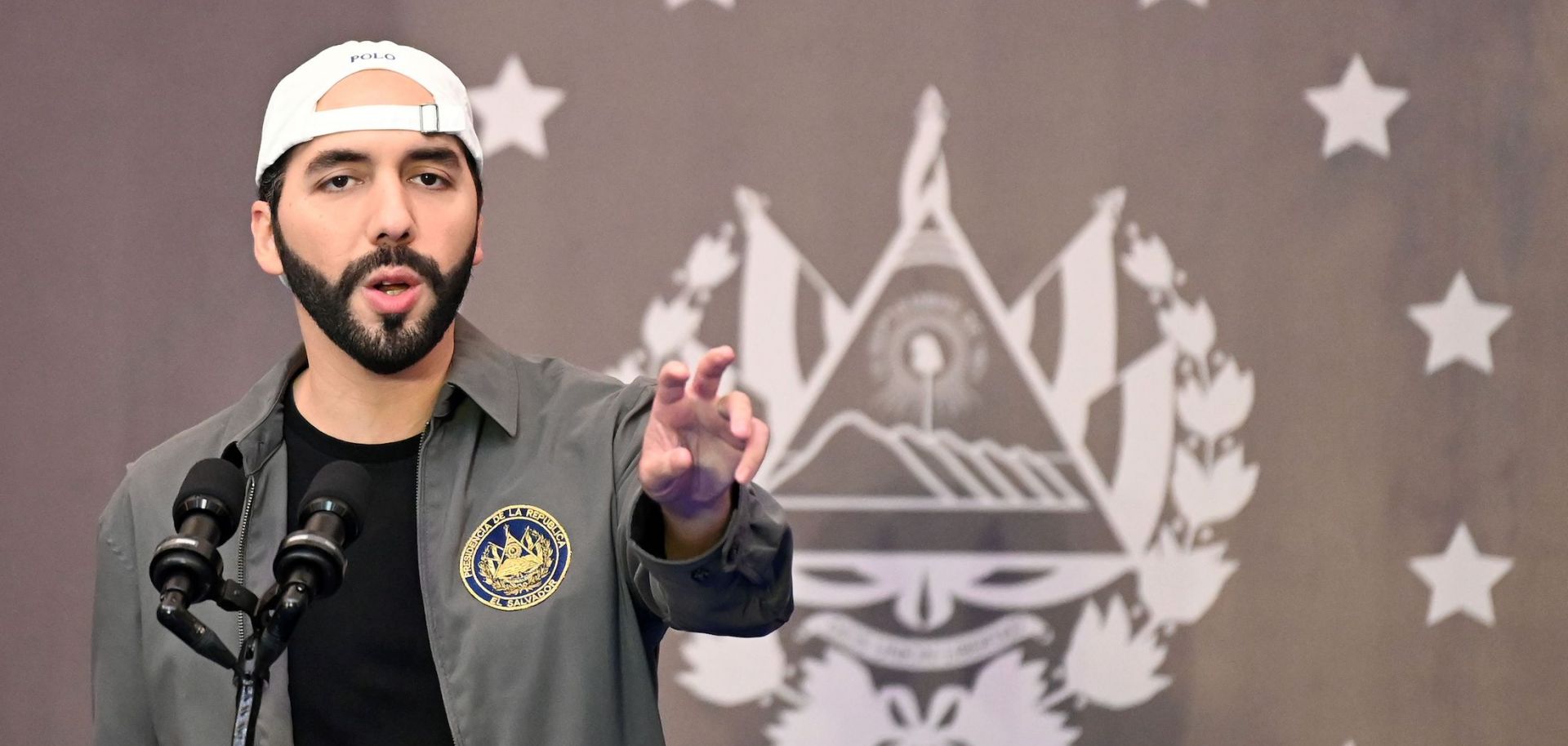
Salvadoran President Nayib Bukele delivers a press conference on Feb. 28, 2021.
With Congress now firmly in his corner, Salvadorian President Nayib Bukele will be free to implement sweeping reforms that may strain his relationship with the new U.S. administration. While votes are still being counted, preliminary results from El Salvador’s Feb. 28 elections show Bukele’s New Ideas party and its allies winning a congressional supermajority, with 61 out of 84 seats in the Legislative Assembly. The surprise landslide victory has vastly bolstered the 39-year-old president’s hold on Congress, where New Ideas previously held only five seats. The win also reflects Salvadorians’ widespread support for the president’s first two years in office despite the country’s ongoing COVID-19 and economic crises, and marks the first time a single party has controlled both executive and legislative branches since El Salvador returned to democracy in 1992.
The sweeping electoral victory has given Bukele a firm mandate to reform El Salvador’s delicate economic, social and security situations. The first two years of Bukele’s presidency saw several of his policy initiatives blocked in the Legislative Assembly. Addressing the country’s fiscal deficit a particular point of contention between Bukele and Congress, which approves the budget. But now that his party has cemented a supermajority for the next three years of his term, Bukele may be able to pursue policies without needing to first form coalitions to gain the necessary support. Some of the issues Bukele is likely to tackle during the remainder of his presidency include:
- Public debt and financing. Bukele is likely to promote restructuring El Salvador’s public debt, which has grown by $3 billion since the onset of the pandemic in early 2020, bringing the country’s debt-to-GDP ratio to 90%. The new Congress is likely to increase the value-added tax and housing taxes as a way to offset the country’s fiscal deficit, as recommended by the International Monetary Fund (IMF). El Salvador sovereign bonds were trading at their highest in a year on March 3 in anticipation of Bukele being able to approve budgets with external debt and sign on to an IMF program.
- Security. Bukele has pushed for tighter security in El Salvador and has seen some success, with murder rates dropping 60% in his first two years as president. Much of Bukele’s current popularity can be attributed to the tangible increase in quality of life due to lower rates of violent crime. Given that Bukele’s push for heavy security funding has been met with resistance from the Legislative Assembly in the past, he is likely to push for further funding now that he has more control.
With control of the legislature, there are now concerning pathways for Bukele to further cement his grip on power and, in turn, weaken democratic governance in El Salvador. Bukele has a history of autocratic tendencies including using military presence to intimidate lawmakers into passing security reforms. With the support of the legislature, Bukele could pursue controversial constitutional changes that would allow him to extend his presidential term. Bukele may also move place the Supreme Court, which has rebuffed some of his policies, in his favor by appointing new justices with the assurance that they would be confirmed by the Legislative Assembly — thus giving him control over all three branches of El Salvador’s government.
While U.S. President Joe Biden and Bukele have great potential to collaborate on issues of mutual interest, the former’s push to strengthen democracy in the region will likely cause friction between their two administrations. Biden has promised $4 billion in funding for economic development projects in Central America, including El Salvador, with an emphasis on democracy-building in the region. But while Bukele’s consolidation of power may also help him coordinate with the Biden administration on issues such as increasing security measures, immigration reform and fighting corruption, his relationship with the new U.S. president has already started off on a cool note, with the Biden administration refusing to meet with Bukele in January 2021. And that relationship is bound to only become icier if Bukele shows any unwillingness to commit to protecting El Salvador’s democratic institutions.
