
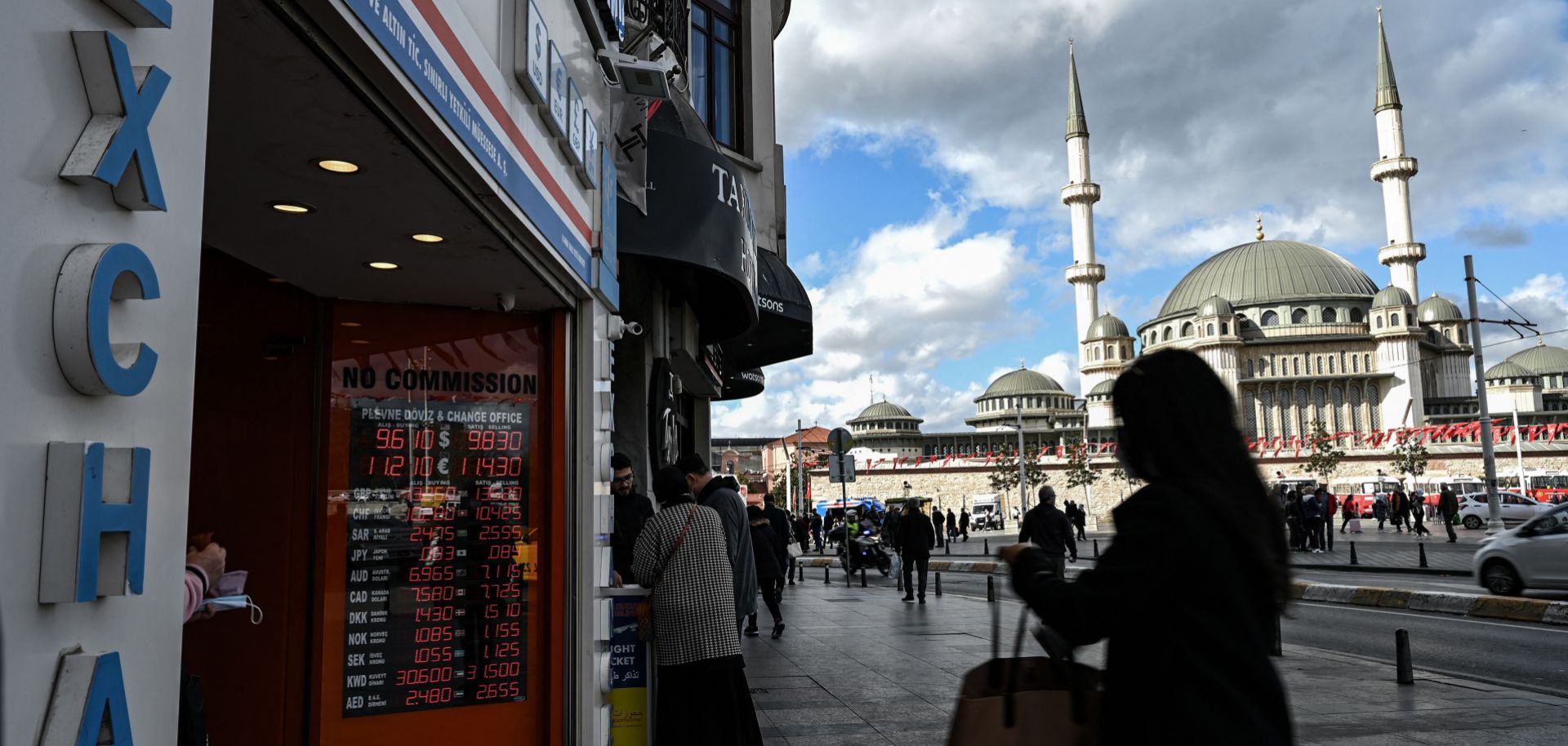
People wait outside a currency exchange agency in Istanbul, Turkey, on Oct. 25, 2021.
While the Turkish government’s unconventional financial policy could result in near-term growth, it could come at the cost of enduring economic instability and political uncertainty. On Nov. 18, the Central Bank of the Republic of Turkey (CBRT) cut its main policy interest rate by 100 basis points (bps) to 15%, marking the third consecutive monthly decrease and a cumulative cut of 400 bps since March. This underscores the government’s adherence to an experimental policy of monetary easing, despite accelerating inflation and the depreciating Turkish lira, which could plunge the country into a deeper currency crisis over the next year.
- After the CBRT announced its latest interest rate cut, the Turkish currency’s exchange rate immediately fell below 11 lira per U.S. dollar, marking a loss of about 50% of its value since the end of 2020.
- On Nov. 23, the currency then depreciated further to roughly 13 lira per U.S. dollar after President Recep Tayyip Erdogan gave a speech in which he defended the CBRT’s monetary easing policy and criticized alleged foreign intervention in the Turkish economy.
Erdogan and his ruling Justice and Development Party (AKP) are likely hoping that near-term growth will increase Turks’ waning trust in their ability to lead the economy. Erdogan’s Islamist ideology shuns interest rates in general. Lower rates also encourage consumption that will further stoke growth, even if unsustainably and at the price of increasing inflation. Erdogan likely wants to capitalize on the immediate boom in economic activity and jobs to boost the AKP’s popularity ahead of the 2023 general elections.
- Turkey is currently experiencing rapid economic growth. The International Monetary Fund recently revised its 2022 estimate from 5.8% growth in 2021 to 9%. The country’s current account of the balance of payments showed an unusual surplus of $14 billion in the first eight months of the year, which may reflect a boost to exports from a depreciated exchange rate.
- Lower interest rates and a depreciating currency benefit property speculators and the exports sector, helping create a limited increase in jobs. The unemployment rate in Turkey fell to 11.7% (seasonally adjusted) in the third quarter of 2021 from 12.1% in the previous quarter, with the number of employed workers increasing by about 700,000 and the number of unemployed also decreasing slightly. This increase in jobs is also due to a return of activity in the tourism sector and increasing domestic consumption amid the easing of COVID-19 lockdown measures.
- According to recent polls, the AKP’s approval rating is at an all-time low, raising concerns about the party’s electoral prospects in 2023.
In the long term, the government’s policies set Turkey up for financial challenges and greater economic instability. Erdogan appears dead-set on his goal of monetary easing, with his repeated promises to continue fighting for lower interest rates. The Turkish government’s unconventional financial policy thus looks likely to persist into the coming year. Continued interest rate cuts amid high inflation will put downward pressure on the Turkish lira and encourage further dollarization in the economy, driving mistrust in both the lira itself and the government’s efforts to promote it. This will create a cycle of fear about the lira that could fuel the emerging currency crisis.
- Turkey spent an estimated $128 billion in foreign currency reserves in 2019 and 2020 to support the lira and has negative net foreign exchange reserves, which limit the amount of foreign currency it has to pay off its debts and pay for imports.
- The country’s current account surplus is also unlikely to last. Turkey was the seventh-largest natural gas consumer in 2020 and the government forecasts that gas consumption will increase another 25% in 2021. Costs of importing gas are increasing in U.S. dollar terms and a depreciating currency will magnify the impact on domestic currency costs.
- High inflation and a volatile currency tend to decrease consumer spending power over time. Despite the modest improvement in unemployment, inflation hurts everyone across socioeconomic classes in Turkey — especially the poor, who require additional financial support from the government to survive amid tight economic conditions.
- The government will eventually have to broaden fiscal spending to support the poor and middle class whose livelihoods risk eroding in the emerging financial crisis. Greater fiscal spending will also jeopardize the government’s ability to cover its budget and increase public sector debt (the government’s budget deficit in October 2021 was $1.7 billion).
- Turkey faces external debt payments with the central bank estimating $13 billion due in November-December 2021 and debt at a residual maturity of one year is $124.4 billion. The domestic currency costs of servicing that debt increase with each downtick in the exchange rate.
- A prolonged currency crisis will increase the risk of the government putting into place capital controls to help prevent runs on the banks.
The political cost of its unusual financial and monetary policy could ultimately see the AKP ousted from power in 2023. Consumer confidence in the Turkish economy is at a record low, which suggests the government will struggle to convince Turks and investors alike of the sustainability of its policies. Additional financial volatility and decreased spending power will also further damage the AKP’s domestic popularity. Opposition parties will seize on Turks’ growing economic worries to cast further blame on the ruling party, which will increase their chance of ultimately defeating the AKP in 2023 elections. The AKP holds significant institutional strength that will help it ward off this threat. But there’s a chance Erdogan may call for an early election during the current period of rapid economic growth before the situation collapses into a greater financial crisis.
- There is a high risk of political instability in the form of reshuffles at the central bank or in the treasury and finance ministry. In its Nov. 18 decision statement, the CBRT suggested that it may consider ending the series of interest rate cuts given “that the transitory effects of supply-side factors and other factors beyond monetary policy’s control on price increases will persist through the first half of 2022.” If the CBRT halts interest rate cuts before Erdogan is satisfied with the extent of easing, there is a high risk of further personnel shake-ups at the bank, which would stoke domestic and foreign investor uncertainty by further undermining whatever central bank independence may be left. More CBRT personnel replacements would also deepen the perception that Turkey’s economic and financial policies are unstable, and that the country is not an ideal site for long-term investments.
