

A child runs past people sitting near the Galata Bridge in Istanbul, Turkey, on Feb. 8, 2021.
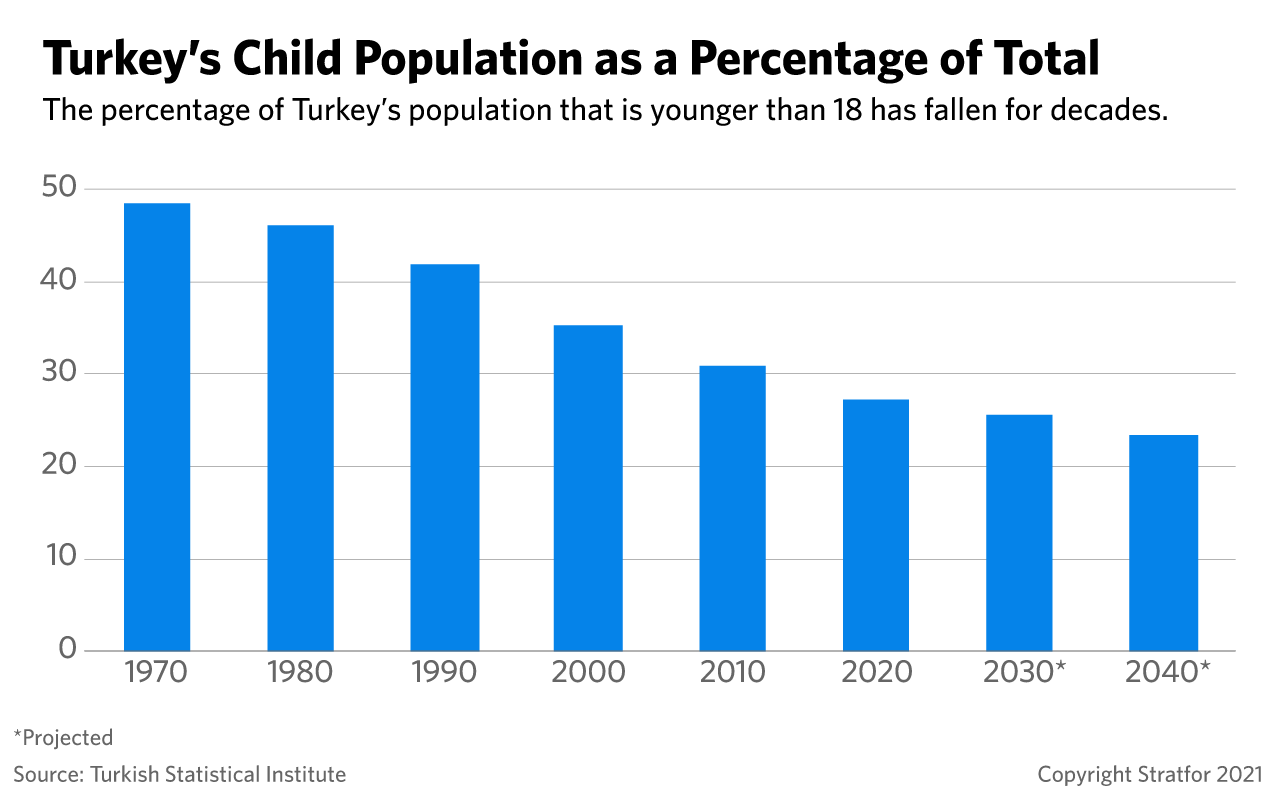
Despite attempts by the government to incentivize having larger families, Turkey’s fertility rate will likely continue to decline — weighing down its economy with older and more expensive workers, higher health care costs, and weaker buying power for younger citizens. Over the past two decades, Turkey has seen a consistent decline in the number of live births per 1,000 women between the ages of 15 to 49, also known as the fertility rate. The percentage of Turkey’s population between 0-17 years old dropped to its lowest point on record in 2020, with a decline of -5.5% in the child growth rate. This drop was likely partially due to parents delaying having children during the COVID-19 pandemic. But last year’s deeper decline only fed into Turkey’s greater slide in national fertility, which began around the year 2000. As its population ages, Turkey could have a majority non-working population before the end of the decade, slowing economic growth while placing younger Turks in fiercer competition with their elders for jobs and wages.
- In 2020, Turkey saw another drop in people under 18 as a proportion of its population, dropping to 27.2% from 30.8% in 2010, according to the Turkish Statistical Institute.
- According to estimates released by the CIA (the U.S. intelligence agency), Turkey’s fertility rate is expected to decline to 1.9 births per woman in 2021, well below a replacement rate, and down from 2.5 births per woman in 2000.
- Turkey’s life expectancy, meanwhile, is expected to reach 80.59 by 2030, up from 77.31 in 2020. According to the United Nations,
Turkey’s slow exit from the COVID-19 crisis and enduring macroeconomic problems will create conditions that disincentivize having children, let alone large families, for the foreseeable future. In the near term, Turkey’s struggle to curb resurgent COVID-19 outbreaks means it will likely endure more economic hardship amid ongoing lockdowns and miss out on at least part of the economically important summer tourist season, which is a major source of revenue and foreign currency. But long after the pandemic subsides, high inflation, private debt, currency problems and a lack of foreign investment will likely continue to plague Turkey’s economy.
Turkey also does not yet have a novel fertility improvement strategy that would break it out of Europe’s decline pattern. Turkish President Recep Tayyip Erdogan has long pushed for a stronger fertility rate, urging Turks to have at least 3 children, out of a combination of traditional values and a recognition that an aging population could complicate Erdogan’s long-term strategic plans to increase Turkey’s global power. In 2017, Erdogan urged Turks living in Europe to have more children as revenge against the West’s “injustices.” But there are few examples of countries that have increased birth rates once they decline below population replacement because social attitudes permanently shift to emphasize smaller families.
- Sweden managed to bring its birth rate up from its 1999 low of 1.50 to 1.76 in 2018 through expansive daycare subsidies, family leave policies, and a shift in cultural attitudes to emphasize family life. Nevertheless, since its recent peak of 1.98 in 2010, Sweden’s fertility rate has again been on the decline — a probable effect of the series of global economic crises of the past decade.
As its labor force shrinks and healthcare costs increase, Turkey will struggle to grow its economy. Turkey’s non-working-age population — that is, those aged 0 to 14 and 65 and older — is expected to reach 52% by 2030. A small labor force could push up wages as businesses compete for fewer workers. It could also restrain economic growth as businesses lack the access to workers they need for operations. An older population will also translate to higher health care costs, which in Turkey is often paid for by the country’s state-backed Social Security. The increase in government spending could eventually force Ankara to increase taxes, further undercutting Turks’ spending power and disincentivizing investment.
- Japan, where more than 20% of people are over 65 years old, spent 10.95% of its GDP on health care in 2018, compared with 7.15% in 2000. Japan also has a state-backed national pension system, which is straining to keep up with the demands of its rapidly aging population and pushing more Japanese to rely on private investments to retire.
Turkey’s ruling Justice and Development Party (AKP) will likely politicize the country’s demographic challenge, using the budget to carry out potentially unsustainable fertility and elderly-friendly policies. With Turkey’s economic competitiveness increasingly constrained by its aging population, the AKP is likely to pivot toward targeting specific projects, like the Istanbul Canal, that can be used to funnel spending and create jobs for specific segments of society that support the party — even if such projects do not necessarily improve the country’s overall economic performance. To win support from voters, the AKP will also likely create family-friendly subsidies and increase overall health care spending, which will further strain the country’s national budget. Fears of political blowback, meanwhile, will deter Ankara from pushing back Turkey’s retirement age as well.
- Turkey’s retirement age is set to increase from 60 to 65 for men in 2046, and 58 to 65 for women in 2048.
