
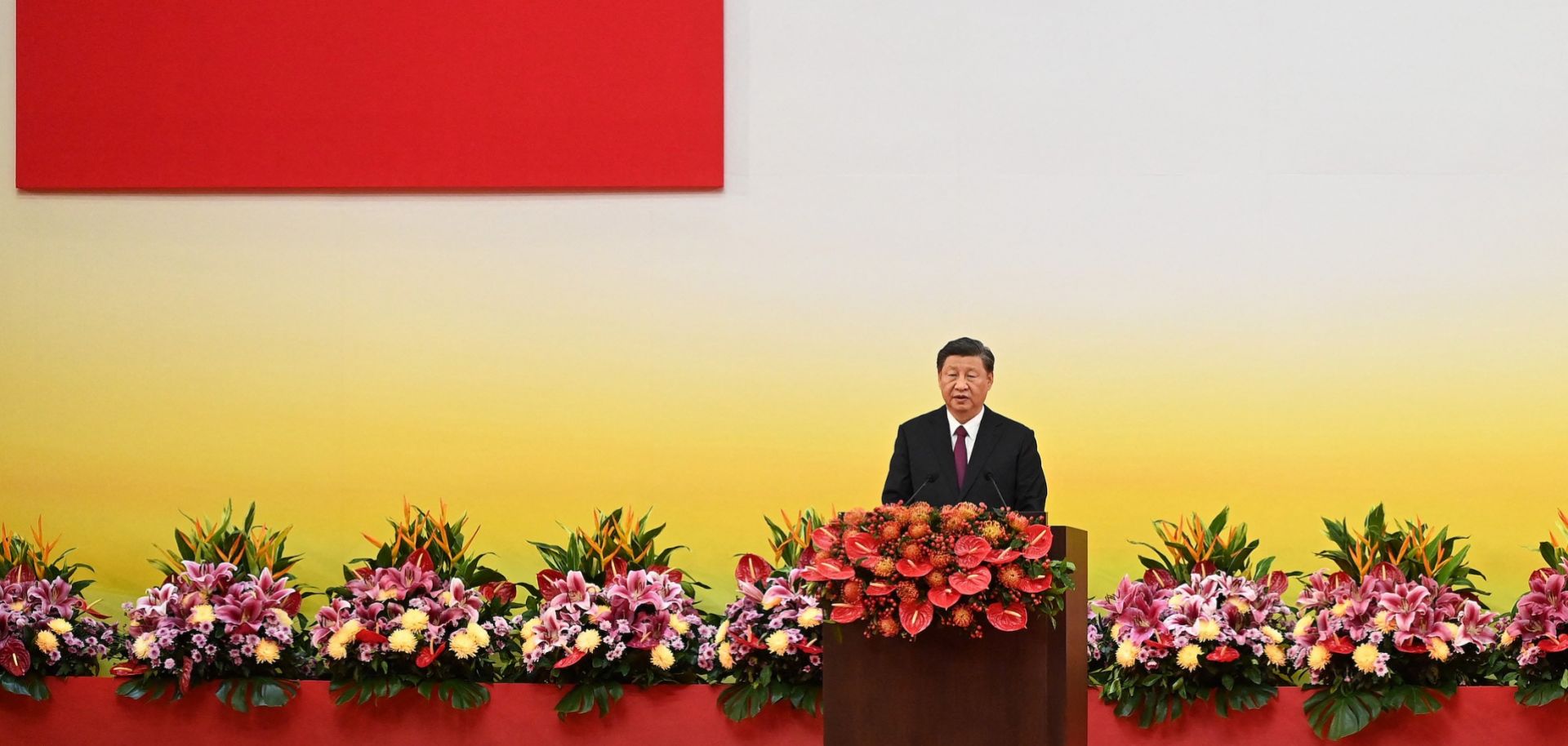
Chinese President Xi Jinping gives a speech in Hong Kong on July 1, 2022.
Chinese President Xi Jinping's first trip outside of China in almost three years will showcase strong ties with Russia, despite the two countries' competition for influence in Central Asia, and enable Beijing to improve diplomatic relations with developing countries. But China's resumption of in-person diplomacy will do little to ease tensions with the West. Xi will visit Kazakhstan to speak with President Kassym-Jomart Tokayev on Sept. 14, according to a Sept. 5 announcement from the Kazakh foreign ministry. Thereafter, he will travel to Uzbekistan to attend a meeting of the Shanghai Cooperation Organization (SCO) — a group of Central Asian states, along with Russia and China, that primarily cooperate on security matters — on Sept. 15-16, according to the SCO's Telegram account on Sept. 4. On the sidelines of that meeting, Xi will meet with Russian President Vladimir Putin, according to statements given to TASS state media by Russian Ambassador to China Andrey Denisov. Beijing, however, has yet to confirm these visits.
- If Xi follows through with these trips, they would mark his first visits outside the country since January 2020, at the start of the COVID-19 pandemic. The lack of foreign visits has likely been a precaution to ensure that Xi does not fall ill, as this would cause Beijing to experience a succession crisis since so much of China's political power is concentrated in Xi's hands.
- These announcements follow Xi's visit on June 30 to Hong Kong to mark the 25th anniversary of the handover of Hong Kong from the United Kingdom to China. Xi made this visit despite the ongoing COVID-19 outbreak in Hong Kong, where daily case numbers regularly exceed those of all of mainland China.
- Xi and Putin have had a particularly close personal relationship in the wake of the Arab Spring, which raised fears about ''color revolutions'' spreading political upheaval to China and Russia. Since coming into office, Xi has met with Putin 38 times, which is more than Xi has met with any other world leader.
- Three weeks after Xi and Putin declared that their nations' partnership had ''no limits'' in a joint statement on Feb. 4 — the opening day of the Beijing Olympics — Russia invaded Ukraine. Though China has since refused to condemn Russia and blamed NATO for ''threatening Russian security,'' Beijing has limited formal aid to Moscow and urged Chinese companies to comply with Western sanctions on Russia, even as Beijing condemns them as indicative of U.S. ''financial hegemony.''
These meetings will provide a forum for China and Russia to compete for influence in Central Asia, even as Xi's meeting with Putin emphasizes the strength of the bilateral relationship in the face of strategic competition with the West. Since the fall of the Soviet Union, Central Asia has been a battleground for Russian and Chinese influence, with Moscow focusing on security agreements with the region and Beijing focusing on economic cooperation. Xi's and Putin's upcoming visits to the region highlight their continued competition for dominance in Central Asia, while Central Asian states, most notably Kazakhstan, are seeking to maximize economic benefits — such as infrastructure investments and trade agreements — and minimize the security threat posed by Russia. In the wake of the Russia-Ukraine war, speculation has stirred in Central Asia that Moscow could use military action against Kazakhstan and its neighbors to maintain Russia's geopolitical influence in other post-Soviet states. Despite this regional competition, Xi and Putin will emphasize the strength of their bilateral relationship as a bulwark against the spread of Western liberal democratic ideology and U.S.-led global sanctions regimes.
- Russia's January military intervention in Kazakhstan under the auspices of the Collective Security Treaty Organization (CSTO) exemplifies the traditionally close security relationship between Russia and the former Soviet states of Uzbekistan, Tajikistan, Turkmenistan and Kyrgyzstan. But these same states were alarmed by Russia's invasion of Ukraine, which they believe could set a precedent for redrawing borders by force in other former Soviet spheres.
- China announced its signature foreign policy, the Belt and Road Initiative (BRI), at Nazarbayev University in Kazakhstan in September 2013, reflecting China's long-standing interest in bolstering economic ties with Central Asia, partially as a gateway to the European market, but also as a key source of mineral and fuel imports. Kazakhstan remains a major destination for BRI investment, while new BRI investments in Russia have fallen since its invasion of Ukraine, showing China's growing interest in Central Asia as an alternative transit corridor to Europe that bypasses Russia.
- Central Asian states are looking to protect themselves from coercive action by Russia in the wake of the Russia-Ukraine war by seeking stronger economic ties with China (e.g. through greater BRI and energy cooperation). Kazakhstan's president stated at the St. Petersburg International Economic Forum in June that he would not recognize Russia's puppet states in Ukraine, while Uzbekistan's foreign minister in March echoed this non-recognition and voiced support for Ukraine's sovereignty.
Xi's trip would also end the COVID-19-induced hibernation for China's diplomatic engagement, which will help improve China's relations with the developing world but is unlikely to heal China's ailing relations with the West. If Xi and other Chinese leaders can capitalize on this diplomatic initiative by planning many other in-person visits, Beijing may be able to buffer growing anti-China sentiment and strengthen trade relations with the developing world (including Central Asia). However, easing strategic competition with the West will be much more difficult, as since January 2020, when Xi last left China, the country's diplomatic relations with the West have deteriorated rapidly over a number of foreign policy disputes. These issues include China's support for Russia's war in Ukraine, as well as various domestic issues, such as China's human rights abuses in Xinjiang, which are unlikely to be resolved soon. Though China also will try to use diplomatic visits to soften its strategic competition with Europe, Australia, Canada and other U.S. allies and partners, Western skepticism of Chinese intentions, especially on trade and security matters, will blunt these efforts. Given that Beijing shows no signs of adjusting its aggressive approach to relations with the West (including increasingly brazen rhetorical slights), diplomatic entreaties toward the West are likely to fail, or worse, further erode China's relationships. This aggression has been an increasingly prominent characteristic of Chinese diplomacy since Xi came to office in 2012, and, especially ahead of the expected start of his third term as China's leader in October, Xi's continued commitment to pushing Chinese nationalism, retaliating economically against human rights criticisms, and combatting Western liberal democratic ideology suggests a diplomatic course correction is highly unlikely. This will only expand China's standoff with the West, even if Xi's summitry in Central Asia portends improved diplomatic relations with the developing world.
- The European Union in May 2021 suspended negotiations on the EU-China Comprehensive Agreement on Investment until China removed its March 2021 sanctions on European members of parliament, which were levied in response to European sanctions on China for human rights abuses in the country's Xinjiang region.
- China's relations with Australia have soured since May 2020 when Beijing began imposing various tariffs on Australian exports in retaliation for Canberra's support of an international investigation into the Chinese origins of COVID-19.
- Canada-China relations remain on the rocks even after Canada released Huawei Chief Financial Officer Meng Wanzhou, who was detained on charges of dodging U.S. sanctions on Iran, in September 2021 and China, in turn, released two Canadian citizens who were detained on dubious charges immediately after Meng's detention in December 2018.
