
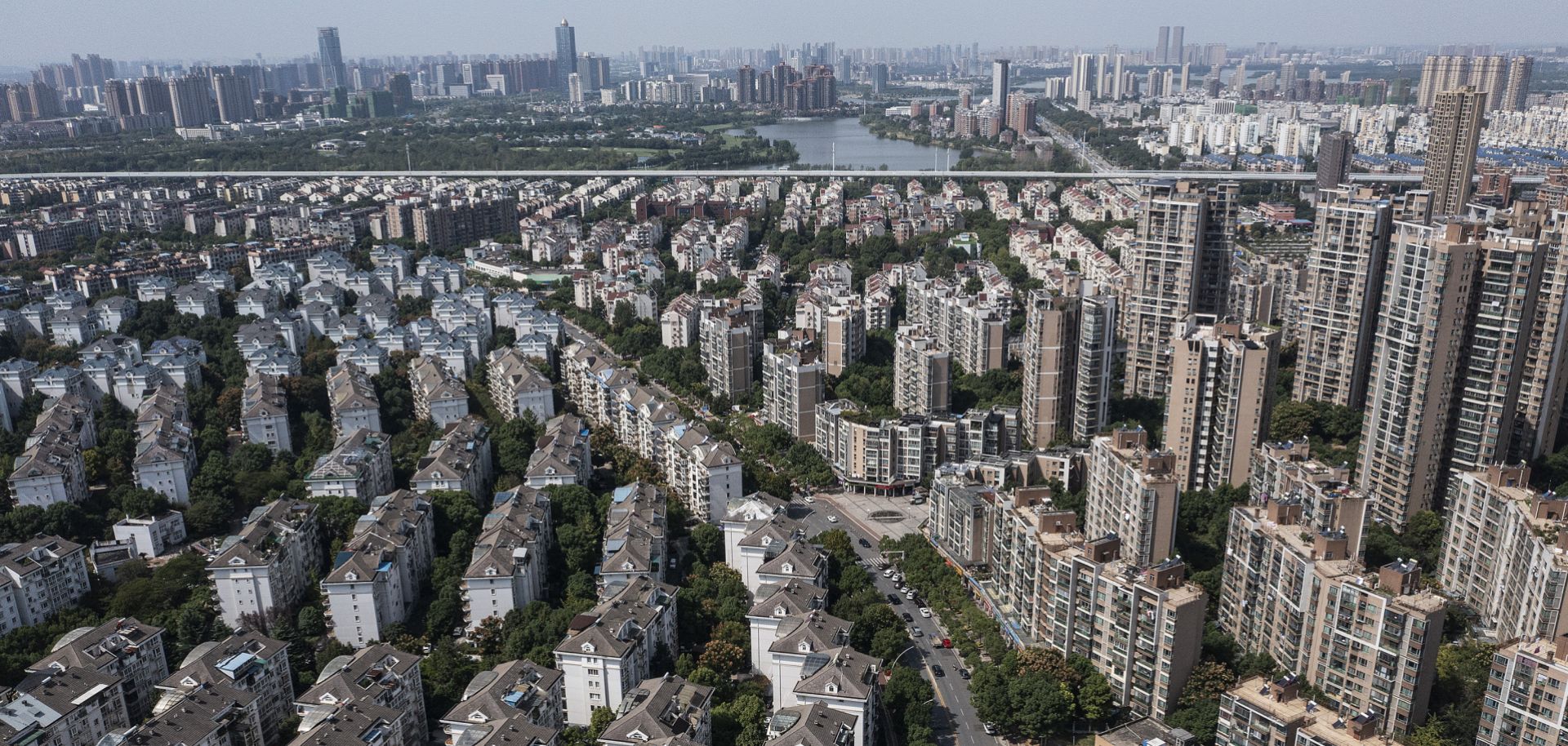
An aerial view shows the Evergrande Changqing community on Sept. 26, 2021, in Wuhan, China.
In China, the financial distress of real estate developers creates significant risks to the housing market, banks and medium-term economic growth. China's real estate sector has been in turmoil since Evergrande defaulted on its debt in early 2021 and prompted other major Chinese property developers (including Kaisa Group and Shimao Group) to follow suit. The current crisis is a direct consequence of the government's efforts to restrict the amount of debt that developers can take on to fund their projects. By clamping down on property developers (who are estimated to carry $5 trillion worth of debt, which is equivalent to roughly one-third of China's overall GDP), Beijing is hoping to reduce a further build-up of financial risks in the real estate sector and, in turn, rebalance China's economy away from construction-intensive growth and toward a more sustainable growth path. This, however, is proving to be a risky balancing act as the real estate sector remains a central pillar of China's economic growth, generating up to a third of China's total GDP. The financial impact thus far appears to have been manageable, but if the real state sector continues to spiral, the fallout risks causing a sustained drag on China's economic growth.
- China's property sales fell nearly 50% year-on-year in August (even though luxury home sales were up more than 10%). Research firm Gavekal forecasts a 15% drop in annual property sales and a 33% drop in construction starts this year.
- The World Bank now expects China's real GDP growth to slow to less than 3% this year, compared with the original target of 5.5%.
The Chinese government's crackdown on real estate debt is being felt across the country's banking sector and housing market. In August 2020, Chinese regulators introduced the so-called “three red lines” policy, which restricts the amount of debt that developers can take on to fund their projects. Without the ability to increase debt to fuel their growth, Chinese property developers have been scaling back their construction plans, pushing several into default, which has negatively impacted housing prices, the banking sector and the country's overall economic outlook. Banks are major lenders to property developers and are now facing large losses on their loan portfolios as a result of the real estate firms' financial woes and defaults. Home prices, meanwhile, have been falling for nearly 12 months straight, with new home prices expected to fall 1.4% this year after annually increasing by 8% for more than 20 years. Chinese property sales have also hit lows not seen since the 2008 global financial crisis.
- China's “three red lines” policy requires real estate developers to reduce their liability to asset ratio to less than 70%, lower their net gearing ratio to less than 100%, and raise their cash to short term borrowing ratio to more than 1.
- Lending to real estate developers in China accounts for as much as 10% of the total loan book (not accounting for bond holdings). Banks' exposure to the real estate sector via mortgage accounts for 30% or more of total loans for many banks.
- In China, bank credit to domestic non-financial institutions stands at 180% of GDP (compared with less than 60% of GDP in the United States), which would make a potential banking sector crisis all the more costly.
The fallout from the ongoing crisis will continue to increase broader financial and political risks in China. China's real estate and housing market woes have led to increased political risks associated with mortgage boycotts and increasing public discontent, because buyers in China often prepay for their apartments before construction is completed. As real estate accounts for almost half of all household assets, the political fallout and economic consequences of a broader housing crisis risk being very severe. Thanks to capital controls and large foreign currency reserves, Chinese authorities are well-placed to prevent broader domestic turmoil. While greater investment in the real estate sector is unlikely, if the fallout from the crisis threatens to become systemically destabilizing, Beijing will intervene to bail out systemically relevant actors (like banks) in an effort to mitigate broader instability. But a more serious uptick in financial and political instability in China cannot be ruled out as leaders in Beijing continue to continue to try to shrink the real estate sector while maintaining broader economic and financial stability.
- China's outstanding domestic debt amounts to a very substantial 300% of GDP, up from less than 200% of GDP a decade ago. If a financial crisis were to lead to substantial writedowns, the government might be forced to intervene and assume significant amounts of debt to prevent broader economic-financial destabilization.
- Chinese foreign exchange reserves currently exceed $3 trillion, and capital controls on outflows remain in place.
- Domestically, real estate woes may raise resistance to the Chinese government's policies and prompt greater centralization of power to enforce the fulfillment of painful economic policies. Increasing public discontent may also make Beijing lean towards a less accommodating foreign policy, with Beijing reacting strongly to perceived external threats.
China's real estate sector will probably shrink further, as the government remains unlikely to significantly boost investments, which would risk derailing its greater economic rebalancing strategy. To avoid becoming “trapped” as a middle- or upper-middle income economy unable to compete with developed countries in higher value-chain industries, China's government knows it must raise the efficiency of its investments by diversifying away from the real estate and infrastructure sector toward sectors characterized by higher productivity, innovation and skilled labor (like technology and education). The government also understands that overinvestment in real estate has led to a significant build-up of financial and economic risks and considers the financial risks associated with the clampdown on real estate developers and the real estate sector unavoidable. While managing those risks without precipitating a crisis will prove challenging, Beijing thus remains unlikely to significantly increase capital investment in the real estate sector, as such a major policy shift would jeopardize this economic restructuring.
- China's incremental capital-output ratio — which measures the amount of investment required to generate an additional unit of economic growth — has tripled over the past 20 years, indicating a massive fall in investment efficiency.
Even if the real estate sector can be reined in without causing financial instability, the underlying issues plaguing the Chinese economy — namely excess savings and unproductive investments — won't be resolved anytime soon, which bodes ill for China's global trade partners. The misallocation of capital and likely write-downs of asset values will be costly financially and economically. Continued excess savings is going to remain a major macroeconomic challenge by raising the specter of deflation and very low growth. A significant and sustained economic downturn in China will lower Chinese demand for imported goods, which will hurt countries that depend on the Chinese market. Reduced trade with China will be particularly damaging for developing countries that are already in bad shape due to COVID-19, higher debt and deteriorating global economic and financial conditions. China's ongoing real estate and housing crisis will also weigh heavily on commodity exporters like Vietnam, which currently exports nearly all (95%) of its steel products to China, by dampening demand for construction materials.
- China's investment-to-GDP ratio exceeded 40% of GDP last year, making it difficult to find profitable investment opportunities.
- The Chinese government's target for real GDP growth was 5.5% in 2022. Medium-term, ten-year growth is unlikely to exceed 4% with risk weighted to the downside.
- Although unemployment among 16-25 year-olds dropped slightly from 19.9% in July to 18.7% in August, it is still higher than at any point in the last four years.
