
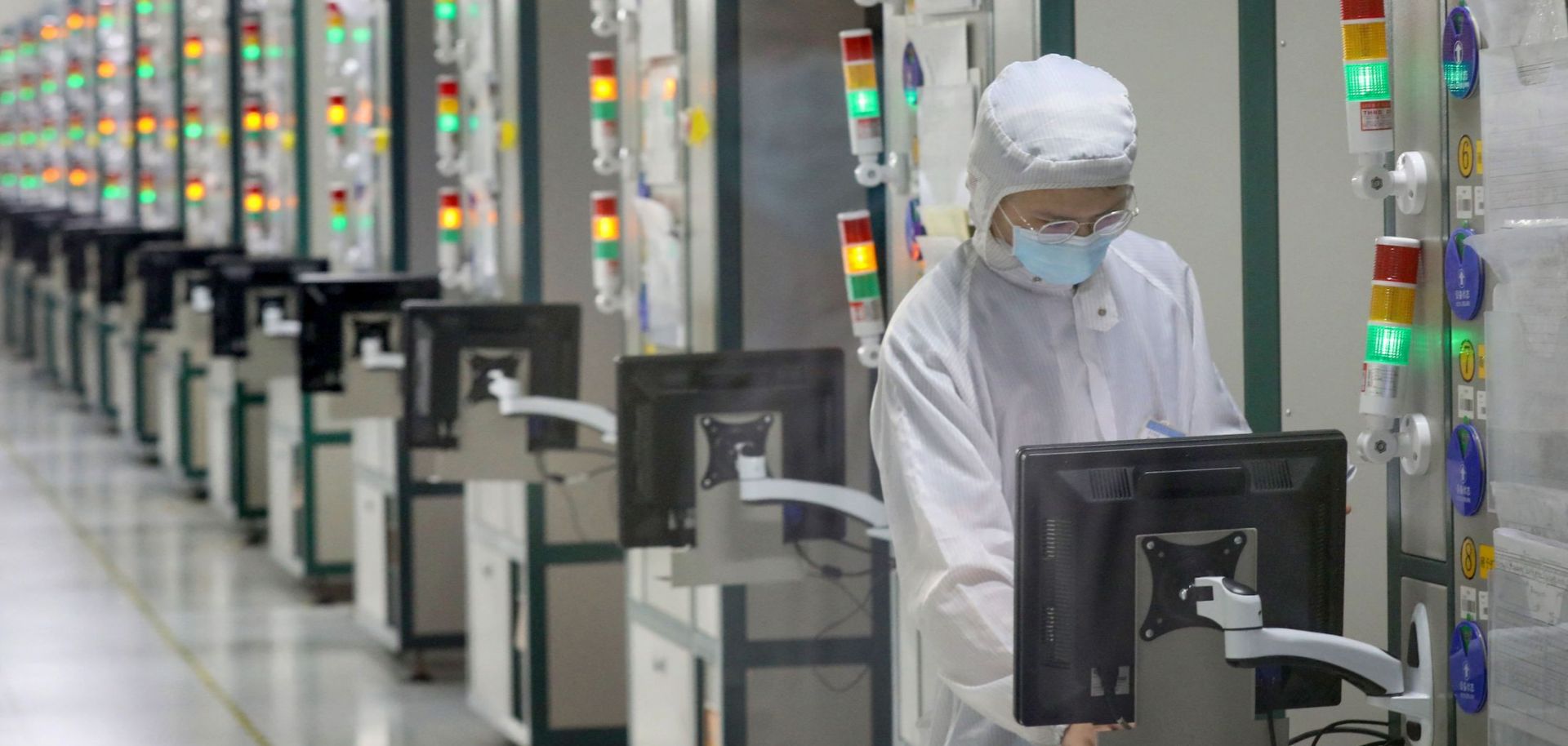
An employee works at a Jiangsu JieJie Microelectronics Co. Ltd. factory in Nantong, a city in eastern China's Jiangsu province on March 17, 2021.
New U.S. export controls on China's semiconductor industry will shatter Chinese President Xi Jinping's ambitions to close China's gap with global peers in the short term. They could also lead to more aggressive Chinese retaliation once his political leadership is cemented. On Oct. 7, the U.S. Commerce Department announced new regulations to block China's access to chipmaking technology and gear that can be used to manufacture cutting-edge logic and memory chips. The regulations also block exports to China of artificial intelligence (AI) and high-performance computing chips (i.e., chips used in supercomputers). Although the regulations have been in the works for months, the announcement came less than 10 days before the opening of the 20th National Congress of the Communist Party of China, during which Xi is expected to formally be granted a third five-year term as the Party's leader. The timing of the moves meant that China's semiconductor industry — a cornerstone sector of Xi's technology strategy — saw significant business continuity disruptions in the week leading up to the twice-a-decade political meeting, demonstrating just how little China has reduced its reliance on foreign semiconductors and associated technologies.
- The new export bans target equipment and other technology used to fabricate 16 nanometer (nm) chips using non-planar transistor architectures (such as FinFET process technology), 18 nm or more advanced dynamic random-access memory (DRAM) chips, and NAND flash chips with 128 layers or more. Foreign companies operating fabrication plants in China building such chips are allowed to apply for licenses to continue shipping equipment for such products, and some licenses have already been granted.
- In a separate Oct. 7 announcement, the U.S. Commerce Department also added 31 Chinese companies — including China's leading memory chip maker Yangtze Memory Technologies Co. (YMTC) — to its Unverified List of companies that the United States can inspect for end-use violations of export controls. In a policy shift attached to the announcement, the U.S. Commerce Department said any company that did not complete an end-use check upon request would be added to the unverified list, after which those companies — including YMTC — would have 60 days to complete such a check before the bureau would begin the interagency process of adding them to the so-called Entity List, its toughest export control blacklist.
Given the dominance of U.S.- and Western-developed technology, the new U.S. restrictions will severely disrupt China's semiconductor industry. The scope of the export controls includes lithography machines and other physical equipment needed to manufacture advanced chips, electronics design automation and other software used in designing and producing chips, as well as U.S. citizens employed as engineers and other positions. By targeting semiconductor manufacturing technology, the restrictions will likely be effective in further stymying the development of China's chipmaking sector. Indeed, a number of U.S. companies have already pulled out of China or suspended their operations in the country in just the two weeks since the new export controls were announced. While China has made progress in building some chips using a 14 nm or high-resolution FinFET process, Chinese companies have not moved these into mass production, and virtually all of the crucial chip-making equipment and software are still imported and use some level of U.S. technology. Given how some of these tools, particularly expensive advanced lithography machines, are perhaps the most advanced pieces of technology in the industry and are only manufactured by a handful of companies, China is unlikely to create a homegrown alternative this decade. China's most advanced indigenous lithography machine manufacturer, Shanghai Micro Electronics Equipment, only has a 90 nm resolution — a technology commercialized by global leaders starting in 2002. While the company has long been developing a 28 nm machine, it has suffered from delays; but even if Shanghai Micro Electronics Equipment introduces the new machine, it would still take time to scale up beyond prototyping into mass production for use in Chinese fabrication plants.
- In response to the new rules, California-based chip equipment manufacturer KLA Corp. plans to stop exporting certain supplies and services to Chinese companies, as well as the South Korean memory chipmaker SK Hynix Inc. (which has memory chip plants in China), according to sources cited in an Oct. 11 Reuters report.
- The U.S. Commerce Department's announcement has reportedly already prompted the Netherlands-based ASML Holding (which is the world's only manufacturer of extreme ultraviolet lithography machines) and the U.S.-based Lam Research Corp. to pull their U.S. engineers from China. ASML also reportedly circulated an internal memo asking U.S. employees (or green card holders) to refrain from serving customers in China, both directly and indirectly.
- Apple, which previously had been considering using YMTC's memory chips in up to 40% of its iPhones, has allegedly halted plans to source the Chinese company's chips as well, likely as a precaution in case YMTC is added to the Entity List under the Commerce Department's new 60-day requirement to complete an end-use check.
While the new U.S. rules focus on only the most advanced chips, they could also disrupt China's more mature chip industry. There are signs that the restrictions and the compliance risks associated with them are already having an impact beyond the technology directly targeted by the new rules. Even ASML — a non-U.S. company — asked all of its U.S. employees to stop serving customers in China at large while it reviews the new rules. Given how U.S. technology and employees can work on multiple projects or segments of companies at once, it will take time for ASML and other companies to put into place internal controls protecting their U.S. employees from violations. Moreover, U.S. companies like KLA Corp. and Lam Research
may struggle to service the greater Chinese market due to challenges in verifying their technologies' end use in certain cases, and may decide to cut or severely reduce their roster of Chinese clients.
- The Wall Street Journal reported that more than 40 Americans holding key executive positions in Chinese semiconductor firms, ranging from CEO to vice president to chairman, may be forced to resign or (in extreme cases) renounce their U.S. citizenship and stay in China to remain in their positions under the new rules. If their company produces any sort of advanced chip covered by the new rules, it would be virtually impossible for their jobs from that particular product set.
Companies based in other Asian countries that do not emulate the U.S. restrictions for fear of Chinese retaliation will be forced to differentiate their operations geared toward China from those servicing the rest of the world. Through the new rules, Washington is demonstrating that it is willing to expand restrictions across the board on the Chinese semiconductor industry. Just before the Commerce Department's announcement, foreign manufacturers in China — including South Korea's SK Hynix and Taiwan Semiconductor Manufacturing Co. (TSMC) — were reportedly issued last-minute U.S. export licenses that, at least for now, will allow them to continue receiving equipment and support from U.S. staff and other suppliers. But it appears those authorizations could eventually be withdrawn or not extended, meaning companies with Chinese operations will likely still start contingency planning. Moreover, U.S. restrictions on exports to China of AI and high-performance computing (HPC) chips could also be expanded in the future as cloud computing and logic chips become more advanced. Because of this, non-U.S. semiconductor manufacturing companies like Samsung Electronics Co., Ltd., SK Hynix and TSMC, as well as suppliers and vendors like ASML, will need to develop supply and production lines with minimal — if any — U.S. engineers, technology and supplies in order to continue selling to companies like SMIC. In the future, the United States may also consider expanding restrictions on leading Chinese technology companies at large, which would broaden the ban even more.
- Already, the United States has effectively cut off Chinese telecommunications giant Huawei from the advanced chip market through sweeping export bans. Washington could eventually target other leading Chinese electronics companies (such as Xiaomi Corp. or Lenovo) or cloud computing and AI firms (such as Alibaba Group Holding Ltd. or Tencent Holdings Ltd.) with similarly severe restrictions.
With little way to directly counter the impact of the restrictions, Beijing will likely instead focus on cleaning up corruption in the sector in hopes of improving efficiency. China will double down on its efforts to reduce reliance on foreign technology, but the slow pace of Chinese innovation in the semiconductor industry — whether it is due to corruption, sanctions or sheer technology challenges — will lead to intense scrutiny of the industry by China's leadership in the coming months. Even prior to the announcement of the latest U.S. export controls, there were signs that Chinese authorities had begun cracking down on leaders in the industry, ostensibly due to corruption and other challenges that undermine efficiency. Tighter government oversight, however, may do more harm than good for China's semiconductor sector, as it risks causing even more internal upheaval at a time when companies are already struggling to adjust to tighter U.S. restrictions.
- In July, Chinese leaders received an assessment that found the country's chipmakers often overstated their technological progress, pace of innovation and competitiveness with international peers. Such overstatement of success is common in China's top-down, state-led, key performance indicator-dominated economy. However, the assessment's findings clearly painted a picture to Xi and China's leadership that changes were needed. On July 30, the head of China's biggest semiconductor fund was arrested in connection with an anti-corruption investigation. According to a Bloomberg report published shortly after the arrest, China's leaders were allegedly ''unhappy'' and ''frustrated'' with the slow growth in the country's semiconductor industry, despite billions of yuan worth of state support.
More broadly, the United States' latest export controls signal a strategic shift toward using more sector-wide restrictions to slow China's rise as a technological peer, as well as a renewed U.S. focus on equating national security with economic security. Much like its predecessor, the administration of U.S. President Joe Biden's national security strategy doctrine explicitly links economic security — and specifically emerging technologies — to national security and uses it to justify restrictions. Although the United States has aggressively targeted China's semiconductor and technology industries with a raft of restrictions over the last five years, virtually all of them focused on export controls targeting a company or a small segment of the Chinese market, such as the 2019 listing of Huawei on the Entity List or developing a new list of Chinese military companies. Although Washington will continue targeting individual companies such as YMTC, which will likely be added to the Commerce Department's Entity List in the future. But the new restrictions signal that Washington will also consider more expansive restrictions, if necessary.
- On Sept. 15, the White House sent a new presidential directive outlining specific criteria for the first time for the Committee on Foreign Investment in the United States (CFIUS), which is tasked with reviewing foreign investments on national security, to use when reviewing whether a foreign investment into the United States is a national security risk. Specifically, CFIUS must take into account ''a given transaction's effect on U.S. technological leadership in areas affecting U.S. national security, including but not limited to microelectronics, artificial intelligence, biotechnology and biomanufacturing, quantum computing, advanced clean energy, and climate adaptation technologies.'' Although it continues to be delayed and remains highly controversial among U.S. business leaders, the United States appears poised to eventually adopt a mechanism similar to CFIUS to screen outbound investments, which almost certainly would adopt similar criteria and potentially block a number of investments by U.S. firms — as well as affiliates of U.S. firms — in China's semiconductor and other industries.
- On Oct. 12, the Biden administration also released its national security strategy foundational document, which explicitly stated that the United States ''must ensure strategic competitors cannot exploit foundational American and allied technologies, know-how, or data to undermine American and allied security,'' and that the administration was ''therefore modernizing and strengthening [the United States'] export control and investment screening mechanisms, and also pursuing targeted new approaches, such as screening of outbound investment, to prevent strategic competitors from exploiting investments and expertise in ways that threaten our national security.'' The document's strong language further indicates that the United States will continue to block China's access to U.S.-developed technology, regardless of the field.
In response to Washington's escalating campaign against China's chip sector, Chinese President Xi may finally be in a strong enough political position to more aggressively retaliate against the United States and U.S. business interests. Despite its trade war with the United States and Washington effectively destroying Huawei's consumer electronics business, China's retaliation against American business interests inside and outside of China has so far been somewhat limited. China's restrictions have largely focused on tit-for-tat retaliation over narrow issues, such as boycotting Nike over shunning Xinjiang-produced cotton. But during this time, China has built an arsenal of legal tools that it can use against foreign firms to pressure them and retaliate against U.S. restrictions, including the 2021 Anti-Foreign Sanctions Law and its own ''unreliable entities list.'' China has been slow to use these mechanisms, likely due to a recognition that their use is unlikely to deter U.S. moves and may only invite more, in addition to creating domestic economic disruptions and detracting from key events (including the 2022 Beijing Olympics and the current 20th Party congress where Xi is setting up his third term). But once China's new pro-Xi political leadership is in place after March 2023 and the next ''two sessions'' legislative meetings, one of those roadblocks will be removed; with Xi's political future and third term cemented and a new premier taking office, he may have the power to push through more aggressive retaliation, even if it results in limited economic disruptions at home. The other limitations — particularly China's weak economy — may moderate any initial retaliation, but the United States' latest salvo may compel Beijing to act.
- China's retaliation would likely focus on less strategic, but still iconic, foreign firms and their presence in the United States, as China would not want to alienate U.S. technology companies even further and give them even more of an incentive to divest from China. But any U.S. semiconductor firm in the process of reducing their exposure or exiting China, particularly in the wake of the new U.S. sanctions, could be targeted directly with economic restrictions or a wide range of informal tactics, such as arbitrary detentions of U.S. executives and regulatory red tape.
