
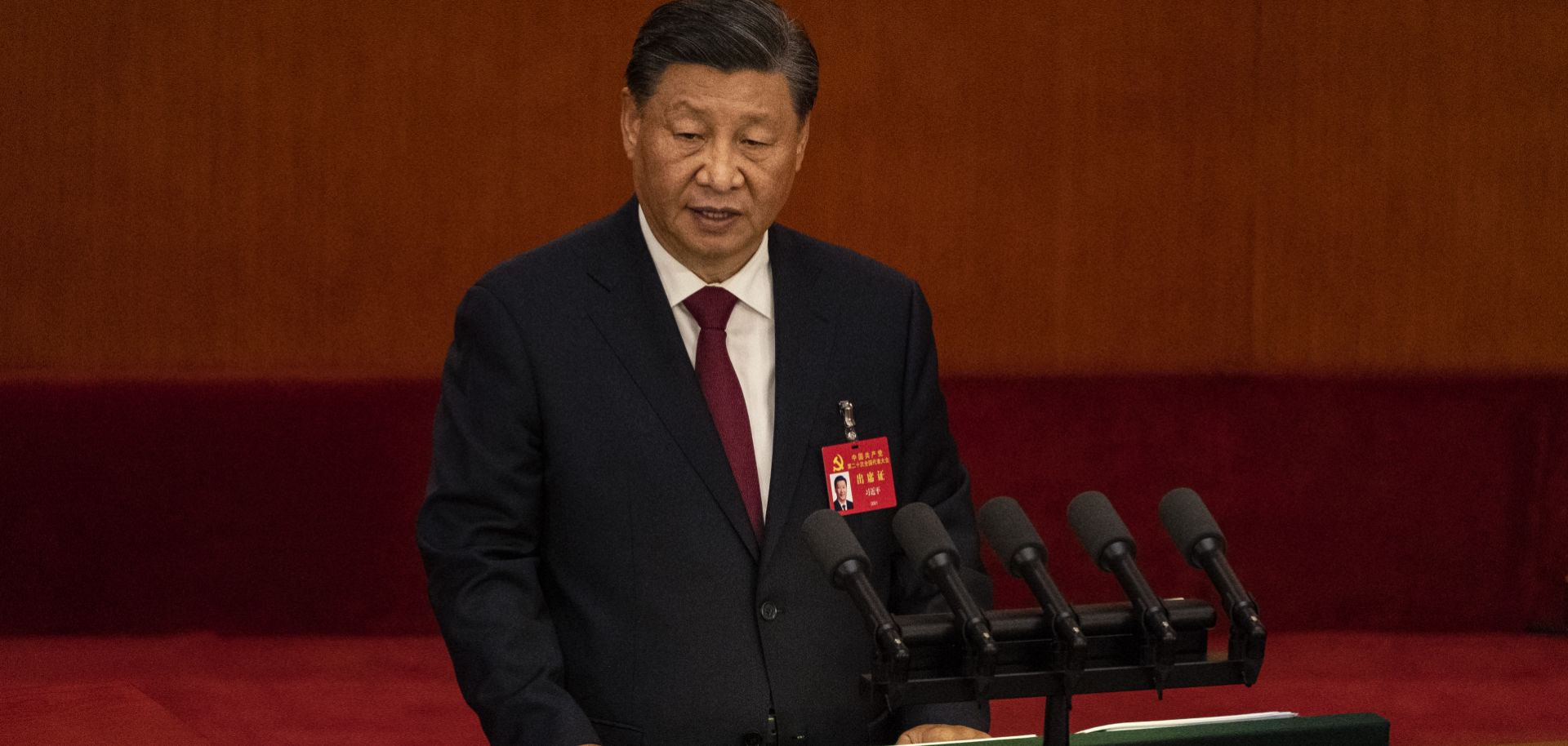
Chinese President Xi Jinping speaks during the Opening Ceremony of the 20th National Congress of the Communist Party on Oct. 16, 2022, in Beijing, China.
The work report that Chinese President Xi Jinping delivered at the beginning of China's quinquennial 20th Party Congress suggests the next five years will be characterized by a heavy-fisted approach to domestic cultural, political and ethnic affairs, as well as a siege mentality toward foreign affairs. These work reports are designed to review the Chinese Communist Party's (CCP) governing successes over the last five years and lay out high-level policy goals for the next five years. The Party Congress started on Oct. 16 and will end on Oct. 22, when its nearly 2,300 delegates will approve changes to the constitution, bolstering Xi's ideological leadership of the CCP. The delegates will also approve the new composition of the 300-400 person Central Committee, the CCP's top cadres from across the country. On Oct. 23, the first plenum of the newly minted 20th Central Committee will meet, revealing the composition of the CCP's elite 25-person Politburo and, more importantly, its Politburo Standing Committee, effectively Xi's cabinet. This lineup may also give insight into who will become the next Premier, the Chinese government's chief administrator and the CCP's second-most important official (behind Xi as the party leader). If all goes according to plan, these roles will predominantly go to Xi loyalists, perpetuating his society-wide ideological programs and national security-focused mindset toward foreign affairs.
- Since Oct. 16, congress delegates have discussed a work report by the Central Commission for Discipline Inspection (the body in charge of Xi's anti-corruption campaign) and held various closed-door meetings between provincial officials and central CCP leadership.
The report laid out a plan for continuing Xi's economic deleveraging, ongoing crackdown on corruption in the CCP, and campaign to ideologically reshape Chinese society. On the economy, Xi reiterated that ''housing is for living in, not for speculation'' in an apparent reference to China's ongoing real estate crisis following the slow-motion financial collapse of major Chinese property developers like Evergrande over the last year. He also said the CCP will ''adjust excessive income and prohibit illicit income'' and that the government should ''better play its role'' in ''guiding the development of the non-public sector.'' Together, these statements suggest that Xi's favored economic policies will persist, including reducing the amount of debt in China's real estate sector, fighting wealth inequality by slowly adjusting income distribution in line with Xi's Common Prosperity program, and letting the government play a larger role in market innovation and capital allocation.
- The work report stated Beijing would push forward with its campaign to reshape China's moral fiber in line with CCP-dictated ethical standards, with a heavy focus on promoting Marxist ideologies and socialist values in all facets of Chinese society, including the arts, education, family affairs, entertainment, the courts, cyberspace, academia and the military.
- The report also lauded the massive anti-graft campaign that has helped Xi purge the CCP of his political rivals, noting that the Communist Party ''must keep sounding the bugle and never rest…in our fight against corruption.'' This portends an even greater centralization of Party power in Xi's hands, as the ongoing crackdown — which saw 627,000 state officials punished in 2021 alone — scares more cadres into submission.
The report was notably silent on more sensitive issues related to the Chinese government's human rights abuses in Xinjiang, unreserved support of the security crackdown in Hong Kong, and its economically disruptive ''zero-COVID'' strategy. The report called out the Chinese government's notoriously strict ''zero-COVID'' policy only once, despite the significant toll that the sweeping and sporadic lockdowns have had on China's economy over the past year. Beijing also remained vague in regard to its controversial policies toward Xinjiang and Tibet, and complimentary toward its policies toward Taiwan and Hong Kong. There were no explicit mentions of Xinjiang except to say that China's campaign against terrorism was ''effective,'' nor were there any mentions of Beijing's assimilationist policies in Tibet. In regard to Taiwan, the work report did not reveal any major policy changes; instead, Beijing maintained its stance that a small cohort of ''Taiwanese separatists'' and foreign powers was attempting to interfere in China's sovereign affairs, and that while the mainland government would continue to try to resolve the issue peacefully, military force remained an option. And when it came to Hong Kong, Beijing expressed its full support of the 2019-2020 crackdown on protesters, claiming ''order [had] been restored,'' and pledged to continue promoting national security in the territory and throughout China. The report also noted that the Chinese government's ''one country, two systems'' model had been perfected, which further suggests that Beijing's heavy-handed approach to dissent in Hong Kong and other restive regions will persist.
On foreign affairs, the work report painted a picture of a CCP beset by Western ''hegemons'' intent on preventing China's rise, and seemed intended to prepare both party officials and Chinese citizens alike for a period of great economic difficulty. Based on the work report, the CCP under Xi seems convinced that contentious foreign relations — and especially U.S.-China strategic competition — will persist for the foreseeable future, and that the CCP must help protect China during this dangerous time. As part of this protection plan, multiple sections of the work report reiterated the importance of ''self-reliance and strength in science and technology,'' as well as the need for supply chain resiliency — particularly in food, energy and other crucial resources. This suggests that Chinese leaders expect a continuation of the global trade disruptions that have rattled markets in China and elsewhere over the past five years. It also indicates that Beijing will view the economy through the lens of national security and take a greater role in guiding markets in order to preserve China's ''national rejuvenation'' plans to become the world's leading superpower while fending off threats from abroad.
- The document promoted ''national security in all areas of [CCP] work'' and urged cadres to ''strengthen popular support for national security,'' highlighting the CCP's strict management of both internal developments within the party, as well as external developments within the Chinese populace, during difficult times.
- It also called for more modernization of the military, adding that China should ''become more adept at deploying our military forces'' regularly and in diverse ways, presaging greater Chinese military involvement overseas and thus a growing threat perception of China in the West.
- The report urged the CCP to brace for ''worst-case scenarios'' regarding China's economy and foreign relations (such as the enactment of greater U.S. restrictions on high-tech trade) — putting additional impetus behind Beijing's plans to reach self-sufficiency in key technologies through large-scale investment and guidance of industrial research and development.
