
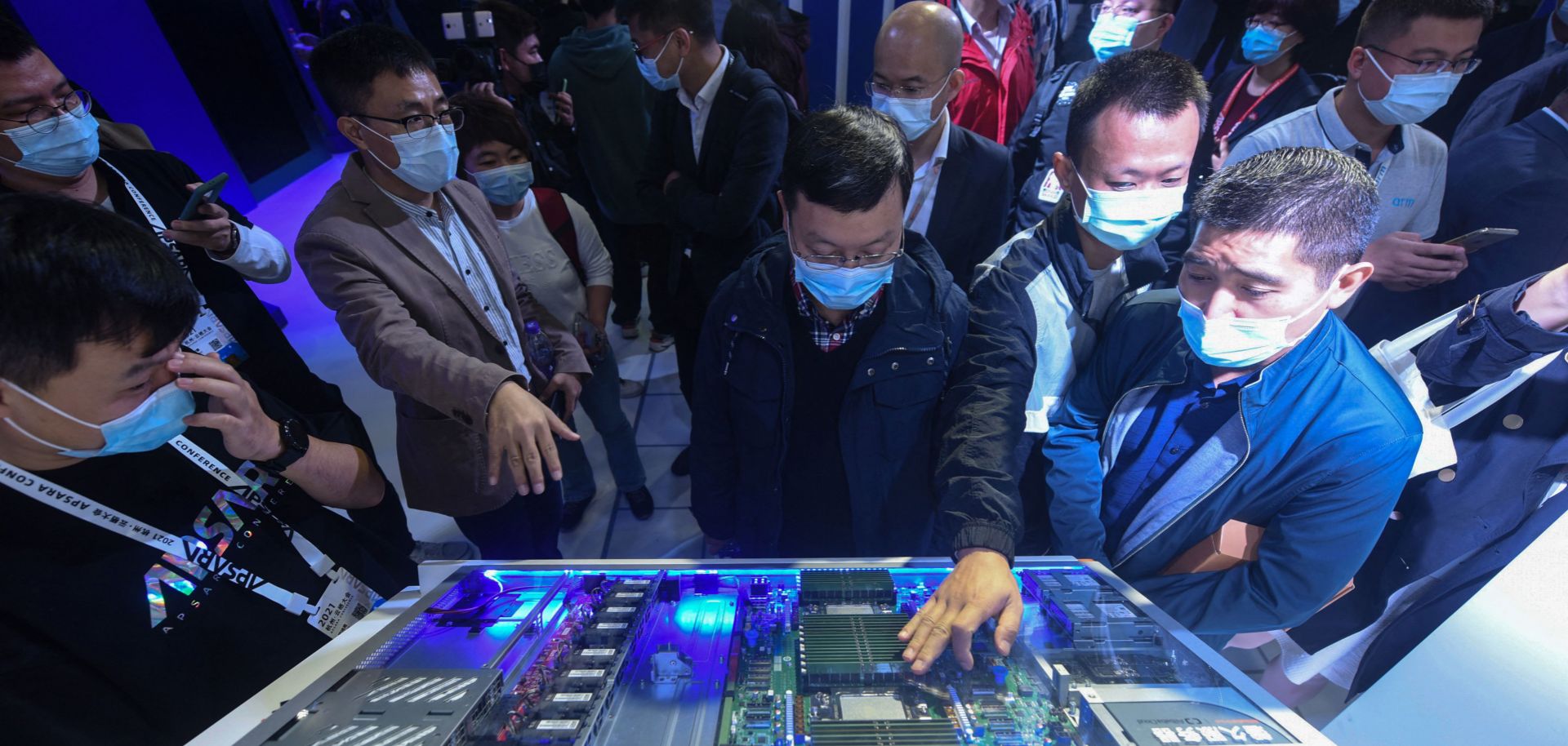
Visitors look at Alibaba's new servers at the company's annual cloud computing conference in Hangzhou, China, on Oct. 19, 2021.
Alibaba’s new server chip will help expand the Chinese e-commerce giant’s domestic and global cloud computing business. But it also marks a notable step forward in China’s greater drive for a self-sufficient semiconductor industry, which could place Alibaba in the United States’ crosshairs. At its annual cloud summit in Hangzhou on Oct. 19, Alibaba unveiled a new server chip that it plans to use to compete with rival U.S. rivals, such as Amazon and Microsoft. The ARM-based Yitian 710 chip based on a 5 nanometer (nm) process is one of the most advanced designed by a Chinese company.
- This is the third self-designed chip Alibaba has introduced since 2019, in addition to chips for artificial intelligence (AI) and Internet of Things (IoT) applications. Alibaba plans to use the new chip in its own data centers and does not plan to sell it commercially.
- Alibaba is joining other cloud computing companies like Google and Amazon designing their own custom data server chips and not relying on other companies. Its rivals in China, like Baidu, are doing the same.
Alibaba’s new chip shows that China’s domestic semiconductor capabilities are advancing, though Chinese firms still remain far behind their competitors when it comes to chip fabrication and building equipment used to manufacture chips. Success in designing chips is a necessary component of the goal Beijing set in March to reach 70% self-sufficiency in the semiconductor industry over the next decade. China’s domestic chip fabrication and manufacturing equipment industries, however, remain Beijing’s Achilles’ heel in achieving this objective. South Korea’s Samsung and Taiwan’s TSMC are currently the only two firms in the world that are capable of manufacturing 5nm chips, although the United States’ Intel will soon join them. China’s Semiconductor Manufacturing International Corporation (SMIC) taped out its first 7nm chip using its new FinFET N+1 process in late 2020, indicating China’s fabrication capabilities for more mature chips (which are important for many applications like Internet-of-Things devices) are improving, despite still being behind South Korea and Taiwan. But that was before the administration of former U.S. President Donald Trump placed SMIC on the Commerce Department’s Entity List in December, effectively blocking SMIC’s ability to buy semiconductor manufacturing equipment produced overseas. China’s indigenous capabilities in building semiconductor manufacturing equipment — which is perhaps the most technologically difficult part of the semiconductor value chain — remain even further behind international peers, with China just now beginning to roll out domestically produced 28nm lithography machines.
Should Alibaba and domestic cloud rivals Baidu and Tencent become global competitors in chip design for cloud computing, the United States may impose restrictions to slow down their advancement or prevent access to U.S. technology. The success of Chinese telecommunications giant Huawei, which led to new export control restrictions from the United States, is a cautionary tale for other Chinese tech companies. Cloud computing will face the same level of national security concerns in the United States. U.S. President Joe Biden has not formally backed Trump’s so-called “Clean Network” strategy, which identified cloud computing as a key target in limiting China’s overall involvement in global tech networks. But Biden also hasn’t substantially reduced his predecessor’s restrictions on SMIC or Huawei. If the Republicans take control of the U.S. Congress in 2022 or 2024 or win the presidency in 2024, it would portend more aggressive action against other Chinese semiconductor companies. Indeed, in July, Republican lawmakers sent the Biden administration a letter asking it to place Yangtze Memory Technologies Company — one of China’s most promising companies for building memory chips — on the Commerce Department’s Entity List. China’s own domestic crackdown on technology firms like Alibaba will exacerbate U.S. concerns about connections between China’s leading tech firms and the government, much in the same way they are concerned about Huawei.
- Huawei invested heavily into its own fabless unit, HiSilicon, ultimately enabling it to design advanced chips for smartphones, servers and 5G base stations that were globally competitive. This, coupled with Huawei’s growth in 5G more broadly, led to the Trump administration putting Huawei and HiSilicon on the Commerce Department’s Entity List, decimating Huawei’s smartphone business by cutting off its supply of HiSilicon-designed (and other) chips from TSMC. Trump argued that Huawei’s close ties to the Chinese military and the potential surveillance and national security concerns associated with its involvement in 5G networks were enough of a threat to the United States and its allies to warrant such actions — arguments that have since been echoed by Biden.
