
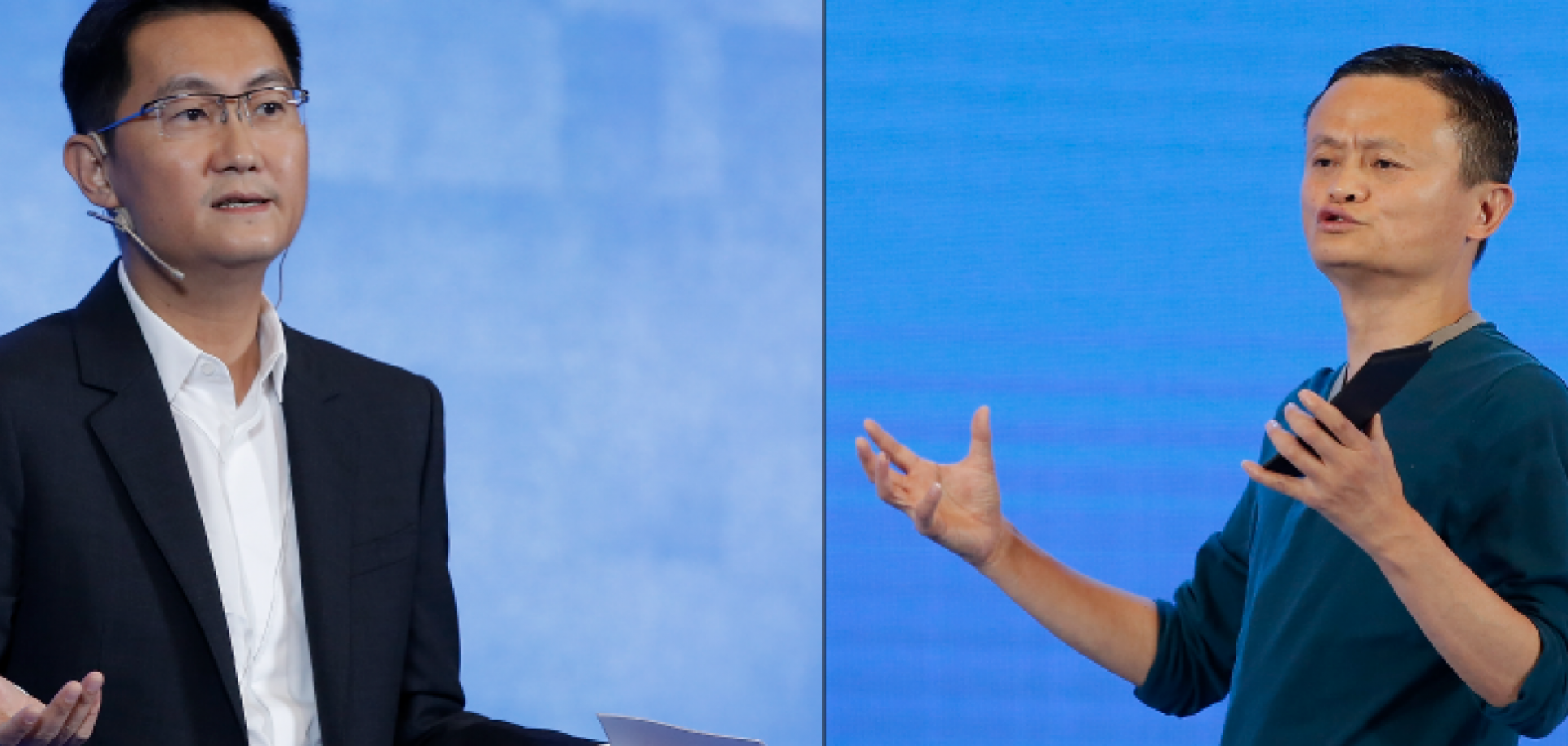
Tencent founder and CEO Huateng "Pony" Ma (L) and Alibaba co-founder and executive chairman Jack Ma have more than just a name in common: The two entrepreneurs are archrivals in China's increasingly competitive tech sector, and both have steadily expanded their companies' products and services to maintain an edge.
Alibaba and Tencent are archrivals in China's burgeoning tech sector. Having carved up the consumer internet sector — including social media, e-commerce, streaming media and mobile payments — the two tech juggernauts are increasingly expanding beyond their core operations. And in every vertical they enter they wind up in fierce competition, creating a dichotomy in the Chinese market that sometimes forces domestic and foreign firms to choose between them when launching a new product or service. The rise of the two companies has been a blessing and a curse for China. While the investment and innovation they offer have helped the economy, the sway Alibaba and Tencent now hold over China's people and economy is putting the government ill at ease. But as much as it can't afford to cede authority to these companies, it can neither afford to rein them in too tightly.
Relentless Innovation
In the internet sector, innovation can come from seemingly anywhere. And in the internet services sector — where data is going to become only more essential — it can be relentless. The dizzying pace at which new services emerge (and, with them, new opportunities to harvest data) forces internet and information technology companies to continuously adapt and expand their horizons.
Since their founding in the late 1990s, Alibaba, which started as an e-commerce site like Amazon, and Tencent, originally a media services provider, have steadily diversified their menu of products. Perhaps the most important new frontier for Alibaba has been financial services. Its original payment service, Alipay, spun off from the company in 2011 — though Alibaba retains a 30 percent stake — changed its name to Ant Financial a few years later and is now the world's largest private tech company, valued at around $150 billion. Today, the company is moving beyond original payment processing into banking and financial tech services. Tencent, likewise, has expanded its services to include the superapp WeChat, a one-stop shop for social media, messaging and mobile payments that could give Ant Financial a run for its money. In addition, both companies have ventured into cloud computing in hopes of disrupting the hegemony of Western firms in the field, such as Amazon, Microsoft, IBM and Google.
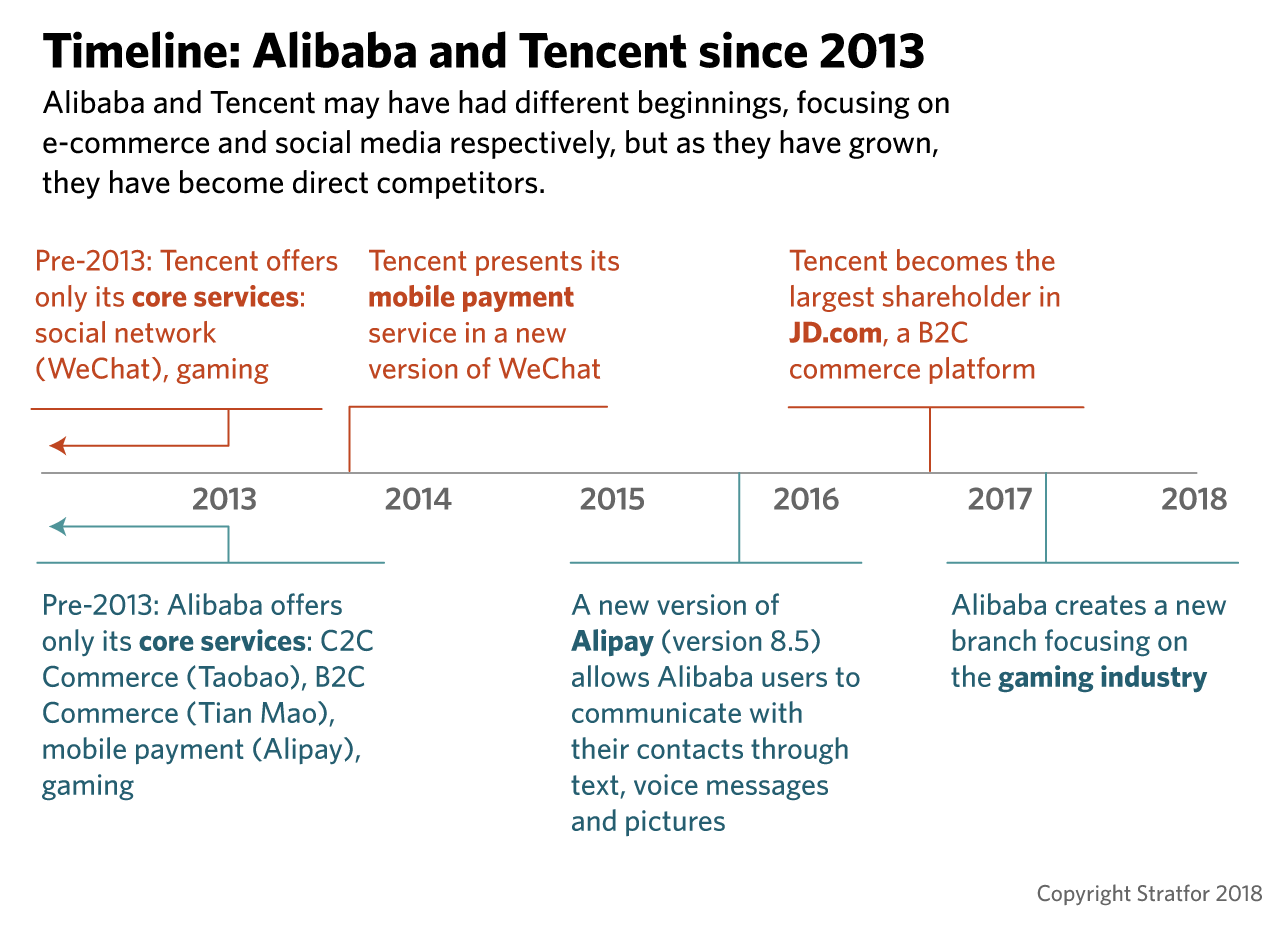
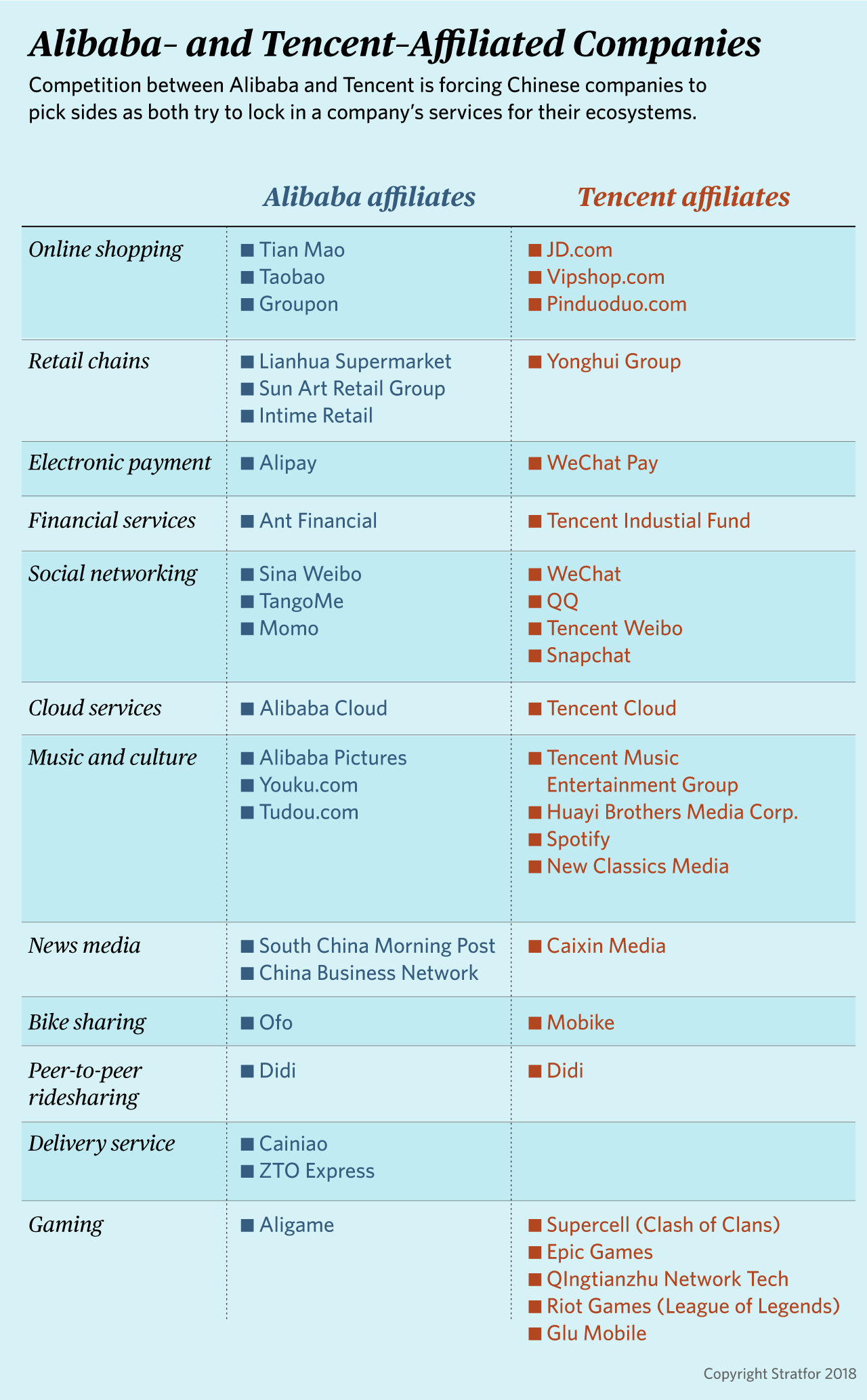
Their constant quest for innovation and expansion puts Alibaba and Tencent in competition at the ground level of emerging technologies with transformative potential for the internet sector. Part of this rivalry entails buying up tech firms that specialize in areas such as artificial intelligence, the internet of things, big data, virtual and augmented reality, and distributed ledger technology. And as online services infiltrate more everyday products and services, Alibaba and Tencent wind up vying to outbid each other in an ever-widening market. Alibaba, for example, is a leading investor in the bicycle-sharing startup Ofo, while Tencent is financing a competing service, Mobike. The result is that the two tech giants are on their way to becoming the two biggest sources of venture capital in China, together accounting for nearly half of Chinese venture capital flows. Tencent alone backs 19 so-called unicorn companies — startups valued at more than $1 billion — and recently led an $820 million funding round for humanoid robotics firm Ubtech. Alibaba, meanwhile, has invested in China's two largest AI startups, SenseTime and Megvii.
Branching Out
Given the scope of their ventures, Alibaba and Tencent are poised to disrupt a variety of Chinese industries with one of their own innovations or that of an affiliate or acquired firm. The financial services sector is one likely target. Because the state-owned banks that dominate China's heavily regulated banking sector offer little or no return on individual customers' savings, some Chinese citizens have turned to alternative ways to store their money, including the stock market and cryptocurrencies. Ant Financial and Tencent have capitalized on this trend by offering their users personal financial and banking services. In 2013, for example, Alipay (as it was known then) launched a money market platform that would allow users to move money in and out of their accounts quickly while still offering a roughly 5 percent annual return. By pooling the personal savings of all its customers, the platform, Yu'e Bao, can give users large returns on investment for the modest size of their accounts, which hold just 3,000 yuan ($435) on average. Yu'e Bao has since become the world's largest money market fund and has inspired Ant Financial — now one of the world's 10 largest internet companies — to start two additional money market funds. Tencent, not to be outdone, launched a competitor, Lingqiantong, last September.
As these new internet finance ventures have taken off, the Chinese government has found itself playing catch-up to try to regulate them. Its efforts have compelled companies in the sector to change some of their policies; Yu'e Bao announced in May that it would cap withdrawals at 10,000 yuan per day. But they have also encouraged internet finance companies to switch focus from personal finance and payments to the technologies that underpin them. Ant Financial, for example, has signed three deals with banks, including the Shanghai Pudong Development Bank, to help bring them into the digital age with technologies to support fraud prevention and risk management. In the next four years, the Alibaba spinoff plans to make financial services, which currently account for about 34 percent of its earnings, its main source of revenue.
To meet that goal, Ant Financial, and competitors like Tencent, can draw on its wealth of data and technical know-how to attract clients in the financial sector. The two firms, in fact, have used their access to large data sets to offer personal credit scoring services, part of China's "social credit" system, a program to monitor, evaluate and, in some cases, punish the behavior of citizens. Based on the information they collect on users of their online services, the companies propose to estimate the likelihood that a customer will default on a loan — a practice that is ubiquitous in the West. Ant Financial Sesame Credit and Tencent Credit were two of eight Chinese companies to set up pilot programs for a national credit system. They have yet to receive licenses for them, though, because of pushback from regulators reluctant to upend the existing government-backed credit system.
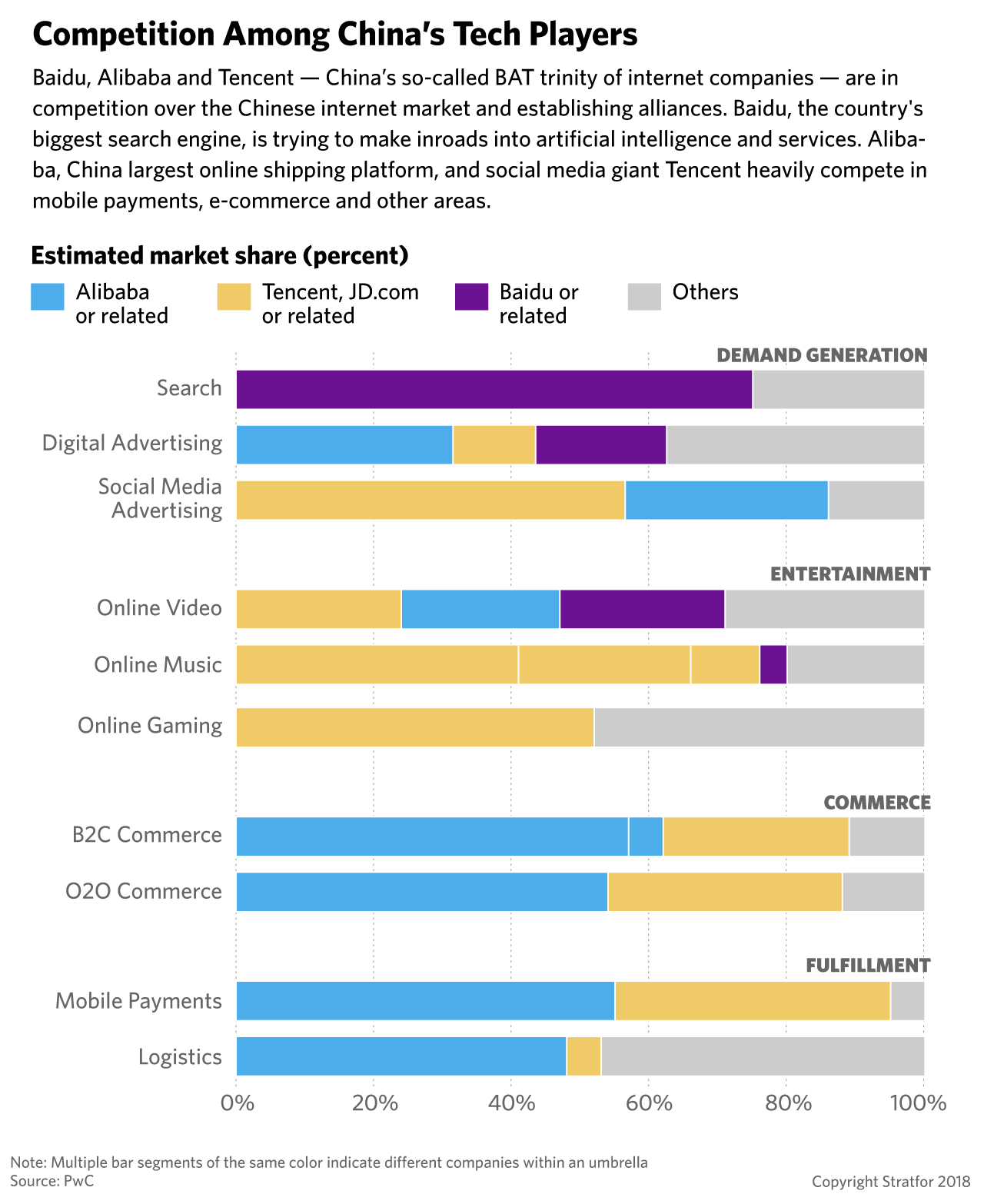
Outside the financial sector, Tencent and Alibaba are also threatening to disrupt retail with their services. Jack Ma, the founder of Alibaba, coined the term "New Retail" in 2016 to describe his company's strategy to combine "online, offline, logistics and data across a single value chain." The next year, Tencent founder and CEO Huateng "Pony" Ma (no relation) unveiled his own retail strategy, dubbed "Smart Retail," aimed at building retailers a decentralized solution that integrates new technologies. Both initiatives will strive to help digitize China's fragmented retail sector and optimize retailer operations through the use of logistics services — such as those provided by Alibaba and JD.com, a Tencent affiliate — and the companies' online platforms. They even include plans to integrate AI and virtual or augmented reality down the line. In the process, Tencent and Alibaba could optimize their own e-commerce efforts, as Amazon has done with its acquisition of grocery chain Whole Foods Market.
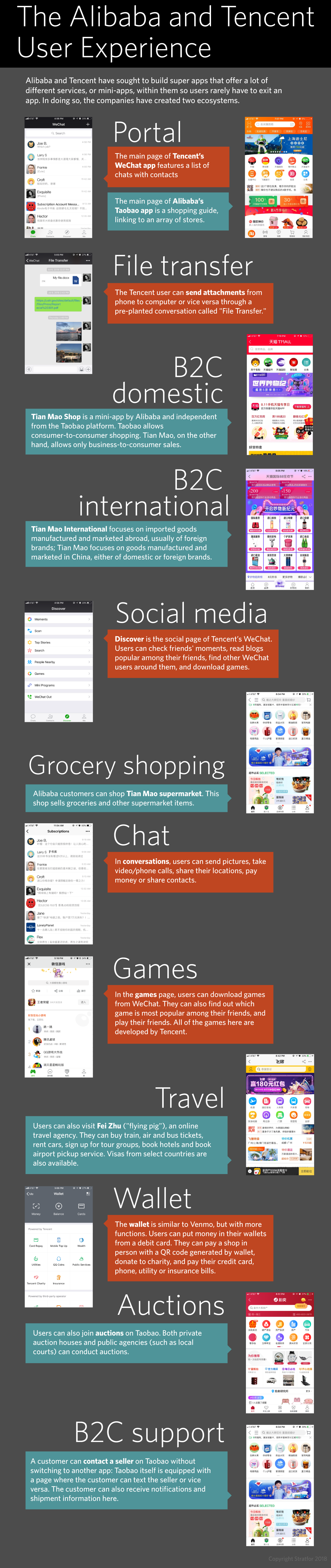
Too Big for Beijing to Handle
For Beijing, Tencent and Alibaba's steady conquest of the Chinese economy is a cause for concern. That two companies control so much of China's venture capital, along with the large investment funds they manage and the array of industries they're involved in, has given their leaders considerable clout — more even than newer members of the Politburo Standing Committee command. Alibaba and Tencent are so powerful, moreover, that the direction Jack and Pony Ma take them in will shape China's future economy. To maintain its unrivaled control over the country, Beijing already has stepped in to regulate the companies' activities in the banking sector, albeit belatedly, and keep them from overturning the traditional banking sector. The Communist Party will probably take more measures in the future to check their growth.
At the same time, however, the Party doesn't want to stifle Tencent and Alibaba, which are crucial for China's economic development and its efforts to move toward a more consumer-oriented model. And the United States' focus on undermining Beijing's tech and industrial policy, the Made in China 2025 program, may make the Chinese government even more reliant on entrepreneurs such as Jack and Pony Ma to fulfill its long-term economic goals. It's a tricky predicament for Beijing. The government has so far tried to keep the companies in line by ensuring that they have no reason to buck the Communist Party or disturb the social order. To that end, Beijing has given Tencent and Alibaba wide latitude to innovate, coming in to regulate the results of that process only after the fact.
The larger China's tech giants get, the harder it will be for the government to keep them under its thumb. Nevertheless, Tencent and Alibaba will remain central to China's internet sector, and, by extension, to government policy. The battle between the two companies, meanwhile, will rage on, driving consumers and investors alike to pick a side.
