
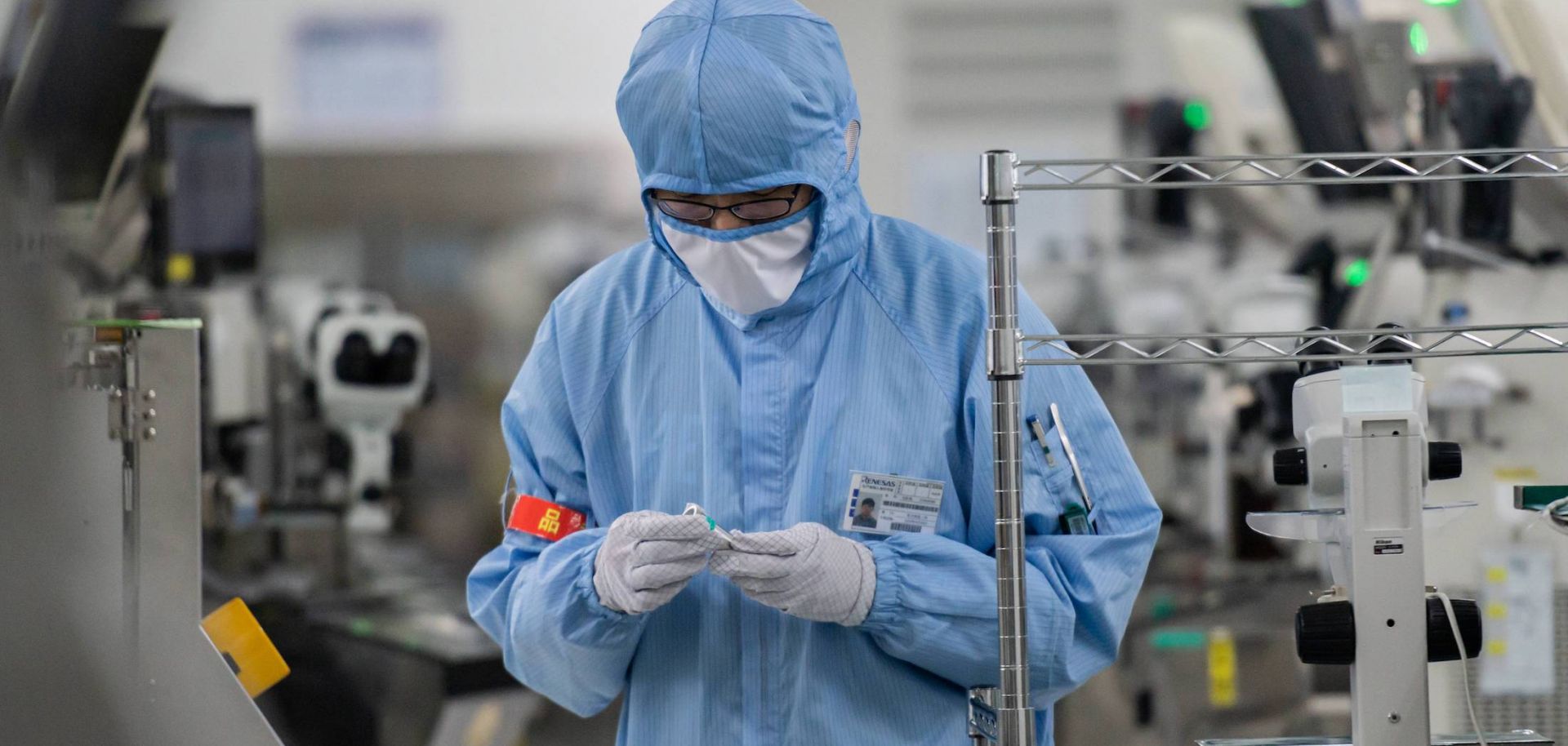
A worker is seen inside the production chain at Renesas Electronics in Beijing, China, on May 14, 2020.
The United States’ move to cut off exports to China’s top chipmaker will impede the company’s manufacturing capabilities, while pushing Beijing to further prop up its domestic semiconductor industry. On Dec. 18, the U.S. Commerce Department announced it was adding over 60 companies, including China’s Semiconductor Manufacturing International Corporation (SMIC), to its entity list, which will effectively bar these companies from accessing U.S. technology by increasing export controls.
- U.S. companies will now need a special license from the Commerce Department before exporting any products, services or technology to SMIC and the other newly blacklisted companies. Requests for such licenses will be subject to the presumption of denial. The jurisdiction of such controls also covers exports by other countries that use U.S. components and technology.
- On Dec. 3, the U.S. Pentagon also added SMIC to its list of Chinese military companies, which will restrict U.S. investment into the company beginning in November 2021.
Severe restrictions on Chinese firms like SMIC and Huawei will likely remain in place under U.S. President-elect Joe Biden, who will seek to maintain — and potentially even widen — his predecessor’s politically popular crackdown against Chinese tech. Aggressive action against China’s tech sector has become an increasingly bipartisan issue in recent years. The Biden administration may shift future action to focus less on specific Chinese companies and more on specific sectors or technologies. But it will be under significant political pressure to keep Huawei and SMIC on Washington’s export blacklist.
- Huawei’s addition to the Commerce Department’s entity list in April 2019 took an immediate toll on its business, which has since been made worse by Washington’s move to expand the jurisdiction of the export controls earlier this year.
- In August, the Associated Press reported that Huawei would soon lose access to advanced smartphone chips, which only a few companies in the world manufacture.
- On Sept. 15, Huawei stopped producing its top-of-the-line Kirin processors and AI chips after new U.S. export restrictions went into effect that barred its key customer, Taiwan Semiconductor Manufacturing Company (TMSC), from purchasing Huawei products.
- Since being added to Washington’s entity list, Huawei has had to lobby the U.S. government for some older generation chips to be sold for smartphones and other American businesses.
U.S. export controls may have a narrower impact on SMIC, as its business faces less international competition compared with Huawei. But it will still hit the SMIC’s expansion plans and damage China’s overall strategy to develop its indigenous semiconductor industry. SMIC is China’s largest and most capable semiconductor manufacturer. And while it remains behind technology-leading peers like Taiwan’s TSMC and South Korea’s Samsung, SMIC has been gaining ground in recent years. In October, SMIC announced it had taped out its first chip using its new N+1 “7 nm” process, putting it closer to its rivals. But it is unclear how long it will take for SMIC to transition to mass production of these chips, and doing so will likely require the use of imported machinery — specifically deep ultraviolet (DUV) lithography systems — that will now be all the harder to acquire, thanks to Washington’s new restrictions.
- SMIC’s current medium- and long-term technology roadmap includes the use of more advanced extreme ultraviolet (EUV) systems, which are manufactured by the Dutch semiconductor company ASML. In 2019, SMIC purchased one of these systems, but its delivery has since been delayed by Dutch authorities and ASML amid U.S. pushback.
- As the United States tries to block foreign-produced chips from entering China’s market, the extent of the impact of U.S. export controls on SMIC’s technology roadmap will also be significant for Chinese consumers by robbing domestic tech companies of one of their only remaining avenues for evading U.S. restrictions.
- China already has plenty of incentives to provide as much financial support to its tech companies, particularly in the semiconductor industry. But increasing U.S. pressure and the recent targeting of SMIC will only reinforce that push. China will, in turn, will take broader action regarding increasing funding for its semiconductor companies, while also pushing for them to outbid competitors like TSMC for engineering talent.
