
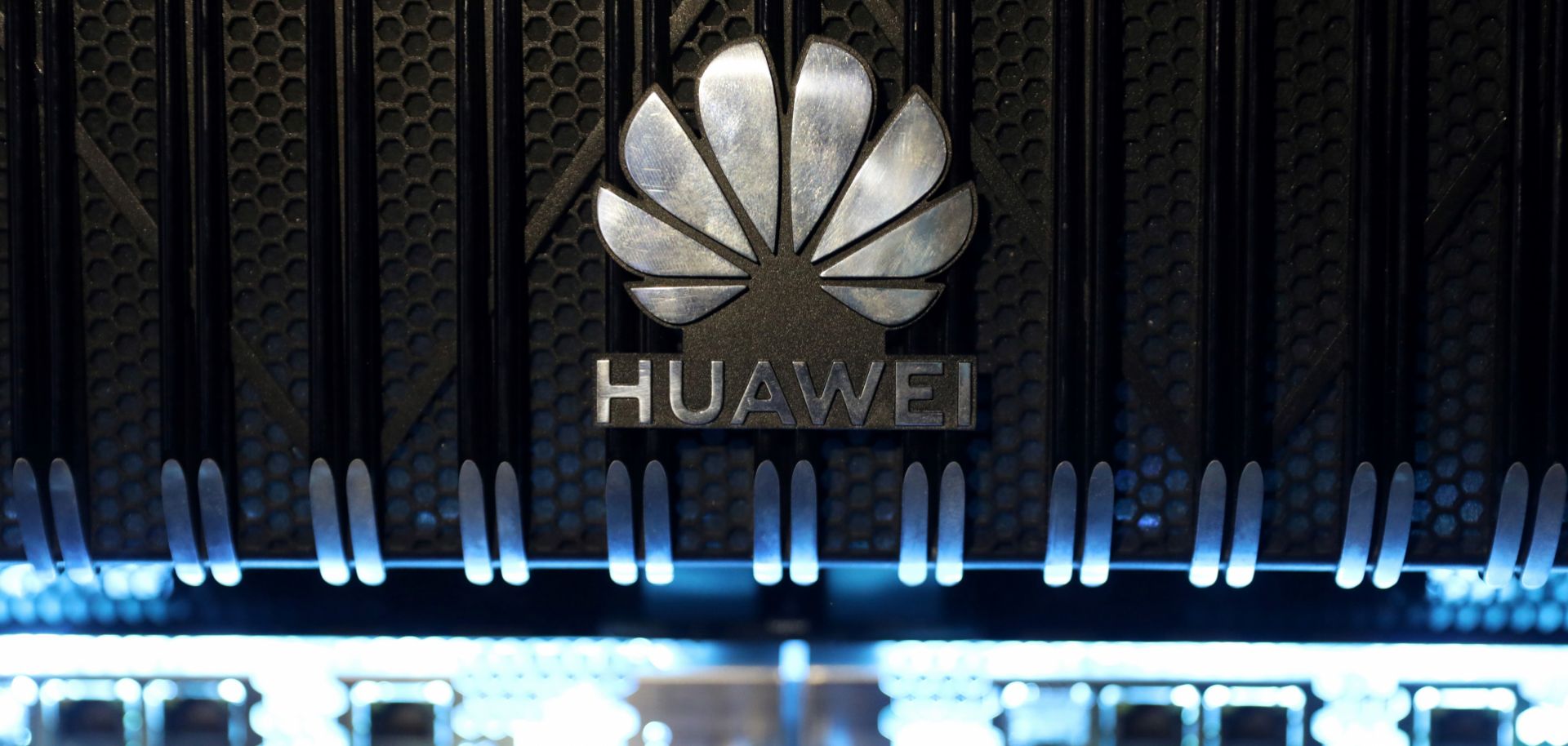
The Huawei logo is pictured on a router during a 5G event in London on Feb. 20, 2020.
Escalating U.S. actions against Huawei will only motivate China to pump its domestic technology sector with even more funding and talent, which will in turn prompt the United States to impose more restrictions on international companies doing business with Huawei and other Chinese firms that pose a threat to its global tech dominance. This will result in a cat-and-mouse game in which Washington deploys whatever financial and diplomatic tools are at its disposal to close any loopholes that China and Chinese tech companies can exploit to better compete with the West.
Exposing China's Vulnerabilities
The latest round of U.S. escalation against Huawei effectively deals a death blow to Huawei’s ambitions to compete with the chip design arms of Intel, Samsung, Apple and others for the most advanced semiconductors — at least, for the time being. The Chinese telecommunications giant has already been forced to delay production for its next flagship smartphone as it reassesses its supply of semiconductors.
- In May, the United States imposed restrictions banning any semiconductor manufacturer using U.S. technology from building chips designed by Huawei’s semiconductor design unit, HiSilicon.
- HiSilicon has become one of the most competitive firms in the world for designing advanced chips for smartphones, tablets, 5G equipment and other applications
- Huawei does not manufacture the chips that HiSilicon designs and is largely reliant on the Taiwanese firm, Taiwan Semiconductor Manufacturing Company (TSMC), to produce the firm’s most advanced smartphone chips.
- But like nearly all of the world’s major chipmakers, TSMC uses manufacturing equipment with American technology. The new round of U.S. restrictions has thus effectively cut off Huawei’s access to chips designed by HiSilicon.
Going Beyond Huawei
Although its actions have so far been focused on Huawei, the United States will likely impose similar export controls and sanctions against any other Chinese company that grows to challenge Washington and the West’s dominance in semiconductor manufacturing.
- The United States’ stated concern with Huawei is its suspected ties to the Chinese military and intelligence apparatus. Similar to the United States (where American tech firms such as Google, Microsoft and other U.S. technology firms all multibillion-dollar contracts from the U.S. military), virtually every Chinese semiconductor and IT company of any significance also has business ties and contracts with China’s national security and/or intelligence organizations, including the People's Liberation Army.
- But a secondary and just as important concern is that Huawei and China have the stated goal of matching and eventually passing the United States and other countries in the global technology sector. The growth of China’s high-tech sector poses a direct threat to the United States’ future economic and industrial success, which is deeply dependent on maintaining its current dominance in the global technology market.
- The United States has already begun enacting similar export controls and other punitive measures on other Chinese technology companies, including artificial intelligence firms such as Megvii. Other Chinese companies that could find themselves targeted in the future include software heavyweights, such as the internet search giant Baidu, and larger chipmakers such as Semiconductor Manufacturing International Corporation (SMIC).
These U.S. actions will further compel China to improve its own semiconductor and high technology capabilities by expanding its efforts to attract international talent and experts, exacerbating “brain drain” from places like Taiwan.
- China will continue to set up more state-backed funds, such as the $29 billion National Integrated Circuit Industry Investment Fund that launched last year, to invest in domestic semiconductor companies.
- Chinese companies will take advantage of government loans, grants and cheap financing to offer lucrative salaries to talented engineers, designers and other critical professionals in the sector who are currently concentrated in Taiwan, South Korea, Japan and the United States.
- An estimated 3,000 engineers previously employed in Taiwan are already working in China’s semiconductor industry, according to a December report released by the island’s Business Weekly.
- SMIC, China’s largest domestic chip manufacturer, is also reportedly doubling the scale of planned share sale later this year, and now aims to raise $7.5 billion to fuel its own growth and acquisitions.
A Moving Target
This U.S. strategy, however, will gradually become less effective in both countering China’s domestic technological ambitions, as well as limiting Beijing’s access to the international tech market.
- The United States pressure campaign is forcing companies to adapt to a more complicated legal and regulatory environment. While complete supply chain fragmentation is unlikely, companies including Samsung are already starting to develop production lines that limit the use of American technology in order to protect sales of certain products to China.
- To achieve its desired goal of limiting China’s tech rise, this means the United States may eventually be forced to rely more heavily on other means. This could include increasing diplomatic pressure on governments, as it did to prevent the sale of Dutch-made extreme ultraviolet (EUV) lithography machines to China’s SMIC in 2019, or potentially even resorting to more heavy-handed secondary sanctions.
