
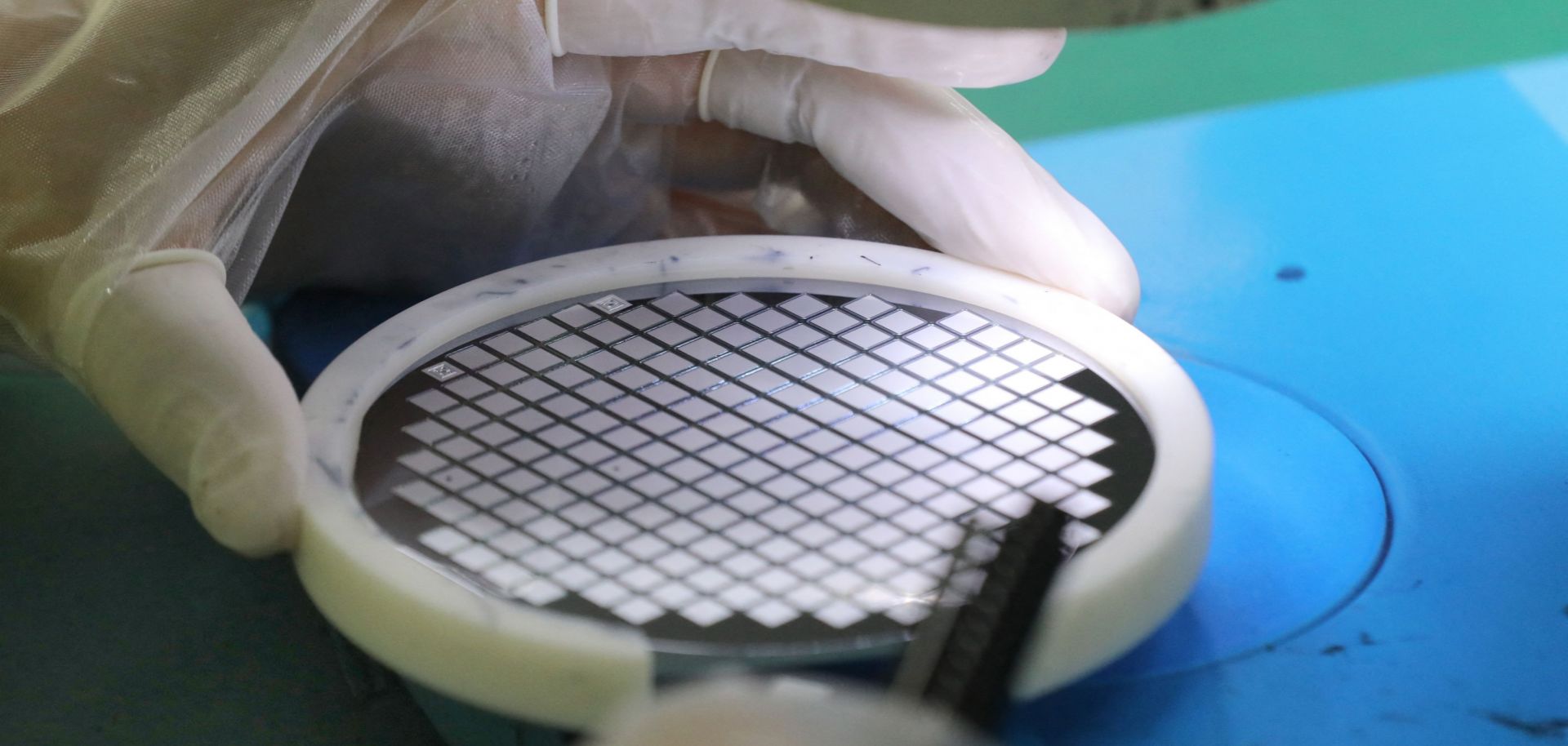
An employee makes a chip at a factory owned by the Jiejie Semiconductor Company in Nantong, China, on March 17, 2021.
If the United States succeeds in curbing China’s access to advanced semiconductor manufacturing equipment, Beijing’s chip ambitions will suffer a major setback. This risk will likely prompt China to retaliate against countries backing Washington and take more brash moves to violate related Western patents. According to a Bloomberg report published on July 6, the United States is now seeking to cut off China’s access to deep ultraviolet lithography (DUV) machines, which are used to make advanced semiconductor chips, as part of Washington's broader effort to counter Beijing’s growing technological prowess. During a recent trip to Belgium and the Netherlands, U.S. Deputy Secretary of Commerce Don Graves reportedly asked Dutch officials to block the semiconductor equipment company ASML Holding NV from exporting argon fluoride immersion lithography (ArFi) machines, the most advanced type of DUV technology, to China. Sources cited in the same Bloomberg report said the United States is also pressuring Japan to implement similar export restrictions on Nikon — the only other company in the world that produces these machines. If Washington is successful in blocking sales of DUV equipment to China, Beijing will be forced to rely on older, less efficient technology, which will significantly delay its efforts to become a leading player in the semiconductor market.
- The Dutch company ASML is the world’s largest producer of lithography machines and has a near-monopoly over the most advanced machines. In 2021, ASML owned 95% of the global market for immersion lithography machines, with Japan’s Nikon owning the other 5%. Immersion lithography machines are less advanced than extreme ultra violet lithography machines, which only ASML produces.
- In response to the recent Bloomberg report, Chinese foreign ministry spokesman Zhao Lijian accused the United States of “technological terrorism,” but did not say how Beijing would respond to any potential action.
The Biden administration’s aggressive push to cut off China’s access to Western technology comes amid a Chinese buying spree for DUV machines during the semiconductor shortage. While not the most advanced in the market, the chips that DUV machines help produce are used in a number of applications, including the automotive industry, power management, memory chips and smart devices. In recent weeks, there have been signs that the semiconductor shortage is easing, largely due to a collapse in cryptocurrency prices and reductions in orders over fears of a global recession. But the shortage is most acute among older chips, including mature and intermediate nodes, that DUV machines produce. For the last six months, Western chipmakers like Intel have complained that the semiconductor shortage is now being exacerbated by a shortage of semiconductor equipment needed to build out capacity, giving Washington even more of an economic incentive in addition to strategic incentives to place restrictions on Chinese companies buying machines necessary to build out capacity.
- In March, ASML’s CEO warned that the shortage of equipment would last into 2023 and 2024 and that the company needed to build out its production capacity by 50%, which would take time. Since then, some U.S. chipmakers have complained that Chinese companies — likely at the behest of China — are willing to pay higher than market prices for lithography machines.
The Dutch government is unlikely to block all ASML exports of DUV machines to China, but may agree to restrictions that only apply to certain Chinese companies. The United States has argued that the sale of advanced lithography machines to China represents a national security threat, as they could be used to produce semiconductors that could be used in military applications. Citing these concerns, the United States successfully convinced Dutch officials in 2018 to ban ASML from selling China extreme ultraviolet lithography (EUV) machines, the most advanced lithography machines in the world that only ASML produces. But Washington will likely have less success in lobbying the Netherlands to ban all of the company’s exports of DUV equipment to China for several reasons. For one, DUV machines are less advanced than their EUV counterparts, and thus pose less of a national security threat. ASML is also not the only supplier of DUV machines, meaning a ban affecting only the Dutch company’s exports would not keep Beijing from getting the equipment elsewhere (namely, from Japan’s Nikon). And lastly, for financial reasons, ASML has long opposed U.S. restrictions on selling equipment to China. ASML and the Dutch government will likely point to these arguments to push back against Washington’s pressure to block DUV exports. In response to such resistance, the United States is unlikely to enforce a full ban through secondary sanctions or more aggressive restrictions. Indeed, the fact that Washington is in talks with the Netherlands suggests a willingness to compromise on the issue. In lieu of a full ban, the United States could, for example, agree to a restriction that only applies to China’s leading state-owned enterprises, like SMIC. This would be similar to U.S. export controls on advanced machines sold to SMIC.
- In a report released in February, the United States-China Economic and Security Review Commission warned that China posed a serious threat to American economic and national security, in part because of its “unprecedented” investments in semiconductors and other advanced technology. The commission urged the United States to take a number of steps to counter China’s advances, including expanding export controls, strengthening the nation’s semiconductor industry and developing new technologies to offset China’s edge in the market.
Even narrow restrictions would disrupt China’s chip ambitions and lead to Beijing retaliating against the Netherlands, the United States and technology companies. Narrow restrictions on SMIC and other state-owned or domestic Chinese companies would cut off SMIC’s attempt to expand its manufacturing capacity in intermediate and more advanced nodes. Due to its inability to buy EUV machines, SMIC is hoping to use DUV technology to produce 7nm chips, which will put the company close to the cutting edge of companies like Taiwan Semiconductor Manufacturing Company, Intel and Samsung because they will enable Chinese companies to build semi-advanced chips for smartphones, computers and other applications with fewer fears of U.S. restrictions. But without access to DUV machines, Chinese companies have few alternatives because China’s domestic semiconductor equipment manufacturing is largely negligible. The semiconductor manufacturing equipment industry is the most technologically advanced, making it more difficult for Chinese companies to catch up and leapfrog technology generations. This will result in China expanding support to domestic producers, including allowing them to more readily violate international IPs covering technology, poaching semiconductor talent abroad and carrying out industrial espionage to fill in the gaps. Still, even with substantial financial and political support, Beijing will be reliant on U.S. technology policy for at least the next five-to-ten years. Any decision by the Netherlands to block exports will give Beijing cause to pressure Dutch companies — even those unrelated to ASML — that are active in China, as well as potentially restrict trade and investment with the Netherlands.
- China’s only noteworthy lithography manufacturer is Shanghai Micro Electronics Equipment (SMEE), whose most advanced machines only have a resolution of 90nm — ancient technology by ASML’s standards. While SMEE planned to introduce a machine capable of manufacturing 28nm chips in late 2021, that timetable has slipped.
- In its 2021 annual report released in February, ASML warned that Chinese firm Dongfang Jingyuan Electron — a part of China’s “Little Giants” startup program designed to boost innovation in strategic sectors — was affiliated with a previous Chinese company that ASML won $845 million dollars in a trade secrets suit in 2019.
Although unlikely, a full export ban would be even more problematic for China and provoke more expansive retaliation. While a narrow ban will curb domestic Chinese companies’ ability to build out their semiconductor manufacturing capacity, a blanket ban on exporting all DUV equipment to China will complicate, and even prevent, plans by non-Chinese semiconductor manufacturers to build fabs in China. Some members of the Biden administration likely also see a cut-off of DUV technology exports to China as a way to deter private sector investment in China’s semiconductor industry. A broader restriction on DUV technology exports could deter investment or expansion in China by foreign companies. It would effectively further decouple China from the global semiconductor value chain as well, at least in critical segments. Such a blow to Beijing’s chip ambitions would, in turn, give China all the more reason to retaliate in kind, potentially more directly against U.S. interests. Beijing could, for example, restrict exports of critical materials, like rare earth elements, to the United States. China could also place a large number of U.S. firms on various sanctions and export control lists that it has laid the legal groundwork for over the last three years.
- In 2021, South Korea’s SK Hynix, one of the world’s largest producers of DRAM memory chips, halted planned upgrades to a memory chip fabrication plant in China. While not a Chinese company, SK Hynix had intended on installing EUV machines at the plant amid challenges in getting the Biden administration to back exports of EUV technology to China.
