
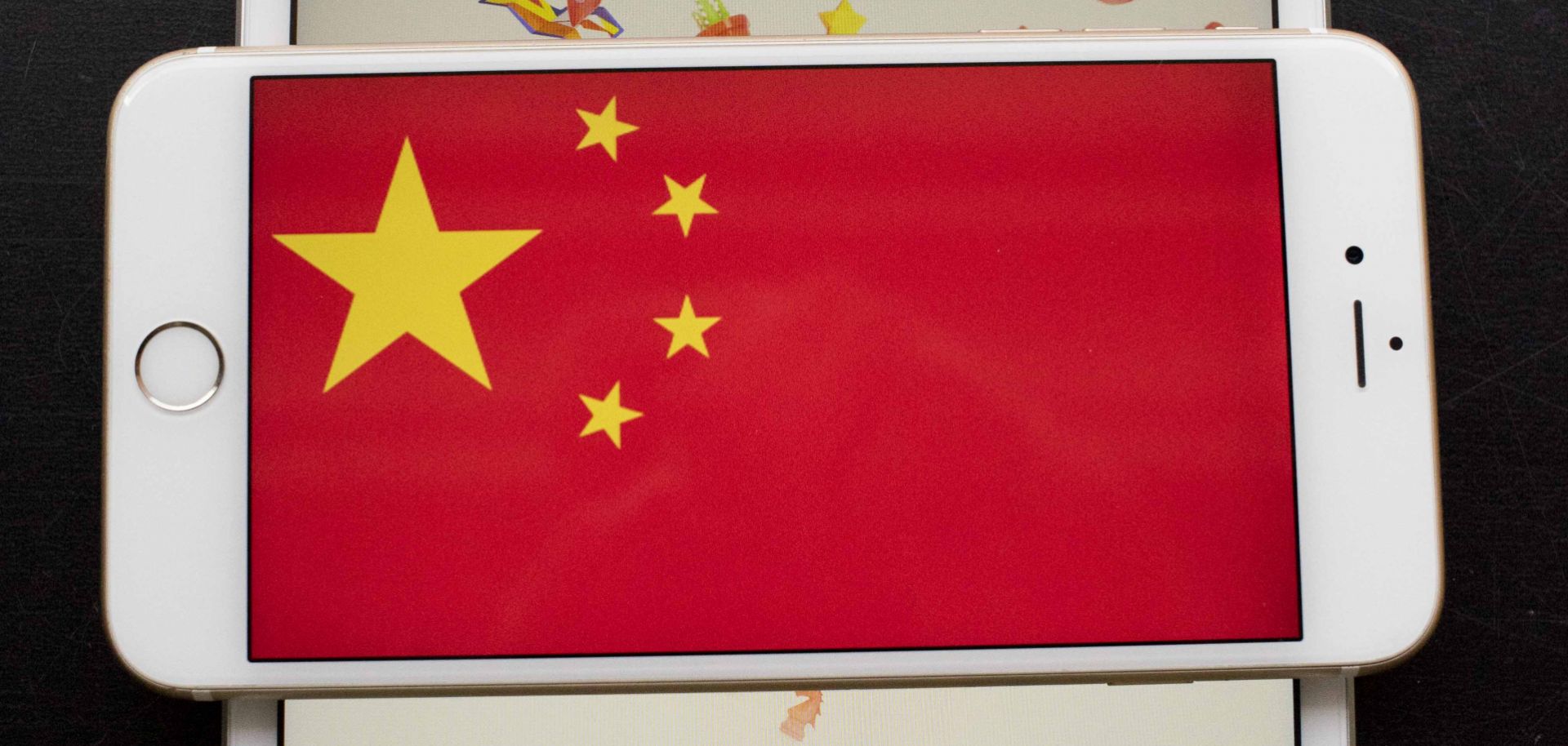
The Chinese flag is seen on a display of an iPhone in Hong Kong.
Amid pressure from the government, social media companies in China are now effectively deputizing ordinary citizens to report on those who profess unorthodox views online. This will make China even more of a black box for business operations by further obscuring one of the only remaining windows into Chinese society at a time when the country is experiencing rapid policy change. On May 4, Reuters reported that Chinese citizens have been converting social media content about the Shanghai lockdown into sharable non-fungible tokens (NFTs) that cannot be deleted in order to protect such content from being censored. These efforts follow an April 27 report published by Trivium that Chinese social media platforms were planning to launch a new campaign against ''historical nihilism'' that encourages users to report other users who insult Marxism or China's current or past leaders, dispute or spread rumors about China's history, criticize China's culture, and/or ''whitewash'' Western history. In China's opaque legal environment, users reported under the new campaign could face censorship, political persecution, jail time, and even career setbacks under the legal charge of ''picking quarrels and provoking trouble.'' This push to have social media users police each other is part of Beijing's escalating efforts to censor online content related to not only the Shanghai lockdown, but sensitive economic topics and inconvenient discussions about China's policies, political history and geopolitics.
- According to the Reuters report, nearly 800 of the NFTs created by Chinese citizens have included a video called The Voice of April, which features a compilation of audio clips of citizens (including local officials) expressing grief, hardship, or anger at the ongoing lockdown. The video was also able to dodge censors for days as citizens reshared it in a grassroots anti-censorship effort before authorities eventually took it down.
- On May 3, a popular Chinese economist and blogger named Hao Hong had his WeChat and Weibo accounts taken down after he posted ''Shanghai: zero movement, zero GDP'' on March 31.
- On April 30, What's on Weibo reported that at least five Chinese social media platforms, including the micro-blogging application Weibo, had begun requiring users to show their location – based on the IP address – on their profiles. Weibo claimed the measure was intended to encourage a ''healthy and orderly discussion atmosphere'' — a phrase commonly used by the Chinese Communist Party (CCP) in reference to nurturing pro-China and pro-CCP content. But many users of these social media platforms think the new location sharing requirements are more aimed at keeping track of dissenters.
- Over the past year, the Cyberspace Administration of China (CAC) has been implementing a campaign to ''clean up'' the internet. Along with targeting fraud and obscenity online, the campaign urges Chinese tech firms to cleanse their platforms of ''bad information,'' create a ''positive online atmosphere,'' and curb the ''spreading [of] rumors, splicing and stirring up old news, and misleading of public perception.'' These phrases tend to be Chinese government-speak for silencing dissent and other unorthodox opinions about current events.
Chinese authorities are attempting to remove critical or unflattering content from the internet ahead of a key CCP meeting, as Chinese social media platforms try to save face amid Beijing's expanding crackdown on tech companies. Chinese President Xi Jinping is aiming to shore up the social media environment to provide a positive and uncontroversial canvas for the propaganda apparatus ahead of China's 20th Party Congress in late 2022, during which he'll begin his third term — breaking with 40 years of tradition of a two-term limit. Xi, however, faces growing criticism abroad and at home due to his administration's ''zero-COVID'' strategy (which aims at extinguishing new clusters of infections as soon as possible through strict lockdowns), as well as Beijing's support of Russia in its war in Ukraine, China's growing unemployment rate and stumbling real estate sector, and Xi's ongoing crackdown against Chinese tech firms. Beijing's crackdown on the country's domestic tech sector, in particular, has left many of China's largest firms shedding jobs at an alarming rate. According to a TechNode report, Chinese tech firms have laid off over 72,000 workers since July 2021. These companies now have fewer workers to run various operations, including censorship. At this time of high political sensitivity, strong government intervention in entertainment and decreased revenues, social media firms thus appear to be trying to protect themselves from further government scrutiny and financial harm by leveraging their users to assist in Beijing's efforts to ''clean up'' online content.
Further tightening restrictions on social media will make gathering risk intelligence on the Chinese economic, social and political situation more difficult, resulting in less informed investment decisions, less reaction time to supply chain disruptions, and greater physical security risks. Up until recently, China's social media space had allowed for some nontraditional viewpoints to be aired, at least until they gained too much of a following. But over the past few years, Chinese social media platforms have become increasingly overrun with government-paid trolls, rent-seeking nationalists and CCP sycophants, along with politically neutral content about pop culture news that is nonetheless heavily scrutinized. If platforms successfully deputize (or worse, monetarily incentivize) nationalists and even ordinary users with a personal grudge to report on their fellow citizens, China could quickly return to Cultural Revolution-era levels of social strife, wherein online communication becomes a constant witch-hunt for views that are pro-Western, anti-Chinese or simply inconvenient truths for the political milieu of the day. This will make it even harder for Western businesses to use social media as a window through which to glean some truth about Chinese society — especially under Xi's increasingly dictatorial reign. Information about supply chain resilience in China and employees' physical security is also dwindling, given that social media platforms have served as an invaluable source of information about the rate of COVID-19 infections and the severity of local lockdowns. Businesses will, in turn, be forced to increasingly make investment decisions about China with less information about the operating environment, and will face an even greater risk of being blindsided by the government's growing onslaught of abrupt policy changes (like those brought by the Shanghai lockdown).
- Beijing's censorship of prominent Chinese economists and other intellectuals can also backfire by making its own policymakers blind to the country's true state of affairs. Without an accurate pulse on what's happening on the ground, Chinese leaders are more likely to continue imposing unpopular and ineffective measures (like the social restrictions under Beijing's current ''zero-COVID'' strategy) that exacerbate China's economic challenges and heighten the ruling elite's political sensitivity to such challenges.
