
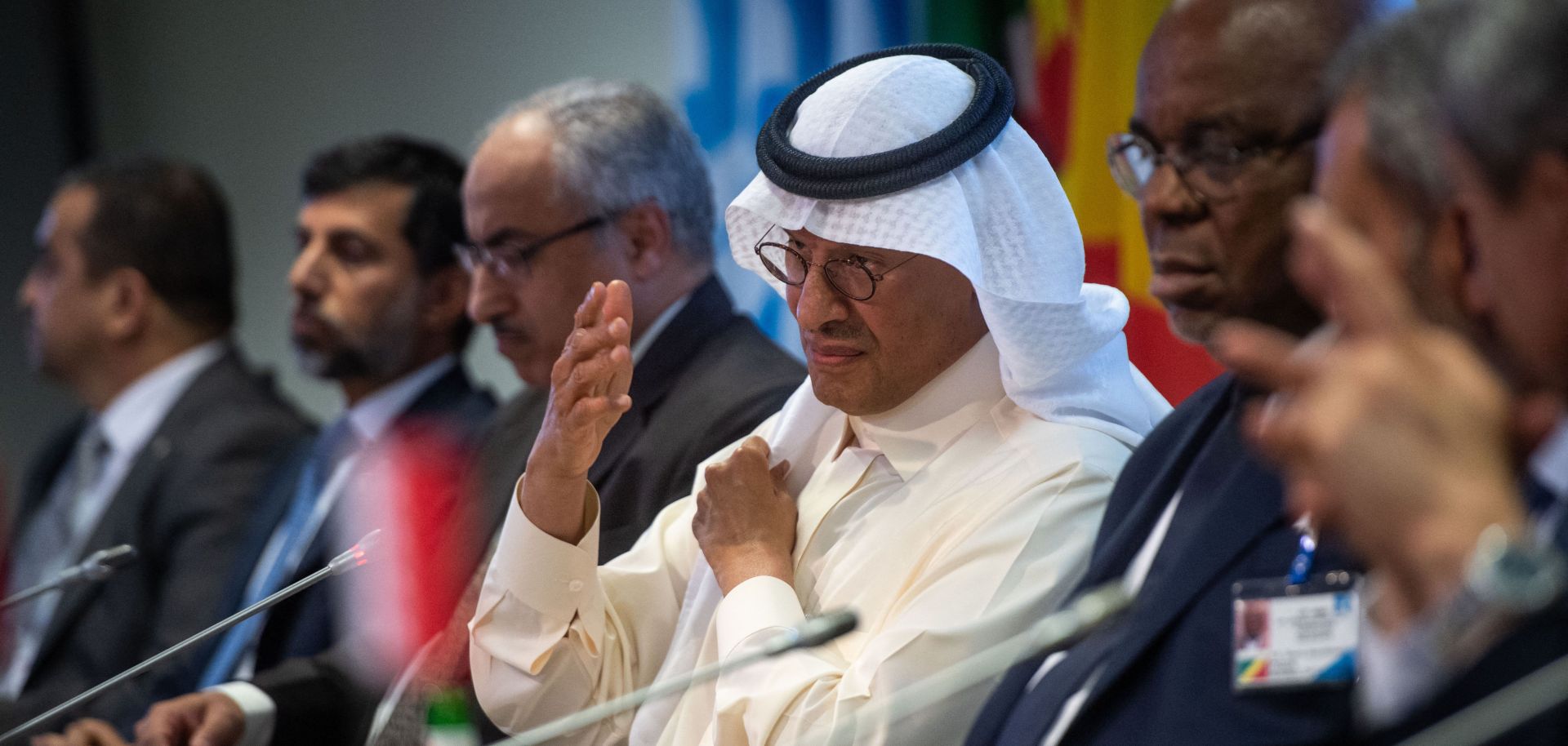
Saudi Arabia's Energy Minister Abdulaziz bin Salman speaks during a press conference after the 45th Joint Ministerial Monitoring Committee and the 33rd OPEC and non-OPEC Ministerial Meeting in Vienna, Austria, on Oct. 5.
OPEC+'s new oil production cuts expose the growing political faultline between Saudi Arabia and the United States, and send a political message that the bloc is rejecting the concept of Western-imposed price caps. The 24 members of OPEC+ agreed on Oct. 5 to cut their production target by 2.0 million barrels per day (bpd) through December 2023, marking the bloc's largest production cut since April 2020. In addition, all OPEC+ members agreed to extend their cooperation pact, which previously expired at the end of 2022, through the end of 2023. They also agreed that their monitoring committee will meet every two months, while OPEC+ more broadly will meet every six months, slowing down the bloc's monthly cadence. These actions come less than three months after U.S. President Joe Biden abandoned his campaign promise to treat Saudi Arabia as a "pariah" state due to the country's human rights violations and instead visited Riyadh hoping to spur Crown Prince Mohammed bin Salman to back production increases to offset rising global oil prices. Biden's visit was followed by a modest Saudi-backed OPEC+ production hike of 100,000 bpd, but the new Oct. 5 cuts dwarf the previous hike.
- In the lead-up to the Oct. 5 decision, U.S. officials pleaded with OPEC+ not to cut production, with draft White House talking points describing large production cuts as a "total disaster" that could be viewed as a "hostile act," according to CNN. While the talking points had not yet been approved by White House leadership, they offer a candid view into some officials' thinking on the matter.
- The 2.0 million bpd production cut is equivalent to about 1.5% of the global oil supply. But this headline figure overstates how much oil production will actually be cut, as most OPEC+ countries cannot hit their current targets; in September, OPEC produced about 1.3 million bpd below its collective production target. Following the Oct. 5 announcement, Bloomberg estimated the actual decline in production may be as low as 800,000 bpd, while Saudi Arabia's energy minister said the cuts will be around 1.1 to 1.2 million bpd.
- European light sweet crude benchmark Brent traded above $120 per barrel as recently as mid-June but fell below $85 per barrel in late September. Shortly after the OPEC+ production cuts were announced, Brent was trading at about $93 per barrel.
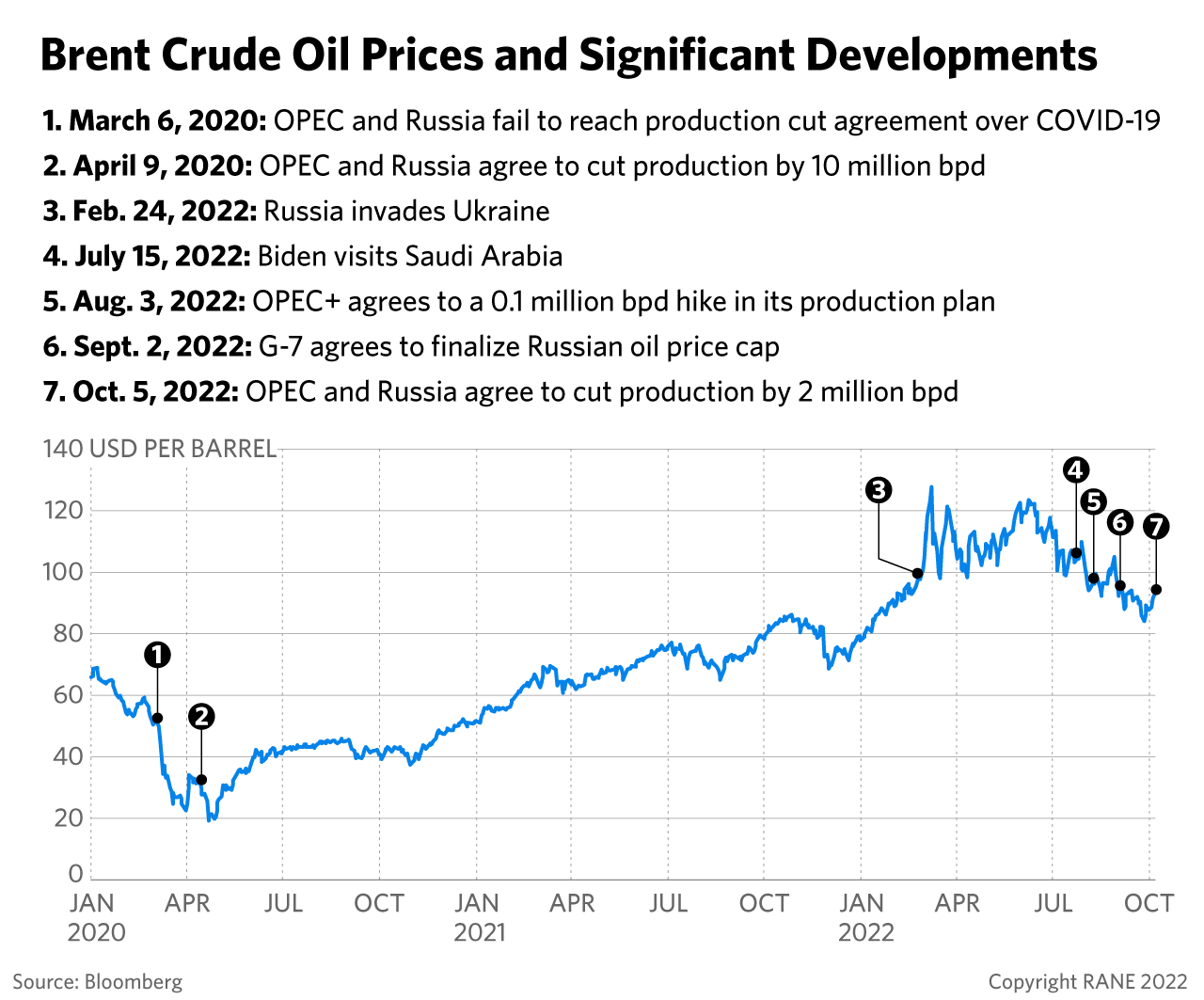
Saudi Arabia is driving OPEC+'s cuts by arguing that market fundamentals give the production cartel significant leverage and support higher prices. Saudi Arabia has repeatedly said that it is concerned about short-term oversupply, an argument supported by the Paris-based International Energy Agency's September monthly Oil Market Report, which projected that oil markets would be oversupplied by 1 million bpd in the second half of 2022. Saudi officials have also warned that global spare oil production capacity is limited, as the OPEC+ bloc — with the exception of Saudi Arabia, the United Arab Emirates and Kuwait — is struggling to hit production targets; Iran and Russia also have spare capacity, but sanctions limit their markets. Rather than maintain, let alone increase, production now, Saudi Arabia wants to reserve some production in case of a future potential crisis, such as Russian oil exports cratering after the Group of Seven (G-7)'s price cap goes into effect in December. Saudi Arabia is also calculating that it will need to conserve some production to meet growing demand from China as Beijing relaxes its "zero-COVID" policies. Effectively, Saudi Arabia — which de facto leads OPEC+'s decision-making — is arguing that those calling for production increases are overly focused on price dynamics instead of seeing the broader state of the oil market.
- One of the reasons Saudi Arabia and OPEC+ have the leverage to cut production and support higher prices is that U.S. shale production is unlikely to be able to respond by quickly surging output.
- Since the Russia-Ukraine war broke out in February, U.S. production has largely been stagnant, ranging from about 11.6-11.8 million bpd from March-July, the last month of data available. The currently tight U.S. labor market and other supply chain challenges have not only inflated production costs for U.S. shale producers, but have also added to drilling and completion times. This makes today's environment structurally different from the environment seen between 2014-2020, when OPEC+ was concerned that cutting production would only cede market share to U.S. shale producers and minimally impact prices.
- In the long run, Saudi Arabia has also said that prices need to be higher to support investment in the oil and gas industry, arguing that increasingly "green" policies adopted by Western international oil companies risk creating a gap in oil production that could lead to a crisis later this decade.
Regardless of Saudi Arabia's motivation, the United States will view the production cuts as a signal that the bloc is aligning with Russia and rejecting Western-imposed price caps on any oil production. While most of the cuts were probably technical in nature, the West will likely see their lengthy 14-month timeline and the resulting rise in oil prices as being motivated by the desire to undermine the forthcoming G-7 price cap on Russian oil. The optics for Saudi Arabia, which has not criticized Russia's invasion of Ukraine, are even worse because it pushed OPEC to extend its oil production cooperation agreement with Russia through next year. But regardless of OPEC+'s motivations, it is true that OPEC stalwarts like Saudi Arabia fear that if the cap is effective in reducing Russia's oil export revenue, the West could consider imposing similar caps on non-Russian oil in the future.
- In her on-the-record remarks, White House Press Secretary Karine Jean-Pierre said on Oct. 5 that it is "clear that OPEC+ is aligning with Russia with today's announcement." The draft White House talking points that CNN reported also asked U.S. Treasury Secretary Janet Yellen to convey to Saudi Arabia and other OPEC+ countries that moving forward with production cuts would pose a “great political risk to [their] reputation and relations with the United States and the West." Making the optics even worse, Russian Deputy Prime Minister Alexander Novak — who was sanctioned by the United States, but not the European Union, in connection with the Russia-Ukraine war — personally visited Vienna, Austria, to agree to the productions cuts amid Europe's energy crisis that is seeing Russia weaponize natural gas exports to the Continent.
- Saudi Arabia's production cut makes the unclear impact of the G-7 price cap on Russian oil production more important. It is possible that the G-7 price cap will deter some Russian oil consumers from buying high volumes of Russian oil above the price cap, particularly beyond India and China. But if this oil cannot find a home and Russia cuts production, it will result in even deeper production cuts than the one to which OPEC+ agreed, which will support higher prices.
The Biden administration has little way to mitigate the impact of the OPEC+ production cuts on rising U.S. gas prices ahead of the November midterm election. While the White House has reportedly asked the Department of Energy to evaluate the impact of curbing U.S. exports of crude oil and refined products, banning petroleum exports would open up the White House to more criticism from Republicans over its energy policy and from the European Union over exacerbating Europe's energy crisis. Additionally, such a ban would likely only have a marginal impact on curbing domestic gasoline prices (and could even result in higher prices), as refiners could reduce throughput because they can no longer export diesel; refineries often optimize refinery output between diesel and gasoline based on having multiple markets.
- Although nationwide gasoline prices in the United States declined from June to September, they have been rising over the last month; on Oct. 3, the American Automobile Association said gasoline prices in Alaska, Arizona, California, Oregon, Nevada and Washington had all risen more than 35 cents per gallon over the previous week.
- The Biden administration is likely also to consider releasing more oil from its Strategic Petroleum Reserve (SPR), but releases of the SPR this year have only had a temporary impact on prices, if any. The United States has already sold nearly 180 million barrels of oil from its SPR this year, nearly a third of its stockpiles, sending the reserve to its lowest level, 422.5 million barrels, since the Reagan administration.
