
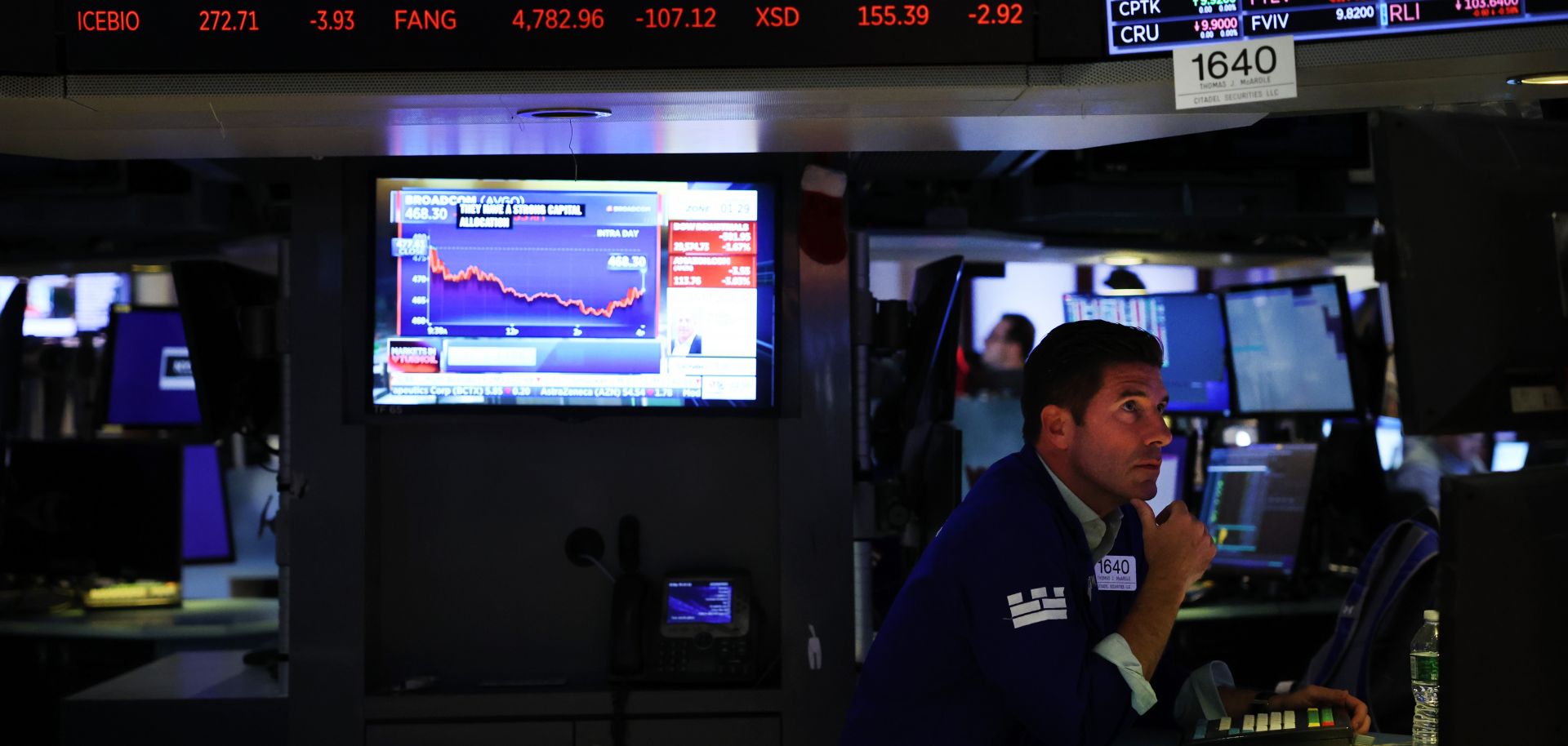
Traders work on the floor of the New York Stock Exchange (NYSE) on Sept. 23, 2022. The Dow Jones Industrial Average dropped more than 400 points that day amid fears of a looming recession.
Tightening global financial conditions are sharply increasing the risk of a broad-based global downturn followed by depressed growth and deflation risks. The U.S. Federal Reserve and other central banks around the world are aggressively raising their policy rates in response to rising consumer prices, which have reached multi-decade highs in the United States and virtually every other advanced economy. In addition to rate hikes, many central banks are pursuing a policy of quantitative tightening by selling assets, thus effectively contributing to higher medium- and long-term interest rates. Within this context, a soft landing is becoming increasingly unlikely, and the risk of a sharp recession is increasing as the U.S. Fed and other central banks will need to weaken the labor market substantially in order to get inflation under control. The risk of financial instability is growing as well, because investors are likely to have taken too much risk on the assumption that interest rates would increase less rapidly than they are now bound to do.
- The Fed raised interest rates by a hefty 75 basis points to 3.0-3.25% in September. The U.S. central bank's main policy rate is now certain to exceed 4% by year-end, up from 0-0.25% at the start of the year.
- The Bank of England and the central banks of Sweden, Switzerland, Norway and South Africa (to name just a few) also raised interest rates in September.
- U.S. core inflation in August increased to 6.3%, up from 5.9% in July, even though year-on-year headline inflation fell due to a sharp fall in energy prices. Core personal consumption expenditure, the U.S. Fed's preferred inflation measure, also remained elevated.
The combination of higher interest rates and quantitative tightening is translating into challenging global financial conditions, threatening to induce severe recessions in the United States and Europe. Futures markets imply that the U.S. Fed will increase its benchmark policy rate to 4.2% by the end of 2023. The Fed, however, now expects interest rates to reach 4.6% by then, after reaching 4.4% at the end of 2022. This indicates the extent to which U.S. policymakers are concerned about U.S. inflation, which the Fed now forecasts to reach 5.4% this year, before falling to 2.8% next year and 2.3% in 2024. But while markets may be more optimistic about the near- and medium-term inflation outlook compared with the U.S. central bank, the recent dive in U.S. equities signals that investors are becoming increasingly concerned about economic growth amid excessive monetary tightening. Indeed, the Fed also sharply downgraded its growth forecast for 2022 and 2023 last month, effectively penciling in a recession. Yields on 10-year treasuries in the United States have also increased above 4%, while U.S. mortgage rates have risen to nearly 7% for the first time in 15 years — constituting a very significant tightening of financial conditions. In Europe meanwhile, where the continent's ongoing energy crisis is already sapping economic growth, the European Central Bank will also continue to tighten monetary policy aggressively in response to rising inflation, pushing the eurozone into a recession even sooner than the United States.
- The Fed now expects the U.S. economy to expand by only 0.2% this year before slightly accelerating to 1.2% next year — marking a notable drop from the bank's previous forecast released in June, which saw the U.S. economy expanding by 1.7% in both 2022 and 2023.
- Having fallen 20-25% year-to-date, the U.S. equity market is in bear market territory.
- The bottom 20% of U.S. households, whose propensity to consume is higher than those elsewhere in the world, now hold less cash than before the COVID-19 crisis.
- In August, U.S. unemployment increased 0.2 percentage points to 3.7%
Global inflation will eventually abate for several reasons:
- 1) Pandemic-related excess fiscal stimulus led to a build-up of household savings at a time of reduced consumption and expenditure due to COVID-19 restrictions, which in turn led to a sharp spike in demand once pandemic restrictions were lifted. Currently, household savings are being eroded very quickly by high inflation, which will start slowing consumption.
- 2) The sharp surge and shift in consumer demand after post-COVID economic reopenings led to significant supply chain disruptions. Barring further shocks, supply chains are adjusting, which should lead to lower prices for many goods.
- 3) The Ukraine war led to a massive increase in energy and food prices. While further shocks are possible, the impending recession should continue to drag down energy prices.
- 4) Monetary policy was extremely loose during the COVID-19 pandemic, characterized by ultra-low, often negative interest rates and massive balance sheet expansion. But central banks are now aggressively reversing those ultra-accommodative policies to tamp down on inflation.
- 5) Reduced labor market supply — partially due to early retirement, long-term health problems and other COVID-related reasons — has led to an extremely tight labor market and surging wage inflation. But unemployment has already started to increase in recent months amid the impending global economic downturn, which will moderate wage increases.
Deglobalization, lower immigration and the energy transition are expected to drive prices up in the coming decades, but they are unlikely to generate significant, persistent increases in inflation. The increasing fragmentation of global supply chains and cross-border trade may eventually contribute to stronger, longer-term price increases. But while U.S.-China tensions may lead to a decoupling of the technology sector, more extensive ''deglobalization'' will not happen for the foreseeable future, short of a U.S.-Chinese military conflict. In fact, global trade in real terms has not declined much in recent years, despite the rise of nationalist governments and more protectionist economic policies around the world. In some countries, lower immigration will weigh on labor supply and could push wages higher, but the impact on inflation will likely remain limited given advances in technology. Technology will become even more of a labor market restraint and driver of deflation than in the past, as revolutionary advancements in high-tech fields like artificial intelligence and 3D printing make it easier to automate jobs. Increased investment in more expensive renewable energies may also become a force for higher prices in the future, but increasing geopolitical risk and energy supply insecurity will slow down this shift toward costly ''green'' expenditures — limiting its impact on inflation and interest rates.
This potential for very low inflation or even deflation in many advanced economies, along with depressed growth, compounds the risk of a sharp global recession. The economic outlook post-recession is likely to remain subdued, as loose monetary policies and significant stimulus spikes in government spending during the COVID-19 pandemic have increased financial debt virtually everywhere. A large run-up in debt may provide even less room to support economic growth through expansionary fiscal policies. And if low economic growth translates to low inflation, high real interest rates (despite low nominal interest rates) will weigh on the economic outlook and weigh on debt and financial sustainability. Such a combination of very low economic growth and very low inflation or even deflation would create particular challenges for countries with high government debt levels, as well as other countries with large public sector burdens and weak fiscal position. Developing economies will face greater challenges than advanced economies. But even the latter will be forced to confront increasing economic and financial challenges.
