
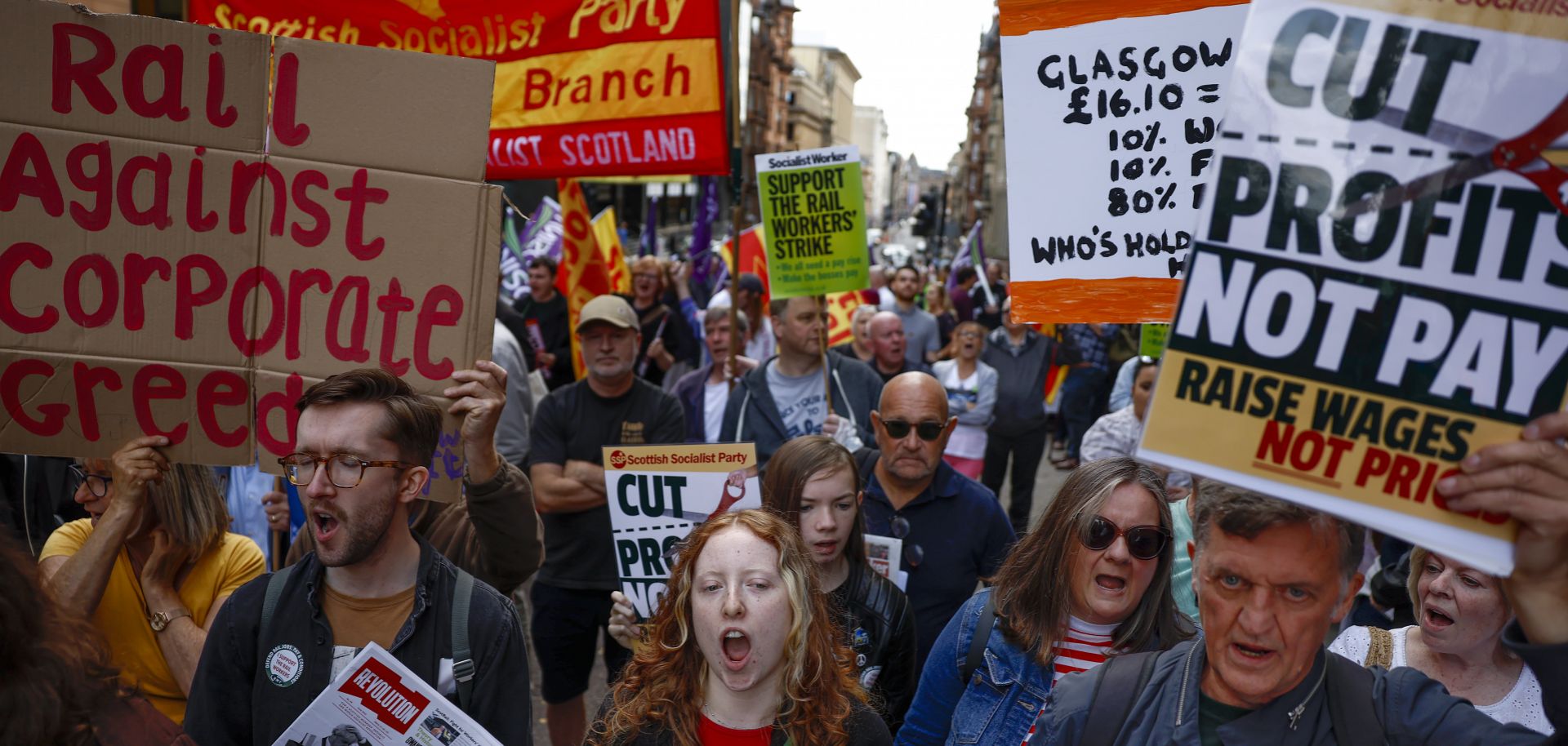
Supporters of the National Union of Rail, Maritime and Transport Workers (RMT) protest in Glasgow, Scotland, on July 27, 2022, as part of a nationwide strike among U.K. rail workers.
The threat of labor action in Spain highlights a broader risk that Europe's ongoing cost of living issues will keep the probability of social unrest high between late 2022 and early 2023, opening the door to additional disruptive labor action and grassroots mobilization. The Secretary General of Spain's General Union of Workers (UGT), Pepe Alvarez, said on Aug. 22 that ''there will be large demonstrations starting in September'' unless unions reach an agreement with the private sector to raise salaries across the country. According to Alvarez, UGT will seek to coordinate protests and strikes with other trade unions. While inflation in Spain reached 10.8% year-on-year in July, salaries only have risen on average by less than 3% during the same period, which explains why unions are pushing for a new round of wage negotiations with the government and private companies. Spain is far from being the only European country in this situation, and multiple strikes have taken place across the Continent in recent months because of the ongoing cost of living crisis.
- In recent months, inflation has increased significantly across Europe due to a combination of supply chain bottlenecks, rising energy and food prices, and labor shortages in some sectors of the economy. Average inflation in the eurozone reached 8.9% year on year in July, up from 8.6% in June, driven primarily by rising energy costs. In the United Kingdom, inflation reached 10.1% year on year in July, the highest rate in four decades, also primarily because of energy costs.
- In June, the European Central Bank (ECB) warned that inflation will remain ''very high'' in the eurozone for the rest of the year, while the Bank of England (BoE) predicted in August that inflation in the United Kingdom could exceed 13% in October. Predictions from private banks and other institutions suggest that inflation in both territories will actually be higher than what the ECB and the BoE are currently predicting.
- Since June, workers in sectors such as aviation, railways and ports have gone on strike in countries including the United Kingdom, France, Italy, Belgium and Spain, demanding higher wages. The strikes have been particularly disruptive in the tourism and hospitality sectors because of their importance during the summer season.
Because of their conflicting goals, governments, unions and businesses could struggle to reach salary agreements, thereby creating fertile ground for strikes and protests during the fall and winter. Wage negotiations will gain momentum across Europe in late 2022 and early 2023, but agreements could be elusive. Unions will insist on a closer link between inflation rates and wage increases. Governments will seek a balance between pushing for modest increases in salaries in the public and private sectors (to mitigate social unrest), while also trying to prevent significant wage increases from further fueling inflation. Companies, for their part, will be reluctant to offer significant pay hikes at a time of slowing economic growth and widespread uncertainty.
- In July, the European Commission's Economic Sentiment Indicator (a survey of confidence in the economy among companies in the European Union's industrial and services sectors) fell to its lowest level since January 2021. This is in line with several other indexes that suggest that business morale is dropping in Europe as geopolitical uncertainty related to the war in Ukraine continues. Pessimism about the future of the economy will make businesses across the Continent more reluctant to give in to unions' demands of higher salaries, especially in the short term.
- Unemployment rates in the European Union are currently very low (the average unemployment rate for the bloc was 6.6% in June, down from 7.9% in June 2021) and some sectors are actually experiencing shortages. Unemployment rates are even lower in the United Kingdom, where they reached 3.8% in July (0.2% below pre-pandemic levels). This currently gives workers leverage when negotiating higher wages, increasing the near-term risk of industrial action if their demands are not met.
- In the probable case that Europe's ongoing energy crisis slows down economic growth to the point that countries enter recessions in early 2023, a potential spike in unemployment may actually result in unions moderating their demands for wage increases and turning their attention to job retention schemes similar to those introduced during the peak of the COVID-19 pandemic in 2020 and 2021. In this scenario, the risk of labor unrest would still exist, but unions would likely also be more willing to compromise with governments and businesses on wages to prevent widespread layoffs.
This worsening labor environment could further slow down economic activity in Europe and force governments to rely on additional public spending and tax hikes to mitigate unrest. If Russia completely halts natural gas deliveries to Europe during the peak consumption season in the winter, some countries (especially in Central and Eastern Europe) will have to ration natural gas use, which will severely slow economic activity. Even without a Russian gas cut-off, the mere threat of such supply disruptions will likely keep energy prices high in Europe through early 2023, which means that the cost of living crisis (and the connected risk of unrest) will continue. Protesters demanding higher wages will likely also block roads, which could further disrupt supply chains in Europe's industrial and service sectors by impeding the movement of goods and people. The labor disruptions caused by strikes could further slow down economic activity as well, especially if they last over several days. Meanwhile, opposition political parties and grassroots organizations across Europe will use the cost of living crisis to try to destabilize governments, which will further fuel the risk of such protests. Against this backdrop, many governments will introduce subsidies and other aid schemes to alleviate the impact of rising prices on households and businesses. But this will come at the expense of higher public spending which, in many cases, will result in governments hiking taxes (especially on large companies) to increase state revenue. Some governments may also increase borrowing from debt markets, which will become increasingly expensive as the ECB continues to tighten its monetary policy.
- In the German city of Schneeberg, far-right, far-left and conservative opposition politicians sent a joint letter to the federal government in mid-August warning that Germany's worsening economic conditions threatened ''social peace'' in the country. This rare case of collaboration between political parties who otherwise have little in common highlights how Europe's ongoing cost of living crisis could result in unusual anti-government cooperation among opposition political forces.
- In May, Hungary introduced windfall taxes on the ''extra profits'' of large companies to finance measures to mitigate the cost of living crisis. In July, Spain announced a similar tax on the profits of banks and energy companies. More countries across Europe will likely adopt similar policies in the coming months as governments look for extra resources to fund subsidies and other forms of assistance for low-income households.
