
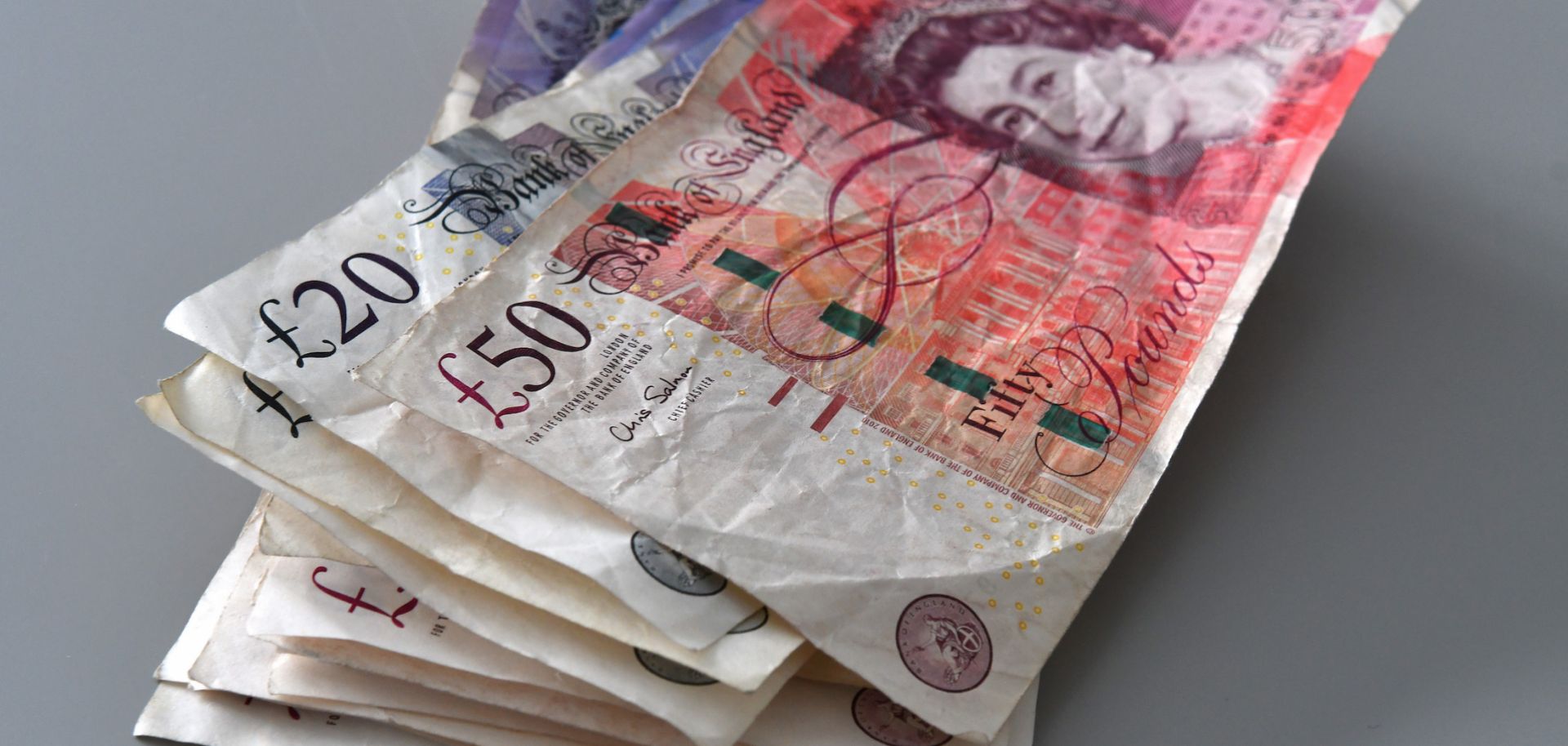
A photo illustration shows banknotes of the U.K. pound.
While a weakening pound underscores the United Kingdom's current economic problems, a full-blown financial crisis remains unlikely in the short-to-medium term, as the U.K. currency's depreciation will not immediately worsen government debt dynamics — thereby buying time for a more gradual macroeconomic adjustment. The U.K. pound's value relative to the U.S. dollar fell to a 37-year low on Sept. 4, driven by a combination of high energy prices, a worsening underlying fiscal deficit and high government debt levels. The United Kingdom's dependence on foreign capital inflows makes its currency more vulnerable to Ukraine-related global price shocks than those of other advanced countries, with inflation in the U.K. reaching a 40-year high of over 10% in July. The resulting cost of living crisis has pushed the U.K. government to fund new measures aimed at mitigating the financial toll on households — leading to increased public spending that will put upward pressure on the deficit over the next few quarters and weigh on market sentiment, further depreciating the U.K. currency.
- Among the developed economies in the Group of Seven (G-7), the United Kingdom has seen the largest increase in consumer prices since the Russia-Ukraine conflict began in February.
- Although the Bank of England has begun to tighten monetary policy, it is behind the curve: the Bank of England's policy rate is 1.75% and consumer price inflation reached 10.1% in July (U.S. inflation, by comparison, is running between 8-9% and the U.S. Federal Reserve's funds rate currently stands at 2.25-2.50%).
- The United Kingdom's current account deficit is also widening and might reach close to 10% of GDP. Declining portfolio inflows and structurally lower Brexit-related foreign direct investment inflows into the country — combined with higher interest rates in the United States — have increased the United Kingdom's balance-of-payments vulnerabilities as well.
- A report by Deutsche Bank highlighted the risk of a British balance-of-payments crisis due to the government's increased public spending, a widening current account deficit and declining financial inflows. (A balance-of-payments crisis refers to a situation where the combination of trade-related and capital inflows fall short and the currency comes under significant pressure. A crisis can occur if this happens very suddenly and raises concerns about government debt sustainability or the stability of the banking sector.)
Aggressive monetary tightening in the United States and the European Union — combined with the potential for increased public spending and renewed Brexit tensions under the United Kingdom's new prime minister — will likely continue to weaken the pound. The U.S. Fed remains hawkish and will continue to hike interest rates, possibly by another 75 basis points at its next meeting on Sept. 20-21. The European Central Bank has also decisively turned more hawkish, with talk of shrinking its balance sheet. The outlook for global rates will, in turn, continue to put downward pressure on the British pound. The economic policies proposed by the United Kingdom's new prime minister, Liz Truss, will also add to that pressure by exacerbating market uncertainty. Shortly after assuming office on Sept. 6, Truss unveiled plans to increase public spending by more than 4% of GDP over the next two years to soften the economic and political impact of high energy prices on U.K. households. This will widen the U.K. government's fiscal deficit and increase the country's current account deficit.
- On the campaign trail, Truss also promised not to raise taxes, further increasing market concerns about the United Kingdom's fiscal deficit and, by extension, the country's trade balance and current account deficit.
- Truss's pledge to suspend the Northern Ireland protocol of the Brexit agreement — which sets custom controls at the Irish Sea — risks increasing tensions with the European Union, the United Kingdom's largest trading partner, as well.
But while it faces greater economic challenges than most of its developed peers, the United Kingdom is unlikely to experience a financial, debt or balance-of-payments crisis. The U.K. pound will continue to weaken, but this will not directly affect the sustainability of the U.K. government's debt. While British public debt is relatively high (just shy of 100% of GDP), it is denominated in U.K. pounds. Unlike in most emerging countries, a weaker currency in the United Kingdom will thus not directly lead to a weakening of public finances. This means that, for now, high inflation should keep the United Kingdom's debt-to-GDP ratio under control. A weakening currency will also continue to increase global demand for cheaper U.K. goods, while decreasing domestic demand for more expensive imported goods. Over the medium term, this combination of stronger exports and weaker imports will help improve the U.K. current account deficit. Even if the U.K. currency significantly depreciates, a broader financial destabilization of the U.K. economy would remain unlikely, given that virtually all public-sector debt is denominated in pounds. And if market pressure were to also increase significantly, the government would very likely cut spending (if not necessarily energy-related spending) and raise taxes.
- The spreads of five-year U.K. credit default swaps (CDS), a financial instrument that allows investors to insure against a U.K. sovereign default, are trading at 27 basis points. Assuming a 40% recovery rate, this translates into an implied probability of default of 0.4%. Economic and political circumstances may yet change, but for now, the risk of a U.K. financial crisis remains low.
