
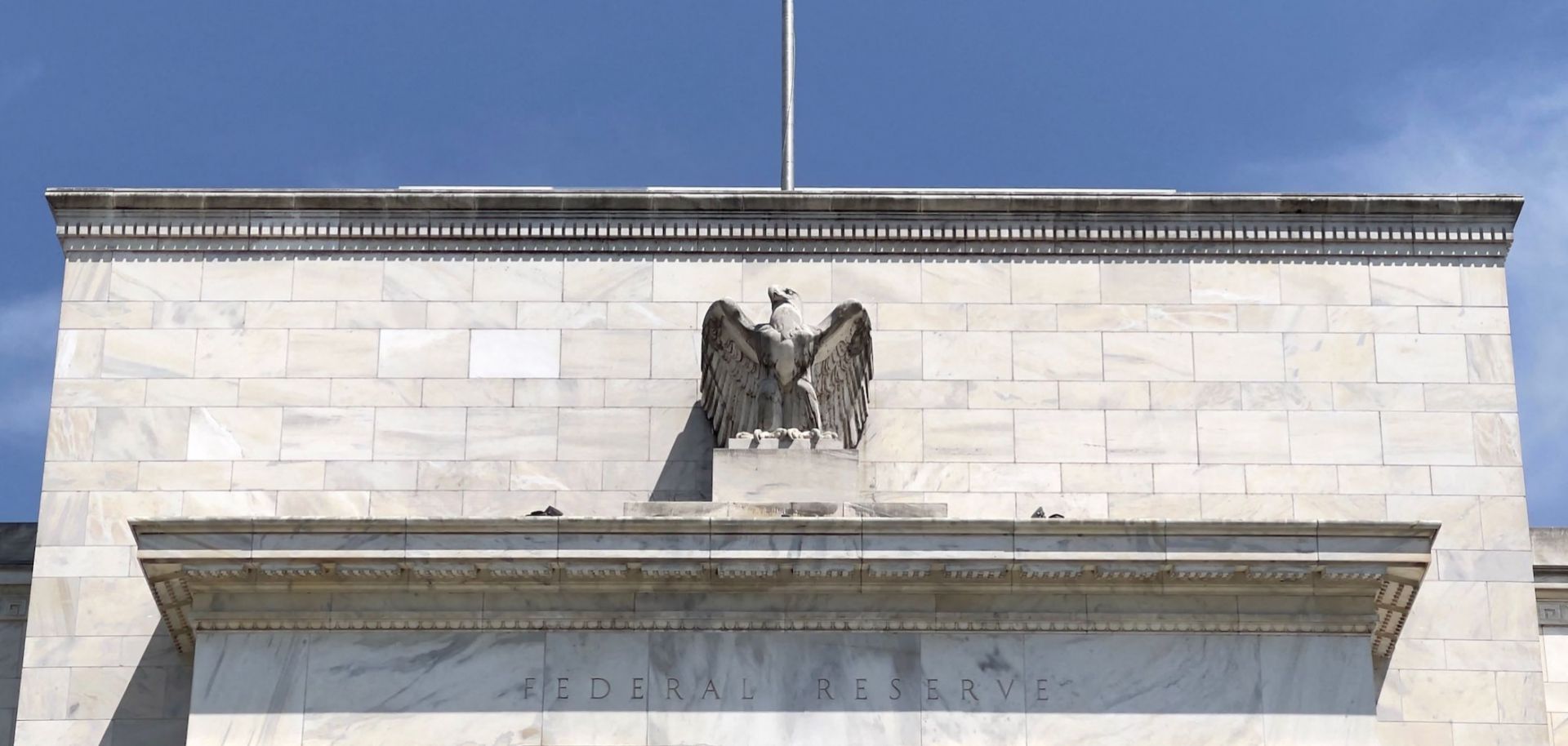
The U.S. Federal Reserve building is seen in Washington D.C. on Aug. 6, 2021.
The U.S. Federal Reserve will probably begin cutting or tapering its asset-purchasing program by the end of the year, while an interest hike is probable in 2023 or sooner. This will have implications, including an appreciating U.S. dollar, rising global interest rates and tightening credit conditions. The Fed’s policy-setting Sept. 21-22 meeting of the Federal Open Market Committee (FOMC) indicated that it will probably announce reductions in quantitative easing of monetary policy on Nov. 3 while interest rates could increase starting in 2023, if not sooner. In its formal policy statement and updated accompanying documentation, as well as Chairman Jerome Powell’s press conference, the Fed indicated:
- A cutback or tapering of purchases of $80 billion per month in U.S. Treasury securities and $40 billion per month in mortgage-backed securities designed to pump up the U.S. money supply and support increased growth (quantitative easing or QE) could start in December and end by mid-2022, although the Fed will probably not reduce the size of its balance sheet and will roll over maturing amounts into other securities.
- Powell confirmed the Fed’s criteria for phasing out QE had been mostly met, including inflation above 2% for a time and substantial progress toward maximum employment. Once started, according to Powell, asset purchases would be phased out rather quickly, reaching zero by mid-2022, at which point the Fed’s balance sheet would not change in size.
- The Fed also moved forward its thinking on when it will start to raise interest rates from near zero at present toward its long-term expectation for the federal funds rate, the main policy rate, of 2.5% after 2024. The federal funds rate, or the amount charged by banks for lending excess reserves overnight to other banks, is the foundational interest rate for the economy and is the one on which all other rates are based.
- While the Fed is a bit less optimistic about U.S. economic growth in 2021, it expects the economy to make up ground in 2022. A short-term deterioration in the economy from the COVID-19 delta variant is projected to be offset by an overall net improvement with slightly better growth than expected in 2022-23, settling back to a long-run trend of 1.8% after 2024.
- The Fed wants to start tapering this year, but has left itself some flexibility to push an announcement to December if warranted by data and other developments. Among current uncertainties affecting markets, Powell said there is little U.S. exposure to the possible financial failure of Chinese property manager Evergrande Group, which he noted was “very particular to China.” Powell also said the Evergrande crisis could impact global financial conditions, although “corporate defaults in the United States are very low right now.” He claimed that any impact would be through “confidence channels” and noted there was some fear that the real estate giant’s financial difficulties could infect corporate bond markets beyond China.
The decision to cut back or taper QE depends mainly on economic data, including especially the September payrolls report due on Oct. 8. A September report below expectations could delay a Fed taper announcement until December, as could a potential government shutdown, a delay in raising the federal debt ceiling, or financial market instability. The U.S. Labor Department’s August payrolls report was disappointing in that only 235,000 jobs were added to the economy despite nearly 11 million vacancies. The expiration of expanded unemployment benefits and returns to school may have been offset by surging delta variant infections across the United States, which are now improving somewhat.
An eventual interest hike will depend on the evolution of labor data to a level the Fed considers “maximum employment” and will not begin until the end of QE. Half of the 18 current FOMC members (11 of whom vote, with one governor’s position still vacant) now anticipate increasing the federal funds rate by the end of 2022, up from seven in July. Still, Powell made clear that there's a stronger requirement of reaching “maximum employment” before raising interest rates, which in any event will not start until after net asset purchases reach zero, with the Fed neither adding to nor decreasing the size of its balance sheet. Although Powell claims support for QE tapering this year is “broad.” But members of the FOMC’s Board of Governors have been less aggressive in foreseeing what Powell calls interest rate “lift-off” compared with regional Fed bank presidents, only five of whom at a time are voting FOMC members. Powell said “we have much ground to cover to reach maximum employment,” which the median Fed projection sees as 3.5% in 2023 and 4% long-term. Still, only one FOMC member, down from five in July, does not see an interest rate increase before 2024.
While the Fed insists that current inflation is temporary, several factors will continue to drive consumer prices up. These include supply chain disruptions that delay global shipping, production bottlenecks such as a shortage of inputs including semiconductors, and worker shortages. How quickly these supply-side cost pressures will abate is a major uncertainty as indicated by a shift in FOMC language from saying inflation “has risen” to inflation “is elevated.”
- The Fed’s preferred inflation measure, the core personal consumption expenditure (PCE) index, was up by 4.2% (y-o-y) in August. The FOMC median projection is for the PCE to rise by 3.7% for all of 2021, up from 3% previously, before dropping back to 2.3% in 2022 and 2.2% in 2023 — exceeding the Fed’s medium-term average target of 2%.
- Powell expects consumer prices to move closer to target next year and in 2023 with minimal overshooting. He also expects long-term inflation expectations to stay the same, given the prolonged period of below-2% inflation in the United States. These projections are consistent with the Fed’s insistence that current inflation is temporary. But they’re also somewhat more optimistic than the Fed’s qualitative “beige book” reports on business conditions in the United States, as well as business and consumer surveys conducted by regional Fed banks that suggest companies have pricing power (the ability to raise prices without suffering sales losses) and expect to use it.
Increasing interest rates will further slow an already sluggish, uneven global recovery from the pandemic as they affect borrowing and investment returns. In addition to strengthening the dollar by attracting capital to the United States, Fed action will also pressure other central banks in countries experiencing inflation to raise interest rates. Indeed, there are signs that many emerging countries with access to international credit markets and large amounts of maturing debt are already acting preemptively ahead of a U.S. rate hike by trying to raise funds in coming months greater than anticipated needs. Creditworthy emerging-market governments want to pre-finance to the extent possible, locking in low coupon rates, before global interest rates start to increase or debt problems emerge that increase risk spreads. Where country credit fundamentals are questionable, global investors with risk appetite will demand higher returns and currencies are expected to depreciate as inflation increases globally and other central banks are forced to respond, which by raising their own interest rates, will decrease growth momentum.
- On Sept. 20, Bloomberg reported that emerging markets face a high rollover need on external debt, with $102 billion due through end-2021 and $389 billion due in 2022.
