
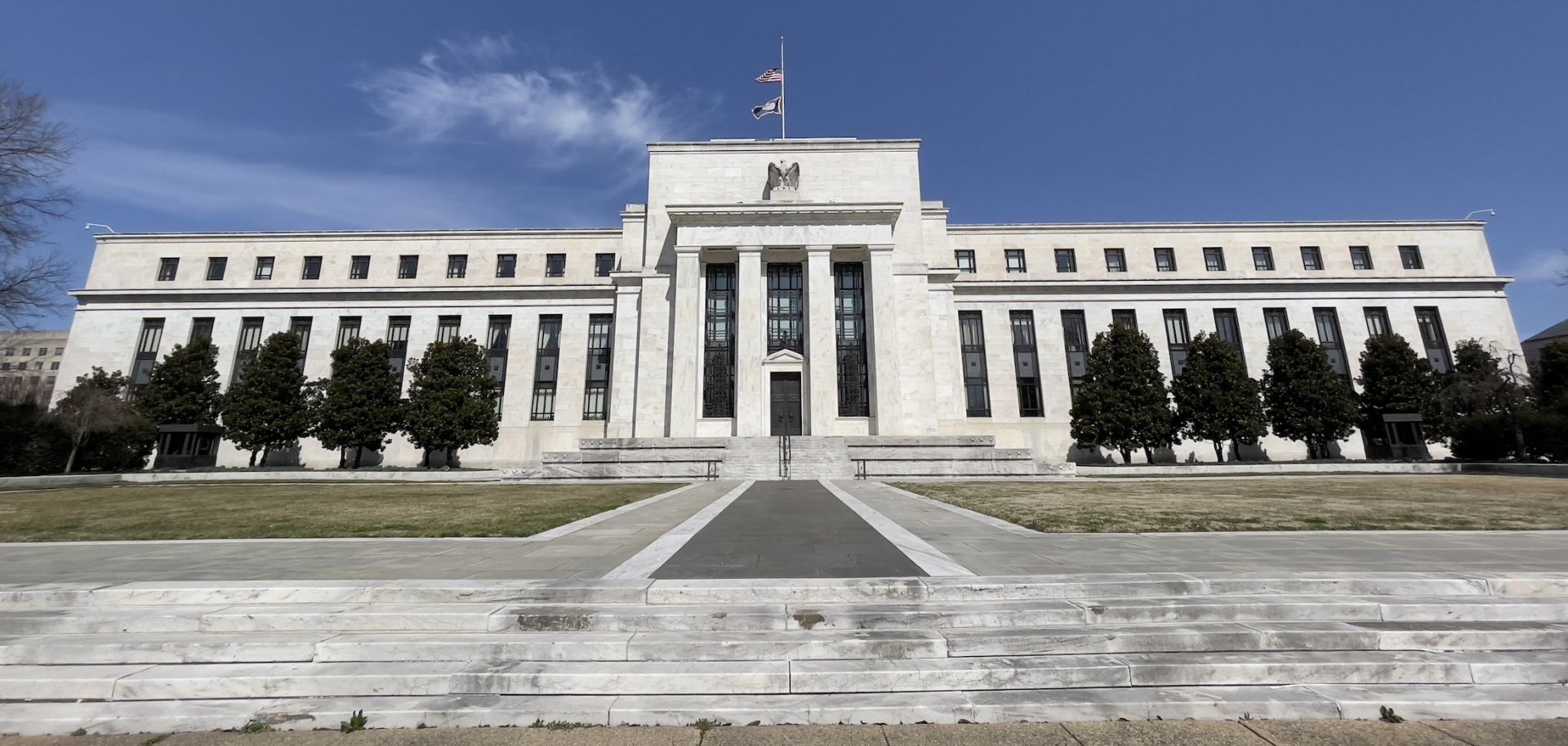
The Federal Reserve building is seen on March 19, 2021, in Washington, D.C.
The U.S. Federal Reserve took no substantive action to tighten monetary policy during its last meeting, but it did convey a greater awareness of possible economic overheating. This indicates an interest rate hike may come sooner than expected, increasing risks for emerging markets that depend on dollar financing. The Fed did not change the federal funds rate, its main policy interest rate, when its policy-setting Federal Open Market Committee (FOMC) met on June 15-16. The U.S. central bank also did not adjust the size of asset purchases or forward guidance. But the Fed did signal that it will consider a withdrawal of quantitative easing (QE) — a prelude to increasing interest rates, a process that could start this year with the first hikes arriving in 2022 or 2023.
The so-called “dot plot,” in which FOMC members anonymously convey expectations of the path of interest rates, shows a dramatic forward shift in possible timing. This conveys a more aggressive attitude toward policy tightening. The Fed has repeatedly made clear that reducing quantitative easing by increasing the size of its balance sheet through asset purchases will precede the first interest rate hike. The Fed could give the first signal of an impending QE taper at its annual symposium in Jackson Hole, Wyoming, on Aug. 26-28. Fed Chairman Jerome Powell discourages observers from looking at the dot plot because it interferes with his communications strategy, but it's a good glimpse into participants' thinking that goes beyond sometimes elliptical public statements. In particular, the new dot plot shows that seven of the 18 FOMC members now expect the first interest rate increase in 2022, up from four in March. 13 members also see at least one rate hike in 2023, with 11 of those thinking there could be two. In addition, the median projection for the federal funds rate is 0.6% in 2023 compared with 0.1% as recently as March.
- An actual announcement of tightening will not happen before September, with the first move in December at the earliest and possibly January. The pace of tapering will be cautious but probably automatic — perhaps proceeding at a rate of $15 billion per meeting, beginning first with mortgage-backed securities.
- Since the meeting, Federal Reserve Bank President Jim Bullard, considered until now a proponent of continued easy money, said he thinks the first rate increase will be in 2022, which could suggest a further acceleration of the schedule.
- According to previous Fed statements, tapering of asset purchases of $120 billion per month (in which the Fed buys $80 billion in Treasury securities and $40 billion in mortgage-backed securities) is a prerequisite for raising interest rates, and the Fed will want net changes to its balance sheet to be zero before acting more forcibly. Fed Chairman Jay Powell said the FOMC started “talking about talking about” tapering at the latest meeting and will assess progress toward meeting Fed goals for the economy on a “meeting-to-meeting” basis starting July 27-28. Details of the June discussion won’t be known until meeting minutes are released in July.
While the Fed still sees current inflation as temporary, the FOMC meeting confirmed that the institution is not blind to a potential increase in consumer prices. For now, the U.S. central bank doesn’t think substantial further progress has been made toward its goals. But it does believe the economy is on track to meet benchmarks sooner than expected, with the Fed increasing its median forecasts for 2021 GDP growth to 7% from 6.5% in March. The Fed also sees improved labor market prospects, despite current low employment growth at a time when job openings are at a record high, which it strongly believes is a temporary situation.
- The FOMC’s Summary of Economic Projections (SEP), which details participants’ forecasts for the U.S. economy, shows the median forecast for personal consumption expenditure (PCE) inflation at 3.4%, up from 2.4% in March. The core PCE, which excludes volatile food and energy prices, increased to 3%, from 2.2% previously. According to the SEP, the Fed sees inflation falling back to 2-2.2 percent in 2022-2024.
- Unemployment is expected to average 4.5% this year, falling below that in 2022 and to 3.5% in 2024.
The new timeline is consistent with the Fed’s average inflation target of 2% over an unspecified period. But it’s unknown how much overshooting of that target the institution will allow and how that will affect the pace of tightening, which will depend partly on whether inflation accelerates after the first hike. While still insisting inflation is temporary, Powell said forecasters should be humble and that the Fed doesn’t know when price pressures and supply bottlenecks will abate.
During the June 15-16 FOMC meeting, the Fed also increased slightly interest paid on banking deposits and excess reserves to absorb liquidity in markets. This was a preemptive move to keep overly abundant market liquidity from pushing down the effective federal funds rate and keep yields from going into negative territory. The market response was nearly immediate, with the Fed selling a record $756 billion in Treasury securities on June 17. Returns for money market mutual funds have also improved in recent days.
Tighter financial conditions in the world’s largest economy will have implications for emerging markets that are heavily dependent on external financing and market risk premia may increase. Higher U.S. interest rates may be welcomed by the People’s Bank of China amid slowing renminbi appreciation and capital inflows to China. But in emerging markets with more cautious monetary policy, exchange rates risk depreciating as inflation and interest rate differentials increase, which will raise import costs and require higher yields on sovereign bonds. India, for example, is holding interest rates constant, even in the face of increased inflation. Turkey, on the other hand, may cut interest rates, even if a decision is still possibly several months away.
