
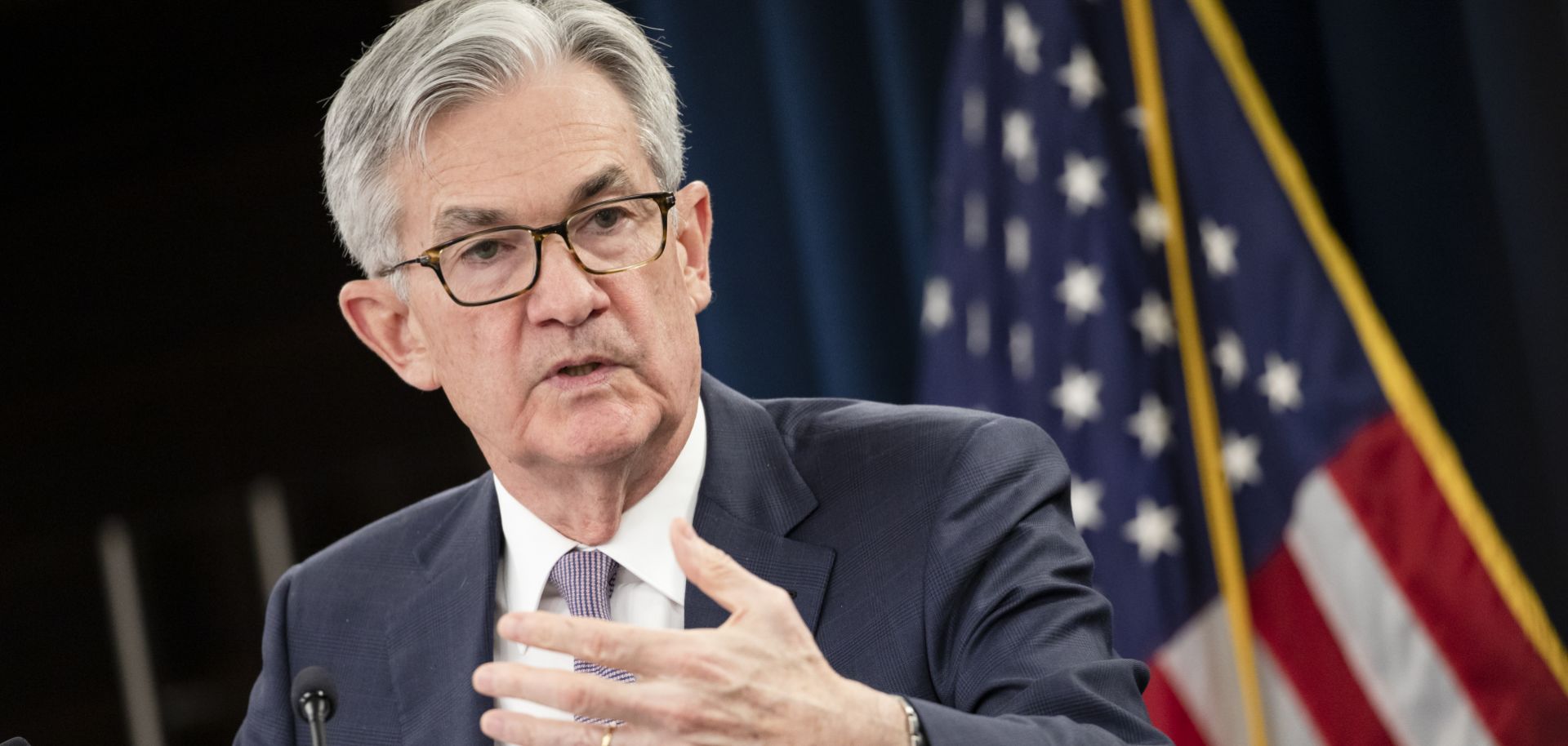
U.S. Federal Reserve Chair Jerome Powell speaks to the press after a policy meeting in January 2020.
As U.S. inflation rises, the Federal Reserve will seek a balance between saying that current inflation is temporary and sending the message that it’s ready and willing to fight price level increases if needed. But in doing so, the U.S. central bank risks a delayed response if inflation continues to surprise as it has the past two months, which could lead to it having to act more aggressively than it might otherwise. The Fed is unlikely to make policy changes during its next Federal Open Market Committee (FOMC) meeting on June 15-16. Instead, the bank will likely only indicate that it’s started the discussion of when to begin cutting back asset purchases known as quantitative easing (QE), and that short-term interest rates will probably stay near zero until at least 2023. Inflation in the U.S. economy is building at the same time there is “slack” in labor markets, with the number of jobs about 7 million lower than before the pandemic.
- The U.S. consumer price index (CPI) rose by an annual rate of 5% in May, up from 4.2% in April. The core CPI, which excludes food and energy prices, increased by 3.8%, both well above the Fed’s target of 2%.
- The personal consumption expenditure (PCE) index for April, the Fed’s preferred measure of inflation, was up 3.6% after a 2.4% increase in March. The May PCE will not be reported until the end of June.
- The U.S. unemployment rate declined to 5.8% in May from 6.1% in April after the economy added 560,000 jobs. But U.S. job openings of 9.3 million and more than 15 million people receiving unemployment benefits suggest serious imbalances in labor markets, with labor shortages coexisting with still relatively high unemployment.
This FOMC meeting will be primarily about signaling, since monetary policy will neither be tightened nor will the Fed indicate when that might happen. The Fed will probably maintain its stance from the last FOMC meeting in April, when it said monetary accommodation would remain in place “until labor market conditions have reached levels consistent with the Committee’s assessments of maximum employment and inflation has risen to 2 percent and is on track to moderately exceed 2 percent for some time.” That formulation is purposely vague to give the Fed discretion on when it acts.
In addition, the Fed is likely to make assurances that it is alert to inflation pressures and talking about how and when to begin tapering its $120 billion in monthly bond purchases.
- The Fed will probably acknowledge financial market and consumer concerns about inflation being more durable than the bank is forecasting and could tweak its message to show sensitivity to a potentially more imminent need for future QE tapering. Comments made by several FOMC members minutes before the April meeting indicated discussions of cutting back on asset purchases could begin this week, and that an overheated housing market could eventually lead to cutbacks in $40 billion a month of mortgage-backed securities (MBS).
- The FOMC will not discuss changing its main policy rate, the rate for so-called “federal funds” or interbank lending of overnight reserves, from its target range of 0-0.25%. It will also maintain the current pace of QE of $80 billion per month in U.S. Treasury securities and $40 billion in MBS.
- The Fed will revise its quarterly Summary of Economic Projections (SEP) to increase March forecasts for GDP growth above 6.5% in 2021 and 3.3% in 2023. It will also increase its forecasts for inflation from 2.4 and 2.0% in 20201 and 2022, respectively.
- There may be indications of anticipation developing within the FOMC for an increase in the federal funds rate prior to 2024. The Fed’s so-called “dot plot” anonymously shows participants’ expectations for the path of interest rates for the next three years, but is not a policy forecast. In March, seven of 18 members foresaw an interest rate hike before 2024 and that number could increase this month.
- There may be a slight operational increase in interest paid on banking deposits or excess reserves to absorb liquidity in markets. That liquidity is keeping the effective federal funds rate near zero at about only 6-7 basis points (bps), compared with its target range of 0 to 25 bps. That could be seen as a small, subtle policy tightening, but the Fed would probably portray it as a technical way to improve management of banking liquidity and to prevent short-term interest rates or the effective federal funds rate from falling below zero.
The Fed will reinforce the message that inflation is transitory and reflects goods and labor market supply falling behind demand from high federal fiscal stimulus and pent-up savings. Shipping bottlenecks, increased wages and higher input costs from increased commodity prices are the primary drivers of higher prices. More than 50% of the May CPI increase and almost 60% of the April increase were due to higher prices in categories of spending that were "reopening sensitive." Trimmed-means from regional Federal Reserve banks, which exclude statistical outliers, show inflation up by more moderate amounts, such as the Atlanta Fed’s measure of only 1.8% in April.
Short-lasting spikes in inflation are less worrying to central bankers than developing expectations of long-term inflation, which the Fed fears will develop into higher wage demands and increased prices. Markets also seem more comfortable, at least for now, with the view of temporary inflation. The yield on 10-year U.S. Treasury securities peaked in March at 1.74 and closed under 1.46 last week, as markets expect the Fed to retain easy money for some time. While some of that is “repositioning” and hedging of earlier trading decisions, many investors seem to believe that weaker-than-expected labor markets indicate sufficient slack in the economy, which would make current inflation transitory. On the other hand, business and consumer sentiment indicators show increasing inflation expectations and public perceptions matter more than statistical fixes such as trimmed means.
- The University of Michigan's consumer sentiment survey of five- to ten-year forward expected inflation rate is above 3%.
- A survey of small businesses by the National Federation of Independent Business showed lower confidence in May due to a lack of workers and higher inflation, with about 40% of small businesses raising selling prices.
The outcome of the Fed’s view on inflation will only become evident in late 2021 or early 2022. The main risk of this strategy is that the Fed may react too late if inflation expectations accelerate and translate into higher wage demands, which get passed on in prices. Accelerating CPI readings through the summer would undermine confidence in the Fed's judgment, and its narrative will be less compelling if evidence accumulates that prices are rising faster than anticipated and that wages are increasing. The soonest the Fed may signal action is probably its annual symposium in Jackson Hole, Wyoming on Aug. 26-28, with actual QE tapering in late 2021 or early 2022.
