
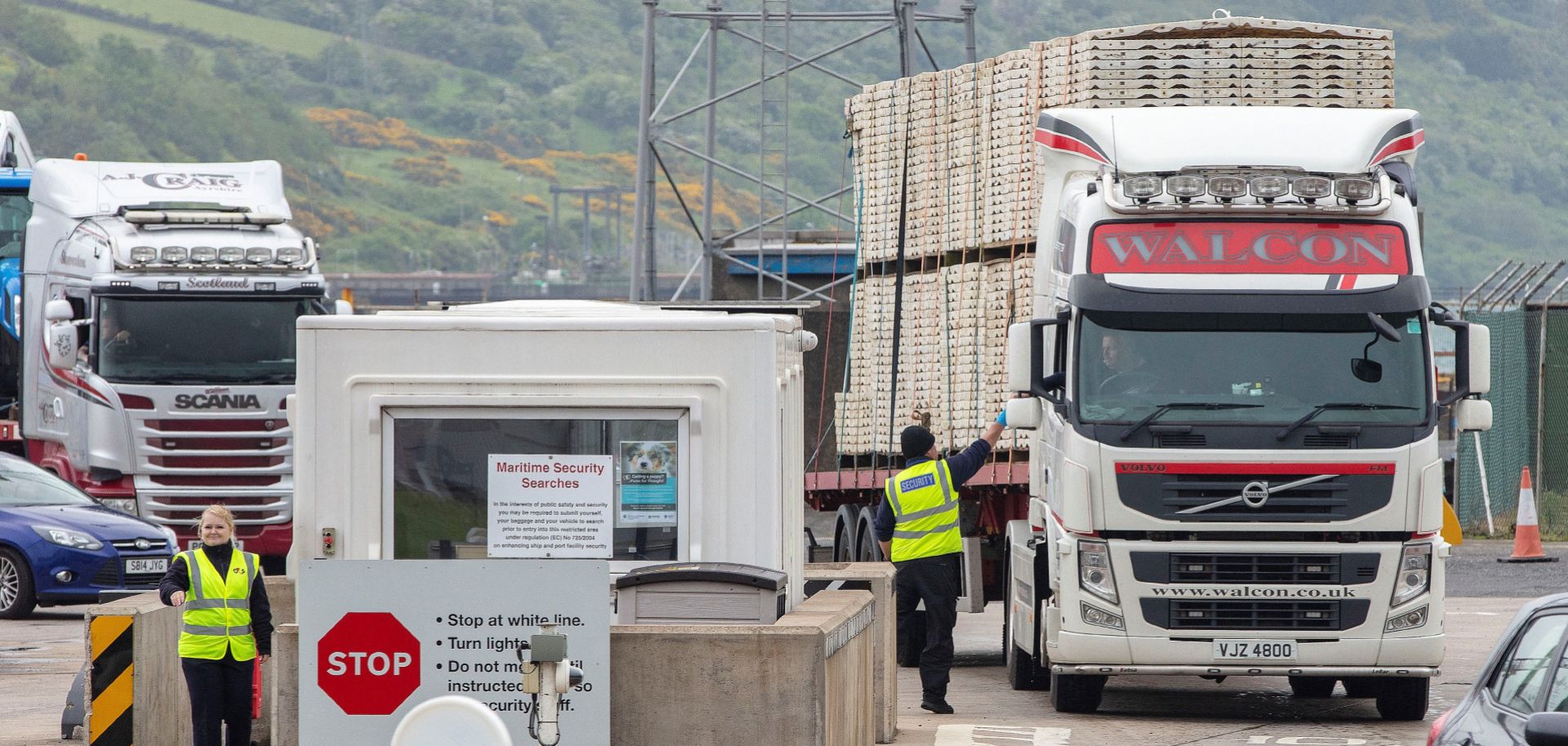
A truck leaves a port near Belfast on May 17, 2022, after the U.K. announced its intention to drastically overhaul post-Brexit trade rules in Northern Ireland.
While a U.K. proposal to unilaterally override parts of the Northern Ireland protocol increases the risk of a trade war with the European Union, it faces constraints on its passage and there will still be opportunities for de-escalation before either side makes any drastic decisions. On June 13, the U.K. government unveiled a bill that would grant British officials the power to override parts of the Northern Ireland protocol, the part of the Brexit agreement that establishes customs and sanitary controls at the Irish Sea. According to the bill, U.K. ministers would have the power to create a “green lane” for U.K. traders sending goods to Northern Ireland that are not meant for the EU single market. These goods would not be subject to any checks and would not need to comply with EU single market rules or standards. Separately, ministers would also be able to create a “red lane” for goods moving from Great Britain to Northern Ireland that are meant to go to the EU single market. These products would be subject to full customs and sanitary checks and would need to comply with EU single market rules and standards. The bill also removes the European Court of Justice (ECJ) as the final arbiter of trade disputes between the European Union and the United Kingdom and calls for “independent arbitration" of any potential disagreements.
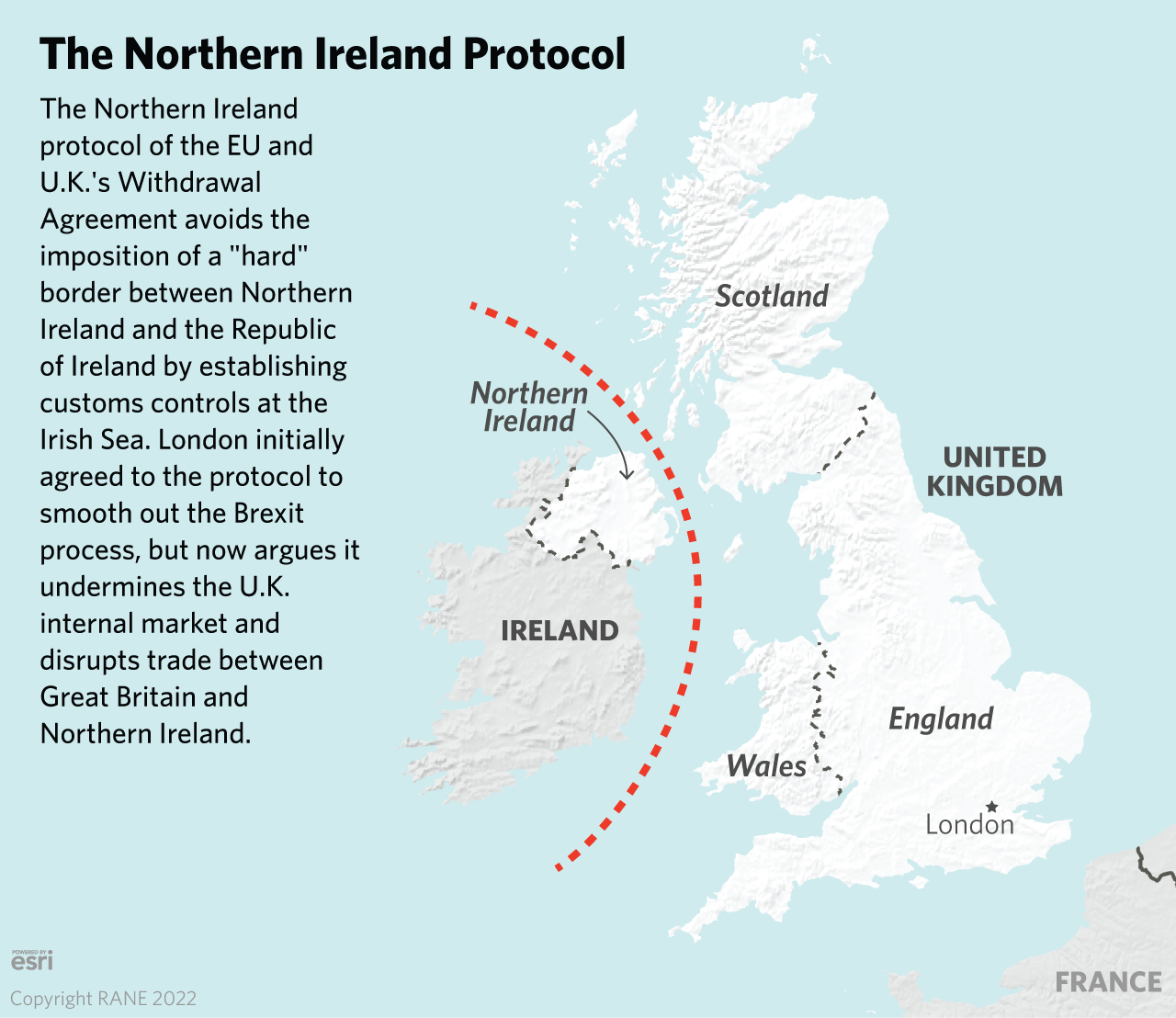
- The goal of the Northern Ireland protocol is to prevent the imposition of a land border between Northern Ireland, which is a part of the United Kingdom, and the Republic of Ireland, which is a member of the EU single market. Under the Brexit deal, the United Kingdom agreed to keep Northern Ireland in the EU single market and adopt customs controls at the Irish Sea. However, the U.K. government now argues that this arrangement undermines the integrity of the U.K. single market and is contributing to friction between Unionist and Republican groups in Northern Ireland.
- In recent months, the European Union has proposed softening the implementation of the protocol. But Brussels still believes that customs and sanitary controls at the Irish Sea are necessary in order to prevent U.K. goods from entering the EU single market illegally. The European Union also believes that the ECJ is the ultimate protector of the EU single market and cannot be removed from the protocol.
The U.K. government will struggle to approve the bill, which will leave the door open to further negotiations with the European Union. While London’s presentation of the proposal marks an escalation in its disputes with Brussels, the parliamentary approval process could be lengthy and changes are possible. Lawmakers from the United Kingdom’s ruling Conservative Party — including those who fear the bill could trigger a trade war with the European Union, think it does not go far enough in overriding the Northern Ireland protocol, or simply want to undermine Prime Minister Boris Johnson’s government — could propose amendments to the proposal or vote against it. Even if the House of Commons approves the bill, the House of Lords (which tends to have more pro-EU views) could delay its approval.
- On June 6, Johnson survived a no-confidence motion triggered by members of his Conservative Party. Around 41% of Conservative lawmakers voted against Johnson, highlighting the fragility of his leadership.
The European Union has options for retaliation but will likely avoid doing so until the U.K. government effectively stops enforcing the Northern Ireland protocol. The European Union has repeatedly warned the United Kingdom that the unilateral violation of the Northern Ireland protocol would result in retaliation from the bloc. On June 13, European Commission Vice-President Maros Sefcovic said that renegotiating the protocol was “unrealistic”. But at this point, Brussels will likely wait for additional political developments in the United Kingdom before inflicting any painful measures against London. The European Union also knows that any retaliatory actions would almost certainly prompt the United Kingdom to respond in kind, which would risk further escalating EU-U.K. tensions. As a result, additional rounds of negotiations are possible where Brussels may be willing to consider further softening customs controls at the Irish Sea in order to reach a compromise. But should the European Union choose to punish the United Kingdom, its options include:
- Political retaliation. The European Union could freeze the implementation of bilateral agreements with the United Kingdom, such as the 95.5 billion euro Horizon Europe funding program for research and innovation. Brussels could also suspend talks with London on issues such as the regulation of their financial markets. Additionally, the European Commission has said it would consider resuming an infringement procedure against the United Kingdom that the commission launched in March 2021 (before freezing it a few months later as a gesture of goodwill), which could result in financial penalties against London. These are relatively low-cost actions that Brussels could take as a first step to show its discontent with U.K. decisions.
- A selective trade war. This would see the European Union impose tariff hikes on selected U.K. goods. Brussels could target politically sensitive goods like fish or agricultural products, which represent a very small fraction of EU-U.K. trade, but are symbolically relevant for the United Kingdom (fishing rights, for example, were a significant obstacle during the Brexit negotiations).
- Ending parts of the Trade and Cooperation Agreement (TCA) with the United Kingdom. This would involve imposing the European Union’s common external tariff on virtually all goods entering the European Union from the United Kingdom, while preserving other areas of the TCA such as tourism or security cooperation. Such a move would severely disrupt EU-U.K. trade and would, in turn, worsen the ongoing inflation crisis in both territories. Bilateral relations would have to deteriorate substantially before Brussels would resort to this option.
- Ending the TCA with the United Kingdom. As a last resort “nuclear option,” the European Union could nix all of the TCA, which primarily covers trade in goods but also covers issues like visa-free travel for U.K. tourists visiting the European Union. This is an extreme and unlikely scenario because it would severely deteriorate the bilateral economic and security relationship and put the European Union and the United Kingdom in the “no-deal” Brexit scenario that both worked for years to avoid.
Even if bilateral tensions continue to rise, there will still be plenty of opportunities for de-escalation. EU-U.K. relations may continue to worsen, but every decision point for both Brussels and London will still include legal constraints and plenty of opportunities for de-escalation. For example, drastic action of canceling the TCA requires a one-year notice, which would create room for avoiding its implementation. The TCA also includes several rounds of arbitration before a final decision is made, which would further delay any permanent outcomes. In the meantime, potential developments in the United Kingdom, as well as Europe and the world more broadly, could still result in a compromise over the Northern Ireland protocol. In the United Kingdom, for example, Johnson’s weakening political position could see the appointment of a new prime minister more willing to negotiate with Brussels. Abroad, the United States may increase pressure on both sides to protect the peace process in Ireland. A severe escalation of the war in Ukraine could also force London and Brussels to put their differences aside to confront Moscow together. Finally, a worsening of the cost of living crises in the European Union and the United Kingdom could make Brussels and London wearier of injecting more uncertainty into European economies by triggering an unnecessary trade war.
