
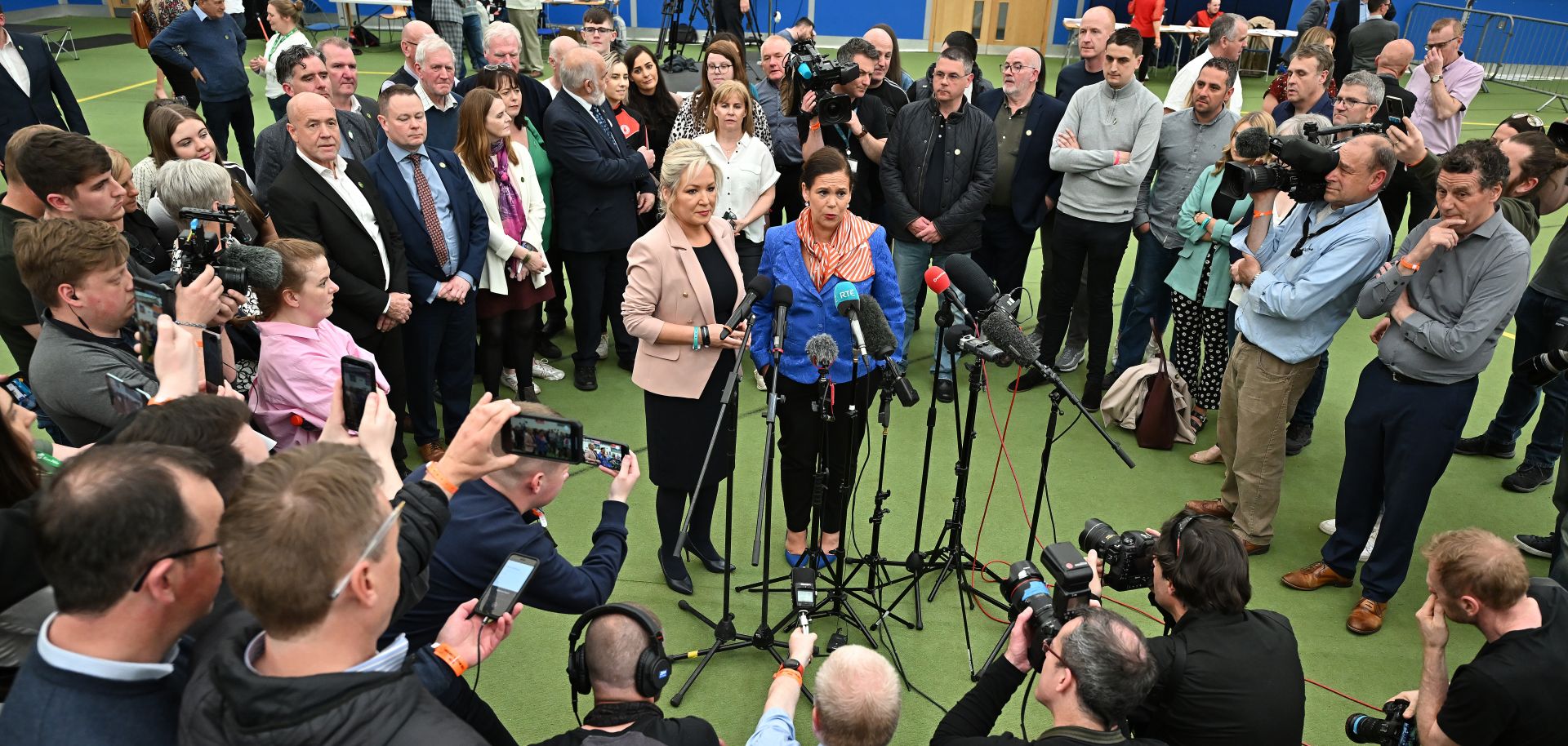
Michelle O'Neill (center, left) and Mary Lou McDonald -- the vice president and president, respectively, of the Irish political party Sinn Fein -- speak to reporters on May 07, 2022, after the results of Northern Ireland's legislative election were announced.
Sinn Fein's victory in Northern Ireland's legislative election will likely create a near-term political crisis and increase the debate over reunification with the Republic of Ireland, but a referendum on the issue is unlikely in the short-to-medium term. The election will also relaunch negotiations between the European Union and the United Kingdom over the Northern Ireland protocol, but a trade war between Brussels and London is still possible. Sinn Fein, Northern Ireland's largest republican party, received 29% of the vote and obtained 27 seats in the Northern Ireland Assembly in a legislative election on May 5. This is the first time the party has won a Northern Irish legislative election, which gives it the power to appoint the region's next First Minister. Meanwhile, the Democratic Unionist Party (DUP) received 21.3% of the vote and 25 seats, and will have the opportunity to appoint a Deputy First Minister. Notably, the centrist Alliance Party — which is neutral on the issue of Northern Ireland's reunification with the Republic of Ireland and does not identify itself with either the Protestant or Catholic communities on the island — ended in the third position, with 15.5% of the vote and 17 seats.
- While Sinn Fein has traditionally backed Irish reunification and has long been associated with the Irish Republican Army (IRA), the issue of a referendum did not feature prominently in its electoral campaign. Instead, the party campaigned on issues like social justice, wealth distribution and the ongoing cost of living crisis in the region.
- The DUP has long been Northern Ireland's main unionist party, but several internal crises have weakened its popularity in recent months. The party has had three different leaders over the past year, while many voters have abandoned the party to support other unionist options.
Sinn Fein's victory will likely create a near-term political crisis in Northern Ireland, while social and political conditions in the region and the broader United Kingdom will make a reunification referendum improbable for several more years. According to Northern Ireland's rules, unionist and republican parties must govern the region together, which means that a government cannot be formed unless Sinn Fein and the DUP agree on it. While in practice the First Minister and the Deputy First Minister have equal powers, the DUP has said it will not join a government led by a Sinn Fein-appointed First Minister. This means that a political crisis is probable, as it could take weeks or even months for Sinn Fein and the DUP to reach a deal. If there is not an agreement within six months, a new election will have to take place. While this likely political crisis will delay any serious discussions about a referendum on Irish reunification, there are structural issues that will also prevent it, even if a government is formed. The authorization of a referendum is a prerogative of the central U.K. government, which has said it is not interested in such a vote in the foreseeable future. Moreover, according to the 1998 Good Friday Agreement (which put an end to decades of sectarian violence in the region), a so-called ''border poll'' can only happen if ''it appears likely'' that ''a majority'' of people in Northern Ireland want it. While this wording is vague, there is a consensus in Northern Ireland that a single regional election is not enough to justify a reunification referendum.
- The U.K. government has the power to govern Northern Ireland directly in times of crisis. But in recent years, London has been skeptical of using this power to avoid escalating political tensions in the region.
- On May 9, the United Kingdom's Northern Ireland secretary Brandon Lewis said London hadn't ''seen a growth in the nationalist vote'' in the May 5 election and that ''the unionist vote [was] still larger,'' as was ''the number of seats held by unionist parties'' in North Ireland's legislature.
- According to Sinn Fein president Mary Lou McDonald, a referendum on Irish reunification should be possible ''within a five-year timeframe.'' This signals that for all its rhetoric, the party is unlikely to push for such a vote in the short-to-medium term.
- The Republic of Ireland's Taoiseach (prime minister), Micheal Martin, said on May 9 that a referendum on Irish reunification ''was not the mandate sought by Sinn Fein in the last three weeks'' and noted that the party's ''whole campaign was on [the] cost of living, on health and on housing.''
London's continued threats to unilaterally abandon the Northern Ireland protocol mean that disruptive tit-for-tat trade sanctions with the European Union are possible, despite incentives to reach a deal. For months, the European Union and the United Kingdom have been negotiating ways to reform the Northern Ireland protocol, a part of the Brexit agreement that establishes customs controls at the Irish Sea to avoid the imposition of a hard land border between Northern Ireland and the Republic of Ireland. In recent weeks, talks significantly slowed down because Brussels and London wanted to avoid any decisions that could impact the electoral process in Northern Ireland. Now that the election has passed, negotiations are likely to gain momentum. While London has repeatedly threatened to unilaterally abandon the deal, it has clear economic incentives to reach an agreement with Brussels. Should the United Kingdom ignore or violate the protocol, the European Union would retaliate with trade tariffs, which in turn would result in British counter-tariffs. The United Kingdom will likely seek to avoid such a trade war at a time of rising inflation and increasing social discontent amid the higher cost of living. U.K. Prime Minister Boris Johnson also has personal incentives to avoid a trade war at a time when several members of his Conservative Party are questioning his leadership skills. Nonetheless, London could still try to escalate the dispute with Brussels to obtain concessions from the European Union, and Johnson may seek to distract voters and his party from domestic political and economic issues. This means that a trade dispute with the European Union, which would do damage to both economies, cannot be ruled out if London's political calculations take precedence over economic ones.
- According to the United Kingdom, if the Northern Ireland protocol is fully implemented, it will fragment the United Kingdom's internal market by disrupting trade between Great Britain and Northern Ireland. While the European Union has made proposals to reduce customs checks and red tape at the Irish Sea as much as possible, Brussels insists that customs controls are necessary to prevent the movement of goods that do not comply with the terms of the EU-U.K. free trade agreement.
- The United Kingdom has also raised concerns about the European Court of Justice's role as the arbiter of the Northern Ireland protocol, arguing London will not be subject to the rulings of a foreign court. Other EU trade deals include arbitration panels to solve disputes regarding implementation, which means this is more of a political dispute and not so much a technical one.
- Northern Ireland's DUP is critical of the protocol and demands London completely amend it or outright exit it. The party is also citing its concerns with the protocol (which republicans tend to support) as one of its reasons for not forming a government with Sinn Fein. In its negotiations with the European Union, the United Kingdom is likely to argue that the protocol must be significantly modified in order to have a stable government in Northern Ireland.
- As a guarantor of the Good Friday Agreement, the United States has repeatedly called on the United Kingdom to reach a deal with the European Union and avoid any unilateral decisions that could destabilize Northern Ireland. Pressure from the United States could also play a role in an eventual U.K.-EU compromise on the issue.
- On May 8, U.K. Deputy Prime Minister Dominic Raab said London wanted to ''fix'' the protocol quickly and noted that while he did ''not want to escalate some of the tensions (with the European Union)...nothing was 'off the table''' regarding the possibility of taking unilateral action.
