
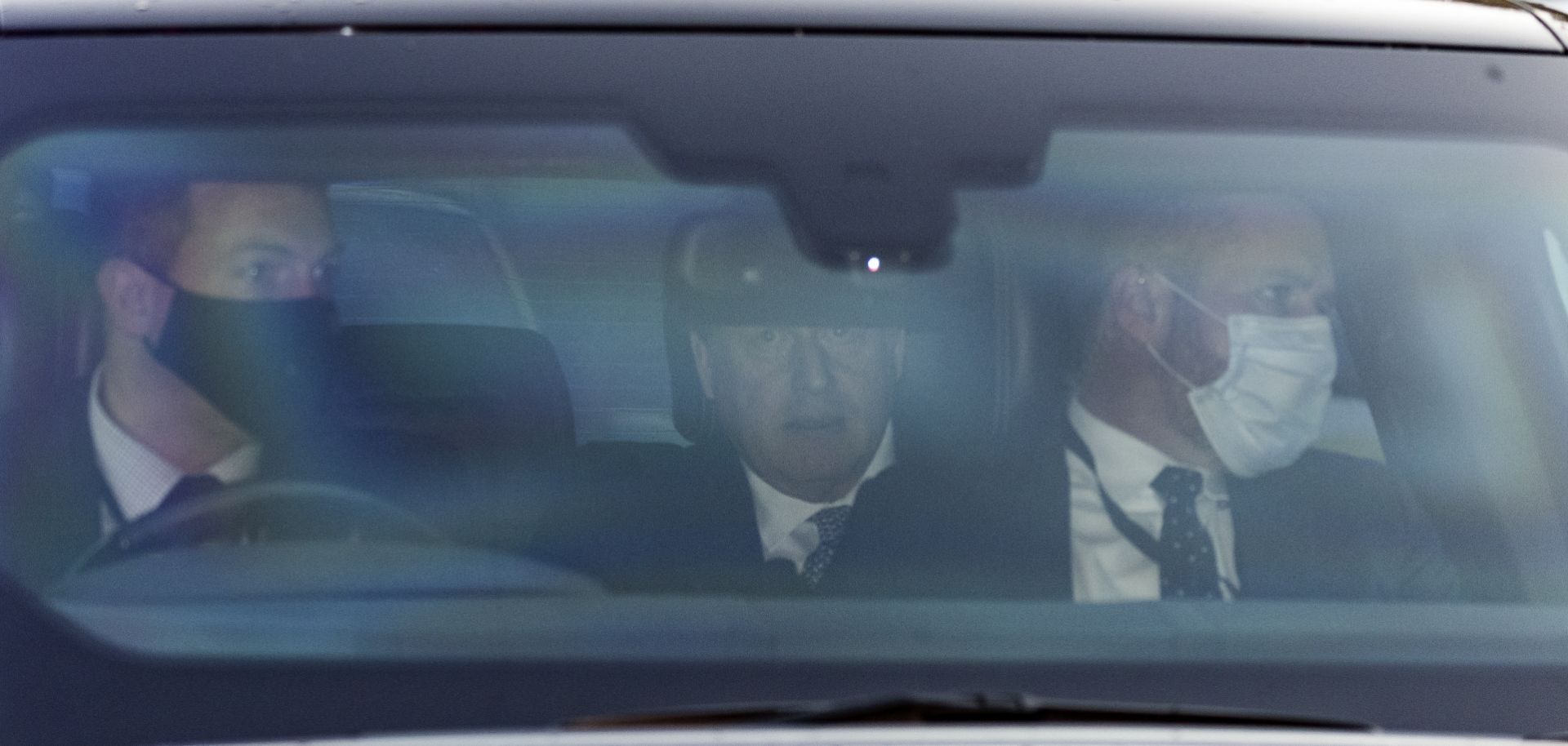
U.K. Prime Minister Boris Johnson (center) is seen in the backseat of a car in London, England, after a Prime Minister's Questions (PMQ) session in Parliament on Jan. 12, 2022.
A series of political scandals and economic issues facing the U.K. government could result in the appointment of a new prime minister, but an early general election is unlikely, reducing the probability of abrupt policy changes in the short-to-medium term. U.K. Prime Minister Boris Johnson is in a fragile position amid continued reports that senior members of the British government held parties in 2020 while the country was in lockdown, fueling criticism about the government’s double standards in imposing COVID-19 restrictions. The opposition Labour Party has openly called for Johnson’s resignation. Some members of his governing Conservative Party have also expressed discomfort with the government’s scandals.
- In late 2021, U.K. media reported government officials held a Christmas party at Downing Street in 2020 that allegedly violated the lockdown measures in place at the time. While these reports were politically damaging for Johnson, there was no evidence he actually participated in the event. On Jan. 10, however, U.K. media reported another party took place at Downing Street in May 2020 when the country was also under strict social distancing rules, which Johnson did attend.
- On Jan. 12, Johnson apologized at the House of Commons for participating in the May 2020 gathering, which he described as “a work event.” After Johnson’s statement, Labour leader Keir Starmer said the prime minister should resign. According to a YouGov survey published on Jan. 11, 56% of U.K. voters also think Johnson should step down over the scandal.
Even if Johnson survives the current crisis, anger against his government could increase again in April when U.K. households are hit with both higher taxes and increased electricity bills. A new price cap for electricity bills will enter into force in April. As energy prices have risen significantly in recent months, the new cap (which energy regulator Ofgem will unveil on Feb. 7) is likely to be much higher than the current one, which will result in higher electricity bills for many households. Also in April, National Insurance contributions (which are paid by employers, employees and the self-employed) will increase by 1.25%. Both changes will result in a higher cost of living for most people, at a time when inflation is also on the rise (inflation exceeded 5% at the end of 2021 and is expected to reach around 6% by April). These developments could further weaken Johnson’s popularity and generate discontent within the Conservative Party.
- To soften the blow of rising electricity prices, opposition lawmakers have called for increased government subsidies and assistance for low-income households. Conservative lawmakers, meanwhile, have demanded the abolishment of the value-added tax (VAT) on electricity bills. The U.K. government has said it is working on measures to address the issue, but has so far rejected both proposals.
- Some prominent members of the Conservative Party have also called for the United Kingdom to scrap the planned hike in National Insurance contributions, but the government argues that the additional state revenue will be used to increase spending in the healthcare sector amid the ongoing COVID-19 crisis.
If Johnson resigns or is ousted, his party would likely appoint a replacement and avoid a general election. This means that political uncertainty is likely to grow but a change in government is improbable. There are three ways the ongoing political crisis in the United Kingdom could unfold in the coming weeks:
- Johnson is replaced by a new prime minister. This could happen in two ways. The Conservative Party could trigger a leadership challenge against Johnson to try to replace him with a more popular party leader. To do this, 54 of the 360 Conservative members of parliament would need to request a leadership vote to the party’s so-called 1922 Committee (so far, there is no evidence of any Conservative lawmakers making this request). Alternatively, Johnson could resign, which would also trigger a leadership vote within the Conservative Party. In either case, the new Conservative leader would automatically become prime minister. While Johnson’s replacement would likely distance themselves from some of his policies, the appointment of a new prime minister from the same party would overall portend greater policy continuity and, in turn, political certainty compared with a general election, where a center-left government could replace the current Conservative government.
- Johnson stays in power. This could happen if the Conservative Party does not launch a leadership challenge against him, or because there is one and he wins it. Conservative Party rules establish that another challenge cannot happen for a year, which would somewhat solidify Johnson’s position. Still, this would be an unpopular government that may struggle to get things done and would be under frequent threats of collapse.
- An early general election is scheduled. In order to end the political crisis, the U.K. government could ask Parliament to approve an early general election. But this is the least likely of the three scenarios, as opinion polls suggest that Labour could win an early vote. This means that the government will probably not risk holding an early election it could lose.
