
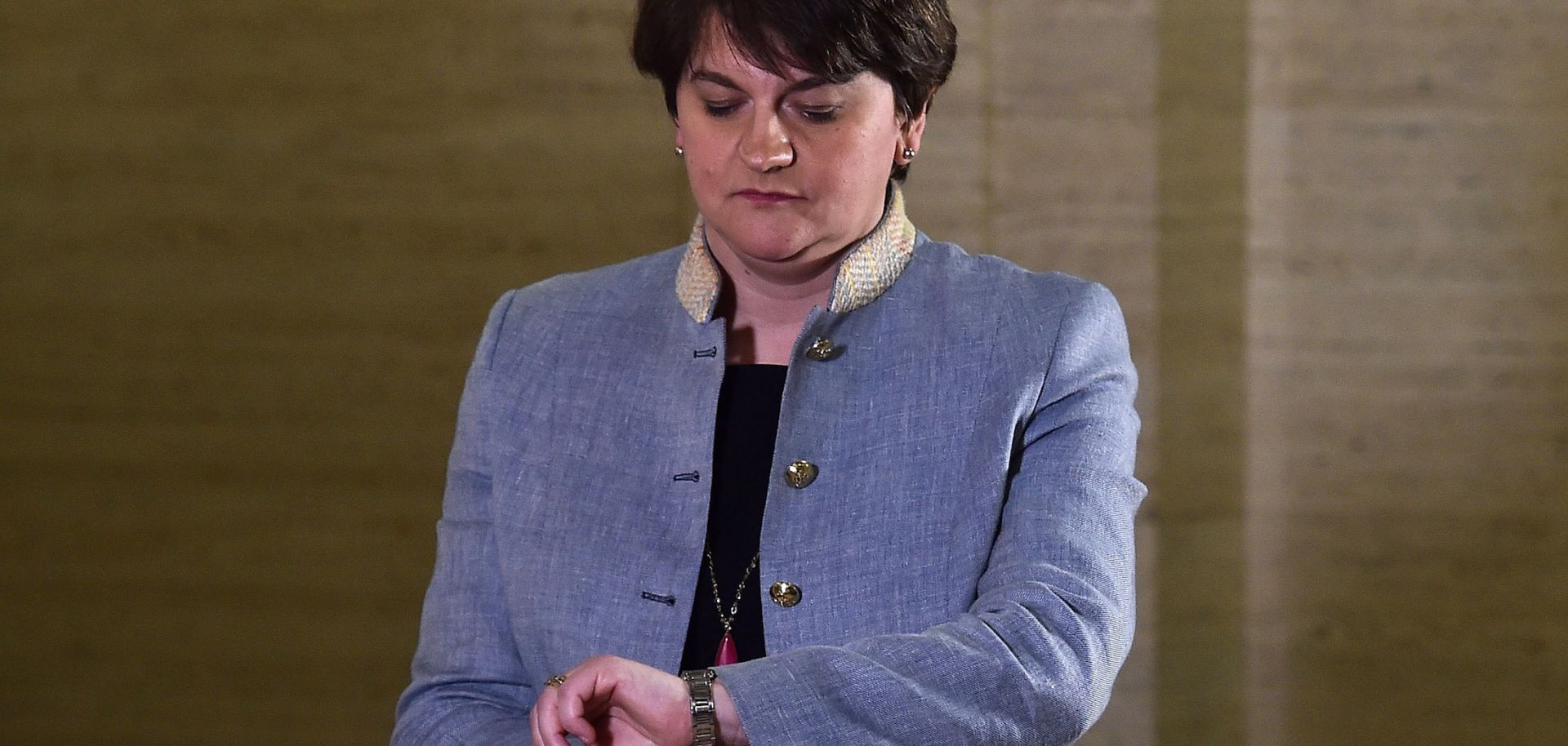
Northern Ireland’s first minister and leader of the Democratic Unionist Party (DUP), Arlene Foster, looks at her watch outside the Parliament Buildings in Belfast in January 2020.
The replacement of Northern Ireland’s first minister with a more hard-line leader could make it harder for unionists and republicans to cooperate in the implementation of the EU-U.K. Withdrawal Agreement, inspire new rounds of riots in the region, and ultimately jeopardize London and Brussels’ free trade agreement. On April 28, Arlene Foster announced she will step down as Northern Ireland’s first minister at the end of June and as leader of the Democratic Unionist Party (DUP) on May 28 amid growing calls for her exit within the party. Foster’s announcement comes a day after a group of more than 20 DUP members in both the Northern Irish Legislative Assembly and U.K. Parliament signed a letter withdrawing their confidence in Foster’s leadership. A small group of DUP members from the Northern Irish legislature and the U.K. Parliament — most of whom signed the letter — will now be tasked with appointing a new party leader.
- A significant number of DUP party members accused Foster of not doing enough to oppose the Northern Ireland protocol of the 2019 EU-U.K. Withdrawal Agreement, which imposes customs controls at the Irish Sea and has led to disruptions in trade between Great Britain and Northern Ireland.
- Some DUP members also criticized Foster for not defending the party’s conservative values enough, pointing most recently to her decision to abstain in a recent vote where the Northern Irish legislature passed a motion calling for the introduction of a ban on gay conversion therapy.
Stronger criticism of the Northern Irish protocol could result in new protests, riots and acts of sabotage in the region. If Foster is replaced with a more hard-line member of the DUP, it could make cooperation with the republican Sinn Fein party, which shares the regional government with the DUP, even more difficult. This could paralyze the decision-making process in the Northern Irish legislature and eventually lead to the collapse of the government. A more hard-line first minister could also lead to louder criticism of the Northern Ireland protocol, making it harder for unionists and republicans to work together on its implementation. Even if the DUP publicly condemns violence, heated rhetoric against the Brexit status quo could still inspire people to engage in acts of violence in the region.
- According to the Northern Ireland Act 1998, unionist and republican political parties must govern Northern Ireland together. The unionist DUP currently shares the executive branch with the republican Sinn Fein.
- According to Northern Irish media, one of the DUP’s top candidates to replace Foster is Agriculture Minister Edwin Poots, a vocal critic of the Northern Ireland protocol.
- In recent weeks, there have been repeated riots and attacks against the police in unionist areas of Northern Ireland, including Belfast and Derry. Customs workers in Northern Ireland have also denounced graffiti and other forms of intimidation from critics of the Northern Ireland protocol.
Stronger unionist opposition to the Northern Ireland protocol could force the British government to further delay its full implementation, which in turn could reduce the probability of a compromise with the European Union and threaten the EU-U.K. free trade agreement. Per the conditions outlined in the Withdrawal Agreement, Northern Ireland remains aligned with EU rules though the rest of the United Kingdom has left the EU single market and the customs union. Brussels wants to prevent Northern Ireland from becoming a place where goods enter illegally into the EU single market, and wants London to enforce customs controls at the Irish Sea. Without these controls, it would be hard for Brussels to ensure the correct implementation of the EU-U.K. trade deal. But London continues to delay the full implementation of these controls, arguing that it does not want to disrupt trade between Great Britain and Northern Ireland. While Brussels has threatened to take legal action against London, the two sides are currently in negotiations to reach a compromise.
- Full customs controls at the Irish Sea were scheduled to enter into force in April, but London unilaterally decided to keep current customs waivers in place until October.
