
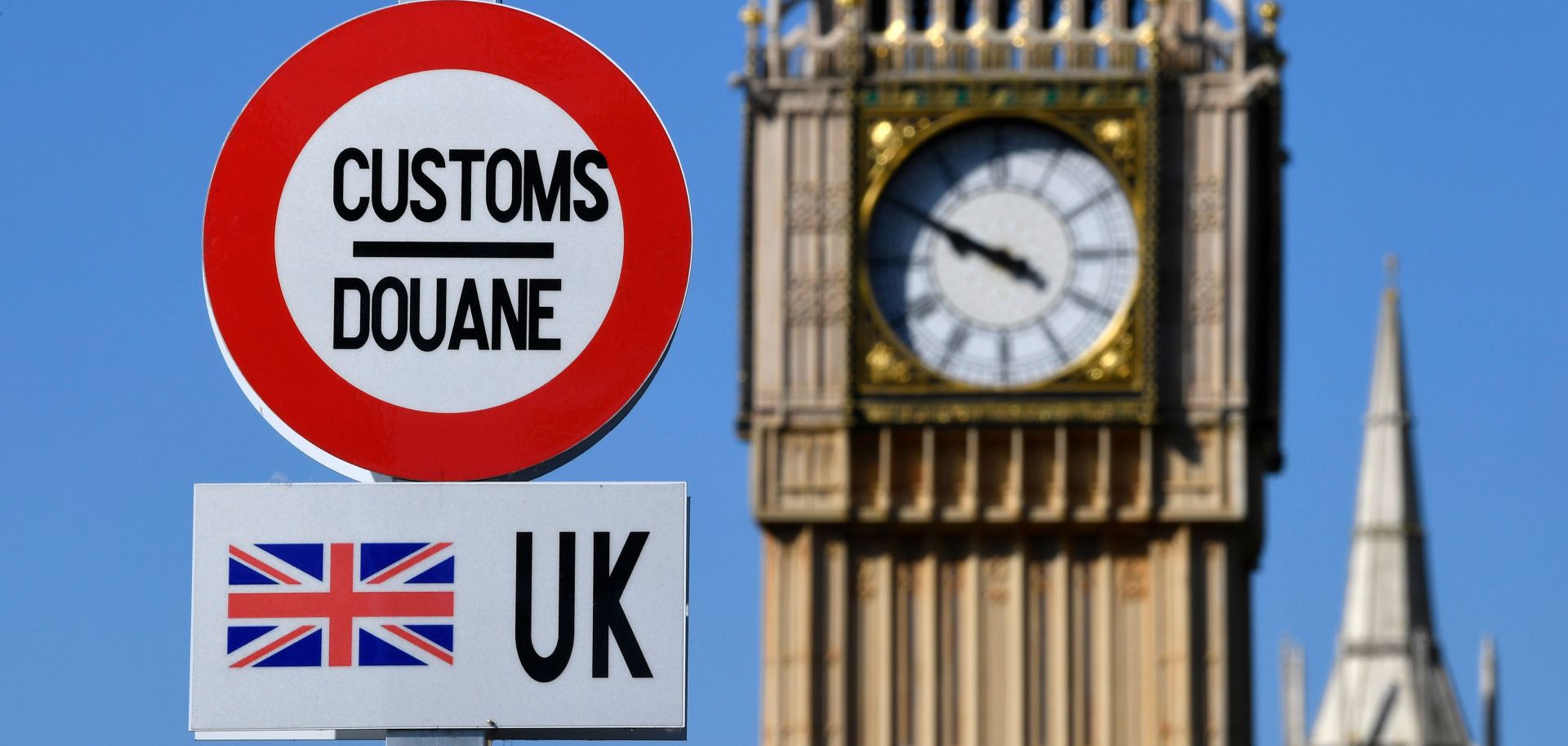
A model of a customs road sign is seen at the mock U.K.-EU border at the Mini-Europe theme park in Brussels, Belgium, on May 20, 2020.
If the current tensions in the trade talks between the United Kingdom and the European Union feel like a repetition of the 2019 disputes, when Britain negotiated its exit from the bloc, it’s because they are. Once more, a no-deal Brexit looms on the horizon, because unless Brussels and London reach an agreement, bilateral trade will happen under World Trade Organization tariffs starting next year. Like last year, both sides are exchanging threats and accusing each other of acting in bad faith. And, in the most notable deja vu from 2019, the status of Northern Ireland has reemerged as an obstacle to a deal. The explanation for this situation is simple: there are fundamental issues that the arrangements of 2019 left unresolved and have come back to jeopardize the negotiations in 2020.
An Ongoing Loop of Disputes
The European Union and the United Kingdom have spent most of the year arguing about the former’s demand that the latter remain aligned with EU single market rules on state aid to companies, workers’ rights, and environmental standards, as well as issues such as the future role of the EU Court of Justice on EU-U.K. affairs and the bloc’s access to U.K. fishing waters. Several rounds of negotiations have taken place since March, making little progress. London and Brussels have said that they want a deal in October, but the deadline may prove too optimistic.
Britain’s reluctance to make concessions on the EU requests is explained by the fact that it wants to regain as much control of its internal policies as possible. After all, Brexit was about “taking back control,” and a country cannot be fully sovereign if an external actor dictates what its labor or environmental standards should be. One of the reasons for leaving the bloc, Brexit supporters argue, was to break free from what they perceive as a cumbersome and often inefficient system of norms and regulations.
The European Union is also defending its strategic goals: even if Brexit will have a negative impact on the British economy in the immediate term, Brussels does not want London to become a competitor over the long term. The European Commission is concerned about a “race to the bottom” on regulations, standards, state aid and taxes that would drive investment away from the Continent to the United Kingdom, a country that will continue to be an attractive place for businesses no matter what happens with Brexit. The European Union is also worried that a successful Brexit could inspire other euroskeptic political forces in the bloc to make similar demands.
These conflicting interests were clear when the United Kingdom left the European Union on Jan. 31, but at the time, did not seem impossible to overcome. The decision to keep the United Kingdom in the single market for another year seemed a sensible plan to allow London and Brussels to first reach a trade deal. In early September, however, a new obstacle emerged when the U.K. government unveiled its Internal Market Bill, which proposes giving Britain the power to make unilateral decisions on issues such as state aid and customs controls in Northern Ireland.
This violates some aspects of the 2019 EU-U.K. Withdrawal Agreement, which made Brexit possible. In that document, London and Brussels agreed to keep Northern Ireland aligned with EU single market rules, as well as create a joint committee to deal with bilateral disputes. These arrangements were necessary to keep the border open between the Republic of Ireland (which remains an EU member state) and Northern Ireland (which left the European Union alongside the rest of the United Kingdom) and honor the 1998 Good Friday Agreement that brought an end to decades of sectarian violence on the island. They were also meant to prevent the Irish border from becoming an entry point for unauthorized goods into the European Union.
Opposing Geopolitical Imperatives
With the Internal Market Bill, U.K. Prime Minister Boris Johnson is forcing an interpretation of the Withdrawal Agreement that favors Britain’s interests and pleases the more hawkish elements of his Conservative Party who were never happy with the document. The bill is probably a part of London’s strategy to raise the stakes in trade negotiations and extract concessions from Brussels. The U.K. government could delay the approval and implementation of the bill for weeks, or even months, in order to allow for the negotiations with the European Union to continue.
But while these short-term tactical calculations have played a role in recent events, London’s actions are ultimately connected to strategic issues. Britain is uncomfortable with the idea of sharing the management of Northern Ireland, a part of its territory, with the European Union. That’s why it wants the power to act unilaterally, even if Johnson has promised this would only happen as a last resort and with parliamentary authorization. The British government is also wary of any decisions that would fragment the United Kingdom’s internal market and give Northern Ireland a different status, which is not a minor concern for a country with separatist movements in both Northern Ireland and Scotland.
Brexit is threatening two of the United Kingdom’s most basic geopolitical imperatives: the political unity of the island of Great Britain (for which the union with Scotland is key) and the need to secure the immediate seas around it (for which a foothold in Ireland is important). These imperatives have driven London’s actions for centuries, and are still relevant to this day. Johnson’s personality and predilections certainly play a role in the ongoing clashes with the European Union, but there are geopolitical factors at play that would influence the United Kingdom’s actions no matter who was in power.
At the end of the day, London’s actions are about its political and economic ties with Europe as much as they are about the continuity of the United Kingdom in its current form, and the preservation of its sovereignty vis-a-vis a continental bloc where the sovereignty of its member states has been eroded. If the tactical aspects of the negotiations between the European Union and the United Kingdom are so hard to reconcile, it is because they are connected to strategic priorities in both negotiators. Many of these questions were postponed in 2019 in order to make Brexit happen, but they cannot be delayed indefinitely.
A Toxic Negotiating Environment
If approved in its current form, the Internal Market Bill will reduce the probability of a trade agreement between the United Kingdom and the European Union this year. Brussels wants London to scrap the bill, or else it would take legal action and consider financial sanctions against the United Kingdom. This is not the most propitious environment to reach a trade deal. The irony is that a comprehensive free trade agreement would probably make the bill irrelevant because there would be no quotas, tariffs or regulatory divergence between the United Kingdom and the European Union to justify London taking unilateral measures. But the risk of a no-deal British exit from the single market is making London believe that it needs a law to protect its internal market in case it happens, in the same way that the European Union saw the Northern Ireland clauses of the Withdrawal Agreement as a safeguard against a no-deal British exit from the bloc in 2019.
The bill also reduces the probability of a trade agreement between the United Kingdom and the United States, because if Britain walks away from the Withdrawal Agreement and fails to reach a trade deal with Brussels, a hard border between Northern Ireland and the Republic of Ireland may be needed. This would not necessarily lead to a return to sectarian violence in the island, but it would be a significant step back after decades of integration. The United States is a guarantor of the Good Friday Agreement, and many lawmakers in the U.S. Congress would oppose a trade deal with a country that has undermined it. The Internal Market Bill has further complicated Washington and London’s trade negotiations, which were already facing significant obstacles over issues such as agri-food products.
None of these risks is permanent. Even if there is not a trade deal with the European Union in 2020, London will eventually return to the negotiating table with Brussels and resume trade talks with the White House. The United Kingdom is both a European and an Atlantic country whose strategic interest is to keep close ties with the European Union and the United States. But in the immediate term, London’s decisions could do significant damage to the British economy, especially if a no-deal exit from the EU single market coincides with the long-term economic problems created by the COVID-19 pandemic.
The ongoing disputes between the European Union and the United Kingdom mirror those of 2019 because both players are trying to find a balance between preserving as much of their trade ties as possible, while making as little concessions on their strategic interests as they can. An EU-U.K. trade deal is still possible because of the deep economic, political and social links between the two sides and because London and Brussels want to avoid additional economic pain amid a pandemic-induced global recession. But even if there is a deal, it will probably leave many aspects of the bilateral relationship unaddressed. Indeed, the United Kingdom and the European Union’s conflicting interests mean that their interactions will continue to be problematic long after the current stalemate over the Internal Market Bill is over.
