
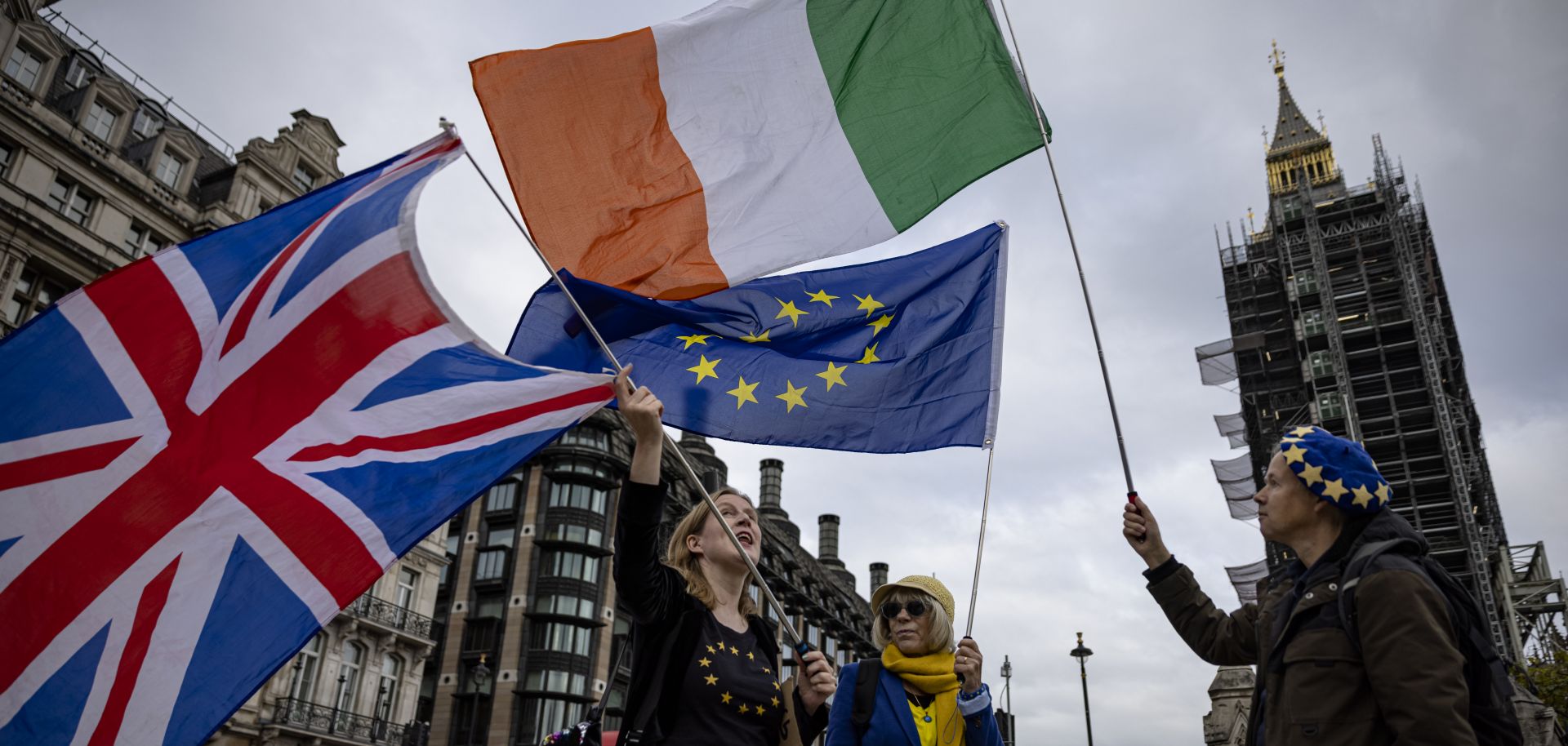
Anti-Brexit protesters wave the flags of the United Kingdom, Ireland and the European Union outside the U.K. Parliament building in London on Oct. 13, 2021.
Recent moves by the European Union and the United Kingdom suggest their dispute over the Northern Ireland protocol could be resolved in the coming weeks, which would not only defuse the threat of a trade war but open the door to greater EU-U.K. cooperation in other areas. In recent months, the United Kingdom has threatened to suspend the Northern Ireland protocol of the Brexit agreement, which establishes customs controls at the Irish Sea, arguing that it causes trade disruptions between Great Britain and Northern Ireland. The European Union has shown willingness to discuss the issue, though it has threatened to impose trade sanctions on the United Kingdom if it makes good on this threat. Both sides have recently made moves to deescalate tensions, indicating a mutual desire to reach a compromise and avoid a trade war. The United Kingdom’s Brexit minister, David Frost, will meet with EU negotiator Maros Sefcovic in Brussels, to discuss the issue on Nov. 19.
- The European Union has suspended the announcement of potential trade sanctions against the United Kingdom, which were scheduled for presentation the week of Nov. 15. The options allegedly included imposing tariffs on some U.K. products and, in an extreme case, scrapping the free trade agreement London and Brussels signed last year. According to unnamed EU officials quoted by European media, Brussels chose not to escalate the dispute to make room for a deal over the Northern Ireland protocol.
- In October, the United Kingdom threatened to suspend the protocol unless significant progress was made by early November. U.K. officials then leaked to British media that London was considering suspending the protocol after the U.N. COP26 climate summit in Glasgow, which ended Nov. 12. The passing of both deadlines with no concrete action suggests that London also believes a deal is possible.
The main obstacle to an EU-U.K. deal that softens customs controls at the Irish Sea remains the Court of Justice of the European Union (CJEU)’s role in supervising the protocol. In the 2019 Brexit deal, the United Kingdom agreed to keep Northern Ireland in the EU single market. For this reason, Brussels argues that the CJEU should be the ultimate arbiter of any disputes in the implementation of the Northern Ireland protocol. But the United Kingdom has said it won’t be subject to a foreign court of justice and wants to create a separate body to settle bilateral disputes. A compromise on the CJEU’s role is possible if Brussels agrees to create a panel to settle trade-related disputes (as is the case in many free trade agreements), and if the United Kingdom accepts to preserve the CJEU’s role in issues concerning single market rules. While politicians and trade experts have suggested this solution in recent weeks, there are no signs that EU and U.K. officials have talked about it.
- In June, the European Commission presented a plan to allow medicines to flow freely between Great Britain and Northern Ireland. Then in October, it proposed to soften sanitary and phytosanitary rules at the Irish Sea (which, according to Brussels, will reduce customs checks by 80%), as well as reduce paperwork regarding the movement of goods by half.
Even if the United Kingdom suspends the Northern Ireland protocol, the two sides would likely still have several weeks to reach a compromise before EU retaliatory measures enter force. The United Kingdom’s legal tool to suspend customs checks at the Irish Sea is Article 16 of the Northern Ireland protocol, which allows either of the signatories to suspend its implementation in the case of “serious economic, societal or environmental difficulties” or a “diversion of trade.” While invoking this article would represent a significant escalation in bilateral political tensions, it would not have a substantial effect on the ground since the European Union and the United Kingdom agreed in September to suspend most customs controls at the Irish Sea for an indefinite period to negotiate a revision of the protocol. Moreover, the protocol establishes that the parties must notify each other a month in advance of triggering Article 16 and set a formal dispute process to look for a solution. As a result, even if the United Kingdom triggers Article 16, the European Union’s retaliation is unlikely to enter into force immediately, leaving room for a compromise.
The threat of creating additional economic disruptions and instability will be a powerful motivator in reaching an agreement that avoids a trade war. A slowing global economy could dissuade the United Kingdom and the European Union from creating more political and economic uncertainty between late 2021 and early 2022. The United States, which is a guarantor of the 1998 peace agreement in Northern Ireland, has also repeatedly asked the United Kingdom not to do anything that would jeopardize social stability in the region. Considering that one of the United Kingdom’s main post-Brexit goals is to preserve its close alliance with Washington, pressure from the White House may also compel London to find a solution.
In addition to avoiding trade disruptions, a deal over Northern Ireland could pave the way for EU-U.K. agreements in other areas like financial services and research. Because of disputes over the Northern Ireland protocol, the European Union and the United Kingdom have made little progress in the negotiations over a deal to grant companies in the United Kingdom’s financial services sector greater access to the EU single market. Brussels and London have also made insufficient progress in conversations to include the United Kingdom in the Horizon Europe program, a seven-year EU research funding scheme. Progress in both areas will be more likely if there is an amicable solution to the Northern Ireland protocol dispute.
