
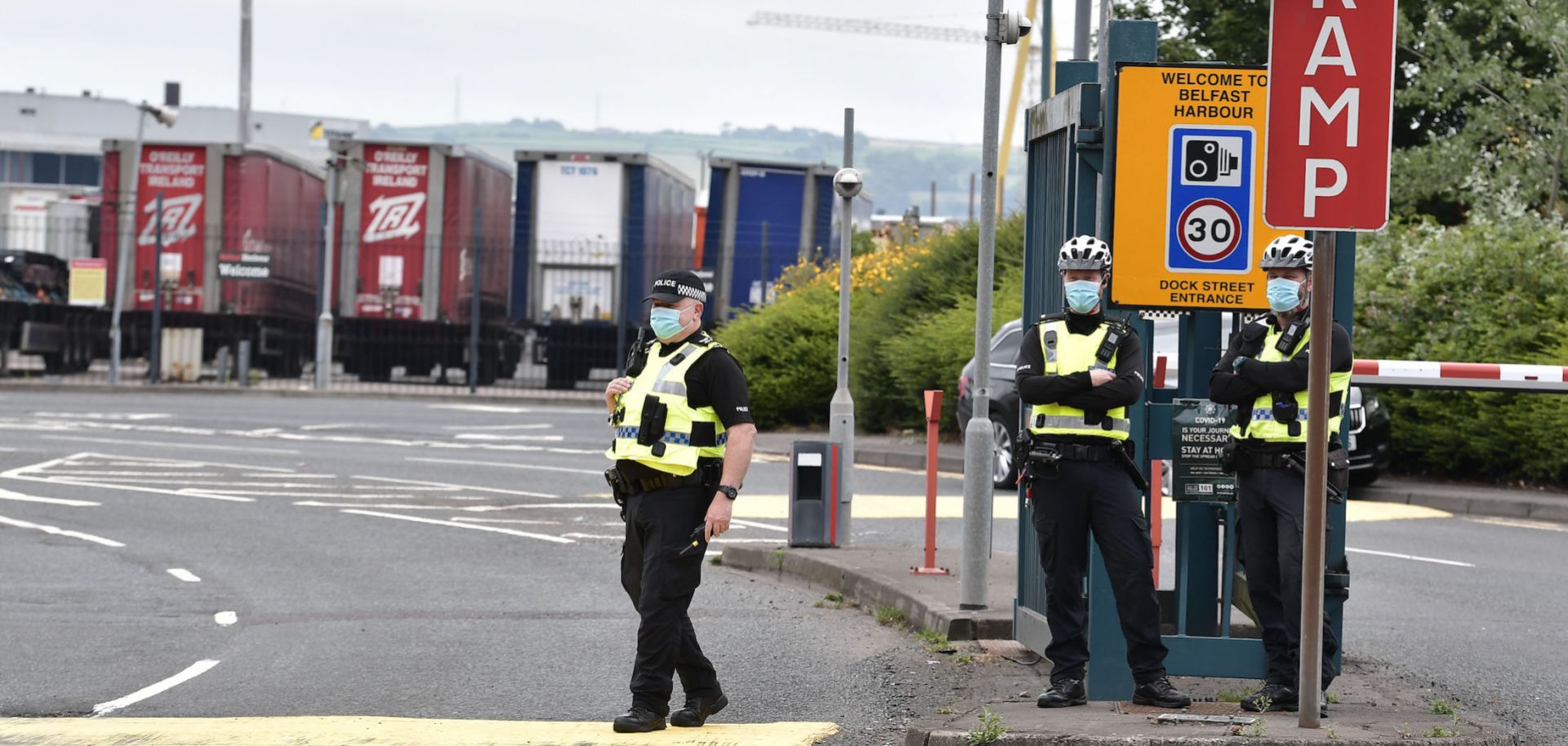
Police officers stand guard as pro-British loyalists protest against the Northern Ireland protocol at Belfast Harbour on July 3, 2021.
Should the United Kingdom follow through on its threat to suspend the Northern Ireland protocol, it’d kick off a new round of tense negotiations with the European Union — increasing the chances of tariff hikes that could jeopardize their free trade agreement, while undermining other aspects of the bilateral relationship. The United Kingdom’s Brexit Minister, David Frost, said during the annual conference of the Conservative Party on Oct. 4 that the British government was ready to suspend parts of the EU-U.K. Northern Ireland protocol unless Brussels agreed to reform it. At a separate event later that day, Frost added that the United Kingdom would make such a decision if no progress was made in three weeks, setting early November as a potential date for an escalation of the conflict with the European Union.
- The Northern Ireland protocol is a central part of the Brexit legal architecture. According to the protocol, customs controls should take place at the Irish Sea in order to keep the land border between Northern Ireland and the Republic of Ireland open, in line with the 1998 Good Friday peace agreement in the region.
- The U.K. government has been critical of the protocol since it entered into force on Jan. 1, arguing that it has created unexpected disruptions in trade between Great Britain and Northern Ireland.
- Unionist political parties in Northern Ireland reject the protocol as well, arguing it has created a separate legal status for the region that could be a prelude to reunification with the republic in the south. The Democratic Unionist Party (DUP) has said that, unless the protocol is scrapped, it will exit the government in Northern Ireland, which could trigger an early regional election.
- The United States, which is a guarantor of the Good Friday Agreement, has repeatedly called on the U.K. government to respect the protocol and to refrain from taking any actions that could result in a return to sectarian violence in Northern Ireland.
Further negotiations are likely, but Brussels and London’s conflicting goals will create obstacles to a compromise. According to Article 16 of the Northern Ireland protocol, the European Union and the United Kingdom can suspend its implementation if the deal is causing “serious economic, societal or environmental difficulties that are liable to persist.” However, the wording of this article is vague, which is why London is currently arguing that it is legally allowed to suspend the implementation of the protocol. Triggering Article 16 would only suspend the protocol, not abolish it, and would also launch a period of consultations between the European Union and the United Kingdom to reach a compromise on the implementation of the agreement. Moreover, Brussels and London would have to notify each other of their intent to suspend parts of the protocol a month in advance, which creates further opportunities for negotiations. But even if triggering Article 16 doesn’t scrap the Northern Ireland protocol, the action itself would still significantly escalate EU-U.K. tensions, exacerbating the already deep mistrust between London and Brussels over the issue.
- In September, the United Kingdom unilaterally decided to waive the full implementation of customs controls for an indefinite period and asked the European Union to renegotiate the protocol. London has proposed to label British goods differently depending on whether their final destination is Northern Ireland or the EU single market, which would theoretically eliminate the need for customs controls at the Irish Sea. London also wants to remove medicines from the protocol altogether, so that they can move freely between the United Kingdom and the European Union, and to remove the European Court of Justice’s role as the arbiter of the agreement.
- While the European Union has agreed to discuss ways to make customs controls less intrusive, it has rejected a complete renegotiation of the document. The European Union is worried that, without customs controls, U.K. goods will enter the bloc’s single market illegally.
Failure to resolve this dispute could lead to an escalation of tit-for-tat tariff hikes, which would disrupt EU-U.K. trade and potentially undercut cooperation on other political, economic and security issues. The European Union and the United Kingdom reached a free trade deal in late 2020 that covers most goods and a limited number of services. This deal could be severely weakened if Brussels and London increase tariffs on each others’ imports in retaliation for their disputes over Northern Ireland. Moreover, disputes over the Northern Ireland protocol could result in clashes over other issues like fishing rights, security and trade in services, which would weaken overall EU-U.K. cooperation.
- While the Brexit deal covers fisheries, France has repeatedly accused the United Kingdom of restricting access to its territorial waters to French fishermen in places like the island of Jersey. In response, French government officials have threatened to impose drastic measures, such as reducing electricity exports to the United Kingdom.
- The Brexit deal calls for continued negotiations to grant companies in the United Kingdom’s financial sector greater access to the EU single market. An escalation in tit-for-tat punitive measures between London and Brussels could further complicate negotiations on this issue, where progress has already been slow.
- In the wake of Brexit, France, Germany and Italy, as well as several Central and Eastern European countries, expressed interest in keeping close defense and security cooperation with the United Kingdom, including the joint production of arms and equipment. However, the strategic agreement between the U.S., Australia and the United Kingdom in September has since strained U.K.-France relations, with Paris now calling to deepen the European Union’s “strategic autonomy” on defense — potentially without London. An escalation of Brexit-related disputes could further cement opposition from France and other EU members to include the United Kingdom in the bloc’s future defense and security plans.
