
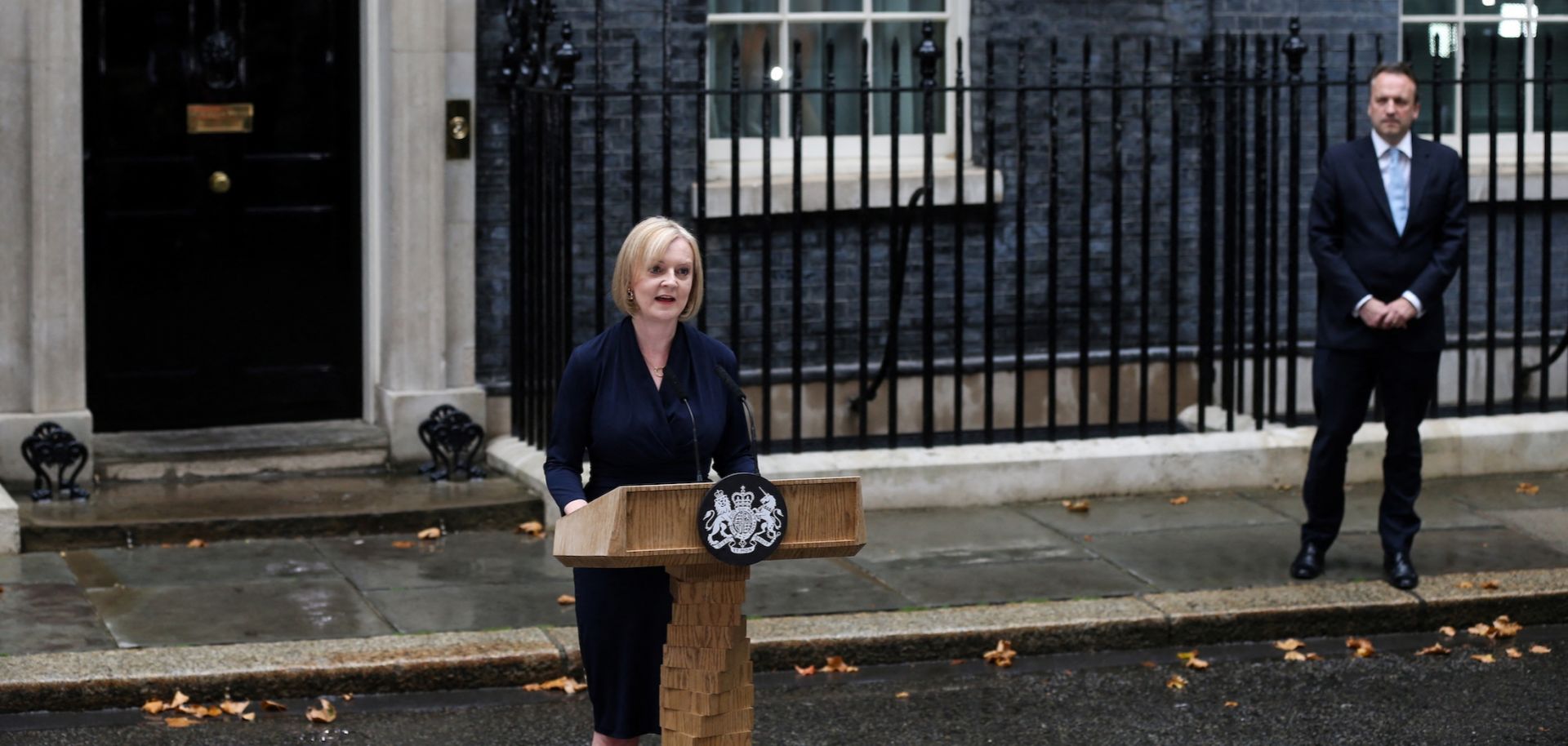
U.K. Prime Minister Liz Truss delivers a speech outside 10 Downing Street, central London, on Sept. 6, 2022.
In the United Kingdom, newly-elected Prime Minister Liz Truss's plan to help businesses and households afford their rising energy bills could somewhat mitigate the cost of living crisis in the country, but it will come at a large financial cost for the U.K. government. While the energy crisis will be Truss's immediate priority, Brexit-related disputes are also likely to re-emerge in the coming weeks. On Sept. 6, Queen Elizabeth II formally appointed former Foreign Secretary Liz Truss as U.K. Prime Minister. Truss is taking over the British government at a challenging time, as the country battles a worsening cost of living crisis driven by soaring energy prices. Inflation is above 10 % (a 40-year high) and is expected to continue rising, and the U.K. economy is expected to enter a recession in the coming months. Since the start of the year, the Bank of England has implemented six interest rate hikes to fight inflation, which will likely dampen economic activity in the near future.
- Truss is the fourth U.K. prime minister since 2016, underscoring the divisions within the governing Conservative Party. Her predecessor, Boris Johnson, announced his resignation in early July after a series of scandals that weakened his government, forcing the Conservative Party to hold a leadership contest to replace him as party leader and U.K. prime minister. On Sept. 5, the party announced that Truss had defeated her main opponent, former Chancellor Rishi Sunak, for the position after she secured 57% of the roughly 140,000 votes cast by party members.
In the coming days, Truss will unveil a multi-billion pound plan to help businesses and households cope with the soaring energy prices. While the details have yet to be revealed, the plan will likely include a scheme to either help households and businesses pay their bills, or to cap the price at which suppliers sell natural gas and electricity to customers. In either case, the U.K. government may have to pay the difference between wholesale energy prices in the market and the capped prices at which energy is provided to customers. As a result, London may be forced to increase borrowing, which would be particularly expensive due to rising interest rates. This would further worsen the United Kingdom's debt-to-GDP ratio (which rose from around 84% of GDP in 2019 to the current 100%, primarily because of the multiple stimulus measures implemented in recent years). An increase in public spending could also result in a pervasively high fiscal deficit, forcing the government to implement unpopular spending cuts in the future. A multi-billion pound plan to cope with the energy crisis would also make it harder for Truss to honor her campaign promise to drastically cut taxes for companies and households in the immediate future, as the U.K. government will probably be unable to simultaneously increase public spending and reduce state revenue.
- Wholesale energy prices have increased significantly in the United Kingdom over the past year, first because of the rebound in economic activity amid the easing of the COVID-19 pandemic, and then because of the war in Ukraine. Reflecting these changes, the United Kingdom's energy price cap increased by 12% in October 2021 and 54% in April 2022. Unless the U.K. government makes a move in the coming weeks, the energy price cap is due to increase by 80% in October.
- On Sept. 6, the BBC reported that the U.K. government is planning to freeze energy bills for households at the current levels for 18 months. The plan would reportedly involve asking energy suppliers to take government-guaranteed loans to help them bridge the gap between market prices and capped prices. If implemented, this scheme may not result in the government significantly increasing borrowing, as private companies (and not the U.K. state) would take on the new debt. But energy companies would repay their debt through supplementary bills to customers in the future, which could be very controversial.
While the new Truss administration will escalate U.K.-EU tensions over outstanding Brexit issues, it will seek to avoid triggering a full-on trade war with the European Union at a time of worsening economic conditions. The Truss administration will likely add new pressure on the European Union to renegotiate the Northern Ireland protocol of the Brexit agreement, which establishes customs controls at the Irish Sea. In particular, Truss will move forward with a bill to grant the U.K. government the power to unilaterally circumvent the customs controls, which violates the agreement with the European Union. Truss may also trigger Article 16 of the protocol, which allows the U.K. government to suspend its implementation during extraordinary circumstances, such as a severe diversion of trade between Northern Ireland and Great Britain. Both actions will worsen relations with the European Union and increase the probability of Brussels imposing financial penalties and tariff hikes on specific U.K. goods. However, London and Brussels will likely seek to avoid a full-on trade war that could eventually result in the collapse of their entire trade and security agreement at a time of worsening domestic economic conditions and the ongoing crisis in Ukraine.
- According to the U.K. government, the Northern Ireland protocol is disrupting trade between Great Britain and Northern Ireland while threatening the peace agreement in Northern Ireland. In June, Truss presented the Northern Ireland Protocol Bill which, if approved, will give the U.K. government unilateral powers on customs controls at the Irish Sea, as well as on regulations, state aid and the application of EU law in Northern Ireland. The bill is currently going through the legislative process in the U.K. Parliament, where some degree of resistance is expected from pro-EU peers in the House of Lords. On June 15, the European Union launched an infringement procedure against the United Kingdom, which could result in financial penalties. Brussels has said the abolishment of the bill is a prerequisite for negotiations with London on amending the Northern Ireland protocol.
- Article 16 of the Northern Ireland protocol gives London and Brussels the power to suspend its implementation during extraordinary circumstances. It also involves an arbitration period between the two signatories to reach a solution to their dispute. This means that triggering article 16 may not immediately lead to EU retaliation, especially if the United Kingdom accepts to enter the arbitration period.
- No significant changes should be expected in other foreign policy areas such as the United Kingdom's support for Ukraine. The former Johnson administration provided financial, military and political support for the government in Kyiv, a policy that Truss has pledged to continue. U.K.-China relations will likely also remain tense, as Truss has indicated she will maintain her Conservative Party's tough stance on Beijing in alignment with the United States' similarly hawkish approach.
