
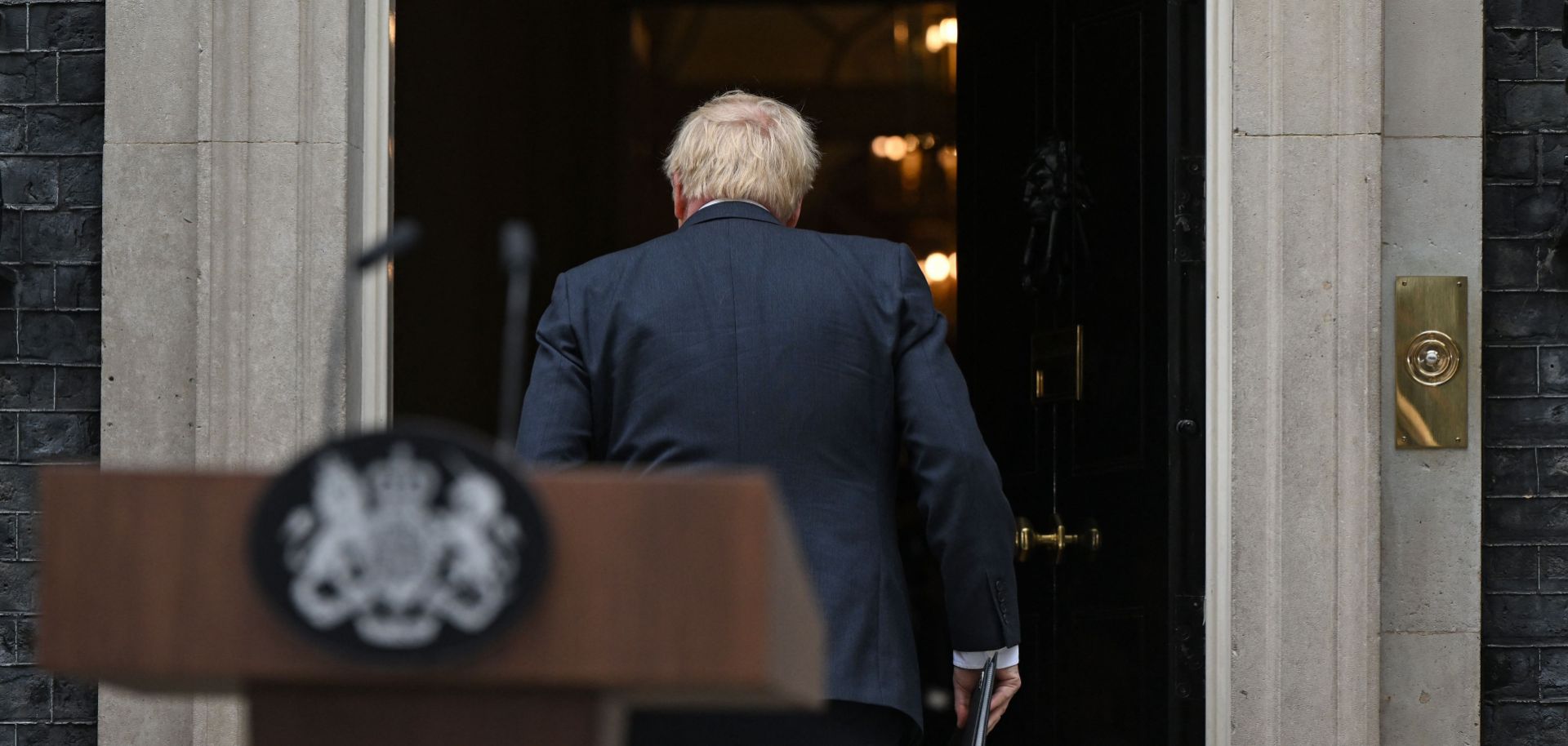
U.K. Prime Minister Boris Johnson walks back into 10 Downing Street in central London after announcing his resignation on July 7, 2022.
While the appointment of a new prime minister will reduce political uncertainty in the United Kingdom, the new government will face a worsening cost of living crisis and a looming trade war with the European Union that will continue to create economic risks. On July 7, U.K. Prime Minister Boris Johnson announced his resignation as Conservative Party leader and eventual plan to stand down as prime minister following the resignation of several members of his government in recent days. For months, multiple scandals and accusations of mismanagement had weakened Johnson, who narrowly survived a no-confidence motion from his own party in late June. Johnson will stay in a transitional government with limited powers while his Conservative Party elects a new leader, who will then become prime minister. Johnson said that the timetable for the Conservative leadership contest will be announced next week, and that his plan is to stay in power “until the autumn.” However, Johnson's political party may pressure him out of office sooner if the leadership contest is resolved quickly, because the Conservatives may want to avoid having a caretaker government in place amid the current cost of living crisis in the country. The United Kingdom does not need to hold a general election until January 2025, and the Conservatives will seek to avoid an early election because most polls suggest that it could lead to a victory by Labour, the main opposition party.
- In May, an investigation by senior civil servant Sue Gray confirmed that several gatherings took place in Downing Street in 2020 and 2021 that violated COVID-19 lockdown measures. Johnson and other government officials were fined because of their participation in the gatherings, in a scandal now known as “partygate.”
- In late June, the Conservative Party lost two parliamentary by-elections, in what many within the party saw as a reaction against the “partygate” scandal.
- In early July, several members of the Conservative Party accused Johnson of being too lenient with Conservative lawmakers who were accused of sexual misconduct.
- These political scandals came on top of a deepening cost of living crisis in the United Kingdom, where households nationwide are grappling with rising energy and food prices, which has further dented Johnson’s popularity. Since late 2021, opinion polls have consistently shown that Labour is between 3 and 10 points ahead of the Conservatives.
Domestically, the next U.K. prime minister will inherit a slowing economy and a worsening cost of living crisis that will constrain their policy options. Recent economic indicators suggest that the British economy may have contracted in the second quarter, which means that the country would enter a technical recession if the contraction continues in the third quarter. In the meantime, inflation in the United Kingdom reached a 40-year high of 9.1% in May, and will probably increase further as energy bills for households and companies are expected to rise again when price caps are revised in October. While the government has introduced billions of pounds in subsidies and stimulus packages in recent months, additional measures may be needed by the end of the year, which could make it harder for London to reduce its fiscal deficit at a time when its borrowing costs are going up and tax revenue could fall because of a slowing economy. To complicate things further for the new government, industry associations and pro-business groups are likely to lobby the new Chancellor for tax relief. Separately, the Bank of England is expected to introduce additional interest rate hikes by the end of the year to fight inflation, which will have a negative impact on economic activity by making it more expensive for households and businesses to access credit.
- In June, the Organization for Economic Co-operation and Development (OECD) predicted that the British economy will grow by 3.6% in 2022 (down from 7.1% in 2021) and will stagnate in 2023. The OECD also predicted that inflation will peak at above 10% by the end of 2022 while private consumption and public investment will slow down. However, the entity also forecasted that unemployment will remain low because of a tight labor market.
- On June 16, the Bank of England took its benchmark interest rate to 1.25% and said it was ready to act "forcefully" to fight inflation. Since then, it has sent multiple signals that further interest rate hikes are probable in the coming months.
When it comes to foreign policy, a new U.K. prime minister will open the door to renewed talks with the European Union on outstanding Brexit issues but will not eliminate the risk of a trade war. Johnson’s successor will likely seek a renewed push to solve the outstanding disputes with the European Union, especially over the issue of customs controls at the Irish Sea. However, the United Kingdom will continue to push for softening or even lifting most customs controls between Great Britain and Northern Ireland in order to preserve the integrity of the U.K. single market, which means that frictions with the European Union and the long-term risk of a trade war between London and Brussels will persist regardless of the change in leadership. The appointment of a new prime minister is also unlikely to change the United Kingdom’s hawkish position on Russia. While the Conservative Party is internally divided on many issues, there is broad support for keeping, or even expanding, the current sanctions on Russia and preserving London’s deep coordination with the United States regarding the war in Ukraine.
- Some of the main contenders to replace Johnson as the new Conservative leader want to abolish some parts of the controversial Northern Ireland protocol, the clause of the Brexit deal that establishes customs controls at the Irish Sea. Foreign Secretary Liz Truss, one of the favorites to replace Johnson, supports the proposed Northern Ireland Protocol Bill, which seeks to eliminate customs controls for goods from Great Britain whose final destination is Northern Ireland. Other potentially hawkish leadership candidates include Attorney General Suella Braverman (who advised the Johnson government that overriding parts of the protocol would be legal) and trade minister Penny Mordaunt (who campaigned for Brexit in 2016).
- There are other potential Conservative leaders who are seen as more pragmatic regarding the Northern Ireland protocol, even if they have also criticized some aspects of it. This camp includes former health secretary Jeremy Hunt, former Chancellor Rishi Sunak and defense secretary Ben Wallace. But even if a more pragmatic leader is appointed, they will still have to deal with a significant faction of the Conservative Party that defends keeping a hard-line stance toward the European Union.
