
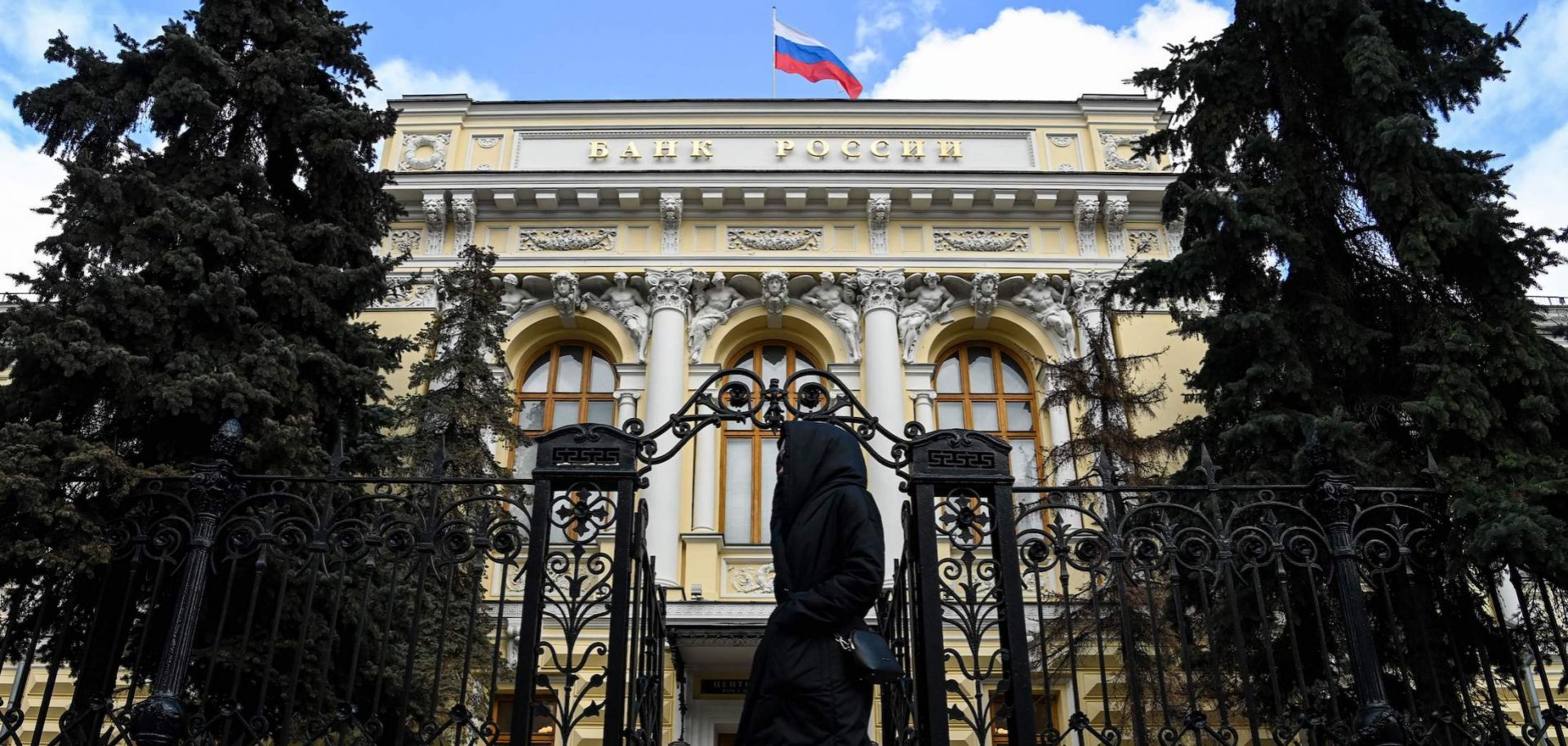
The headquarters of the Russian Central Bank on March 19, 2021, in downtown Moscow.
The United States is poised to force Russia into sovereign default, despite Russian protestations that such a default would be "artificial." While its immediate impact on the Russian economy will be relatively minor compared to the immense challenges Moscow already faces, a default could aid efforts to seize Russian assets abroad and poses limited risks to international bondholders. U.S. Treasury Secretary Janet Yellen on May 18 said that the Treasury Department's Office of Foreign Assets Control is likely to let a temporary exemption expire May 25. The exemption had allowed the Russian government to pay coupons to its U.S. bondholders and avert a default on its government debt. After what is reported to have been intense debate, U.S. authorities appear to have concluded that forcing Russia into default would erode the Kremlin's ability to finance its invasion of Ukraine, and that the harm to U.S. holders of Russian bonds will not pose a systemic risk to the Western financial system.
- While a sovereign default initially seemed likely this month as Russian officials continued to insist they would only pay their debt obligations in rubles, Moscow backtracked April 29 and paid two dollar-denominated bonds before their 30-day grace period expired May 4.
- Bank of Russia chief Elvira Nabiullina on April 29 said that Russia's Finance Ministry had all the resources to fulfill its obligations, and that any sovereign default was out of the question. Nabiullina's comments underscore that the Russian government will likely insist that any default designation is "artificial" because it is willing and able to pay, but that banks are not letting it do so due to U.S. sanctions and asset freezes. Russia might lodge legal action using this argument, to which some Western arbitration courts might well prove sympathetic.
The most likely technical trigger for a sovereign default will be the expiration of the 30-day grace period on any Russian sovereign bonds denominated in a foreign currency. The next sovereign transfer stipulating payment exclusively in dollars is due June 24, meaning Russia being barred by the U.S. Treasury from making this payment could trigger a sovereign default after the 30-day grace period expires in July. Were the Treasury to extend the waiver — something that looks increasingly less likely — Russia would be able to keep paying bondholders via its unsanctioned banks. It could do so only if it has enough dollars; at present, it continues to bring in sufficient foreign currency from its sales of oil, gas and other commodities. Preserving the exemption, however, would not meaningfully drain Russia's assets because Moscow's bond payments amount to a tiny fraction of what it brings in daily from these commodity sales.
Russia already faces much more significant short- and long-term economic problems, meaning the relative direct impacts of sovereign default would likely be small. Russia is already experiencing many of the worst consequences of sovereign default due to Western sanctions and corporate boycotts almost totally starving Russia of foreign investment and greatly limiting its access to needed technologies. In case of a default, the Russian Central bank will likely print more currency to repay its debt, which would lead to a spike in inflation. Capital controls the country has already introduced should temporarily mitigate currency volatility. Moreover, while Russia will face greater external financing expenses, Russia has not been reliant on external financing in recent years. It has one of the lowest debt-to-GDP ratios in the world of only around 17%, and will likely continue to be able to take in more foreign currency than it spends and run a current account surplus due to high prices for oil, gas and its other commodity exports for the foreseeable future. Thus, the typical consequences of a sovereign default, such as complications receiving support from the International Monetary Fund or other external sources of financing, will have little immediate effect, as sovereign defaults are more damaging for countries with larger foreign debts and that struggle to bring in foreign currency.
Nonetheless, a default could fuel attempts to seize Russian state-linked assets abroad, which is probably one reason why the Kremlin has sought to avoid being seen as in default and may also factor into U.S. calculations over whether to end the special license on May 25. A Russian sovereign default would give foreign bondholders an additional argument in U.S. and European courts to file legal claims against Russia's foreign assets, such as seizing part of its frozen reserves in foreign banks as collateral or compensation. Foreign bondholders could also try to trigger cross-default provisions whereby default on one issue gives holders of the country's other bonds a reason to demand early redemption, which Russia would likely also not be able to cover. Cross-default clauses could be extended to the debts of Russian state-linked companies to force them to default and open the door for creditors to confiscate their assets as collateral or compensation, preventing the assets from being used to generate foreign currency for Russia, including to finance its war in Ukraine.
- In an April 11 interview, Russian Finance Minister Anton Siluanov accused the West of using all means at its disposal to try artificially to create a default. When asked about the possibility of cross-default clauses being triggered on Russian corporate debt, Siluanov gave a vague answer that the Russian government would work with Russian corporations to service their debt.
Beyond Russia, a default would cause financial losses for foreign bondholders that could pose a limited contagion risk, but international banks' exposure to Russian debt is relatively low. An end to Russian payments and likely inability to renegotiate them so long as Russia's occupation of Ukraine continues means that bondholders will have to write them off as losses for the foreseeable future, causing financial pain among the relatively small group of financial institutions and individual fund investors who are bondholders. Additionally, as Russian sovereign bonds are often a component of relatively risky emerging market bond funds and exchange-traded funds, these will likely take losses, but the share of Russian bonds in such emerging market bond indexes tends to be relatively small (at no greater than 5%), likely limiting the losses to fund investors.
- IMF Managing Director Kristalina Georgieva on March 13 said that banks' exposure to Russian debt is "not systemically relevant." According to December 2021 data from the Bank of International Settlements, exposure to unpaid Russian debt totals around $121 billion and is highest in Italy and France, where banks are owed over $25 billion. In Austria and the United States, exposure stands at $17.5 billion and $14.7 billion, respectively.
