
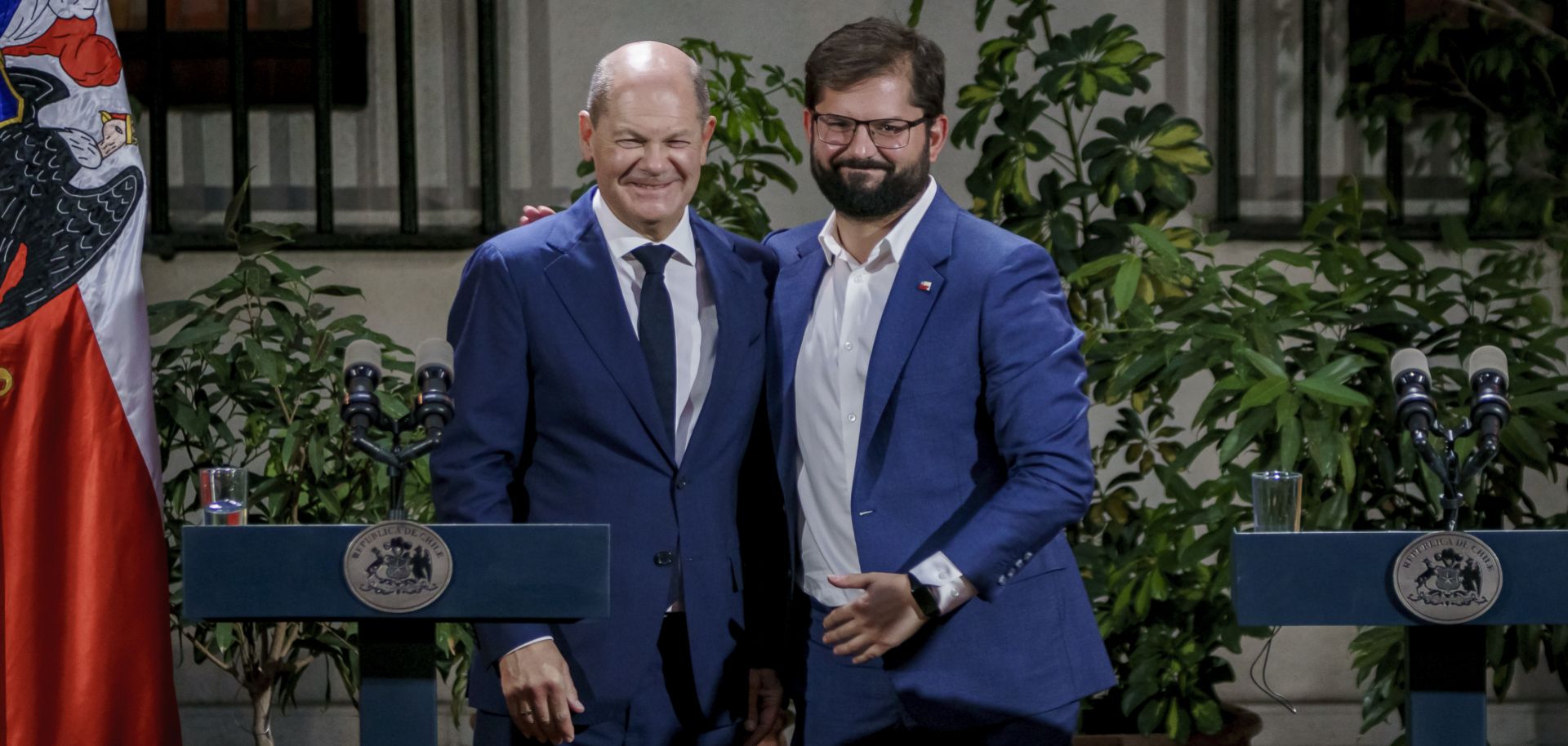
German Chancellor Olaf Scholz (left) and Chilean President Gabriel Boric (right) pose after holding a joint press conference at the Palacio de La Moneda in Santiago, Chile, on Jan. 29, 2023.
Partnerships with two of the world's largest lithium producers, Chile and Argentina, will help Germany diversify its supply of the critical battery material and, in turn, reduce its strategic dependencies on China. But the Latin American countries' difficult business and regulatory climate may complicate German firms' investment plans. German Chancellor Olaf Scholz visited Argentina, Chile and Brazil between Jan. 28 and 31. He was accompanied by a large business delegation in a bid to promote increased energy cooperation with the Latin American countries and secure more supplies of critical raw materials like lithium, a key mineral used in the batteries that power electric vehicles (EVs). On Jan. 28, Scholz met Argentine President Alberto Fernandez in Buenos Aires, where the two signed a business cooperation agreement and discussed ways to increase German companies' access to the country's lithium resources. The two leaders also reaffirmed their countries' commitment to resolving the outstanding issues for a trade agreement between the European Union and South America's Mercosur trade bloc (which includes Argentina, Brazil, Paraguay and Uruguay). On Jan. 29, Scholz then traveled to Santiago, where he met with Chilean President Gabriel Boric and signed various cooperation agreements in areas such as technology, sustainable mining, environment, and energy. In Santiago, like he did the previous day in Buenos Aires, Scholz reiterated Germany's intention to invest in Latin America's lithium sector to reduce his country's dependence on China for the critical mineral. Scholz and his business delegation ended their tour with a trip to Brazil on Jan. 30, where he met with newly elected President Luiz Inacio Lula da Silva.
- In Chile, Scholz and Boric signed a cooperation agreement on the German-Chilean Partnership for Mining, Raw Materials and the Circular Economy, along with a memorandum of understanding on cooperation in the field of research, development and innovation.
- In Argentina, Scholz and Fernandez signed a memorandum of understanding for the office of the ''German Accelerator,'' the main accelerator of German ventures and startups, to operate in Buenos Aires and discussed future cooperation on natural gas, lithium and green hydrogen.
- On Jan. 3, Germany's coalition government announced plans to revamp its strategy for reducing Germany's strategic dependencies on critical raw materials, in which lithium plays a central role. According to a recent analysis from the Institute for Economic Research at the University of Munich (Ifo), the German economy depends on China for several critical industrial goods and raw materials, particularly for EV motors, for which about 65% of inputs are imported from China.
Scholz's Latin America tour is part of a broader effort by his government to reduce Germany's dependence on Chinese battery imports and, in turn, challenge China's dominance in the global lithium market and growing influence in the region. Lithium is a key material in lithium-ion batteries and, consequently, a key element for the global energy transition as it is central for the production of electric vehicles (EVs), energy storage units, and batteries for portable electronics. Chile is the world's second-largest lithium producer (behind Australia) and — together with neighboring Argentina and Bolivia — sits on the world's largest trove of the battery metal. Chile, Argentina and Bolivia are home to more than half (about 56%) of the world's estimated lithium reserves in what is known as Latin America's ''Lithium Triangle.'' However, most of the lithium produced by these three countries is currently imported by China, which controls more than half of the global capacity for refining the raw material into specialist battery chemicals, and is the world's leading maker of batteries. According to the International Energy Agency, lithium demand is expected to surge by 42 times by 2040 as global carbon-cutting efforts accelerate the transition from fossil fuel- to electric-powered products. This, combined with Germany's economic dependence on an auto industry that will increasingly need the material for EV batteries, has made Berlin particularly concerned about China's dominance in the global market and growing presence in Latin America's Lithium Triangle. Scholz's tour in Latin America is thus part of a broader effort to address those concerns (through offtake agreements, stakes in mining operations and investment in local refining capacity) and reduce Germany's reliance on China for the supplies of critical raw materials, batteries and key technologies, which Berlin sees as a key vulnerability.
- China sits on estimated lithium reserves of ''only'' 4.5 million tons — well below Bolivia, Argentina, Chile, Australia and the United States' estimated reserves. But China controls the majority of the world's lithium refining capacity, which grants it an overwhelming dominance in battery production. According to data from S&P Global Market Intelligence, China produced 79% of the lithium-ion batteries that entered the global market in 2021, followed by the United States at just 6.2%.
- China's relatively limited domestic reserves, however, means it also remains heavily reliant on imports of lithium. This has seen Beijing pour massive investments into Latin America's Lithium Triangle to consolidate its position in the global market, with Chinese companies acquiring multiple Argentinian, Chilean, and Bolivian lithium mining operations in recent years. Chinese lithium miners Ganfeng and Tianqi are the world's third- and fourth-largest, respectively. Ganfeng has operations in Argentina while Tianqi owns a 28% share of Chile's major basic materials and chemical company SQM. A third Chinese company, Zijin Mining, added lithium to its portfolio through the acquisition of Canadian company Neo Lithium operating in Argentina and, in 2022, announced plans for a $380 million new lithium carbonate plant in the country's northern province of Catamarca.
Germany aims to increase its supply of lithium from Latin America by investing in the creation of local refining capacity in Chile and Argentina and boosting trade cooperation with the two countries. Building strategic partnerships with democratic countries like Chile and Argentina is a key component of Germany's strategy to diversify its supply of critical raw materials away from China and lower its dependence on Beijing for essential elements of its green and digital transition, like lithium. Berlin ultimately hopes to import refined lithium directly from Chile and Argentina (effectively trying to cut China out as the ''middle man'') by helping build the infrastructure needed to increase the South American countries' local production capacity. In this effort to make Chile and Argentina a ''one-stop shop'' for lithium supplies, German companies aim to boost their investments in the two countries' mining sectors. Berlin is also hoping to capitalize on local governments' growing pro-environment approach (particularly in Chile under Boric's left-wing administration) by having German firms work more closely with local producers to help make extraction and refining processes less environmentally damaging, which would align with Germany's attention to high environmental, social and governance (ESG) standards. This effort will require significant industrial and political coordination, but German companies already have a presence in Argentina and Chile from which to expand operations if properly backed by the state (through, for example, investment guarantees and trade agreements).
- While Chinese companies dominate lithium mining operations in Latin America, Germany counts two active mining companies in Argentina and Chile. Deutsche E-Metalle has indirect access to a large portfolio of licenses thanks to its 50% stake in Lithium Mining Corporation (LMC), which holds over 70,000 hectares within the Lithium Triangle of Argentina. Another German company, Liverde, signed contracts in October 2022 with Chilean RjR Lithium for the extraction of lithium with lower water waste, with operations ready to start in Salar de Maricunga.
- The European Union concluded a trade deal with Chile in December that will grant the bloc greater access to the country's lithium, copper and other minerals vital to the EU green industry. But Brussels has struggled to advance talks to finalize a trade deal with Mercosur countries.
But German companies will likely continue to struggle with poor investment climates and considerable tax uncertainty in Argentina, Bolivia and (to a lesser extent) Chile, which could complicate Berlin's ongoing push to increase its presence in the Lithium Triangle. While Argentina has sought to promote investment into its lithium sector by easing import taxes for equipment and overall royalties, the country's overall investment climate remains poor as the government is unable to guarantee a stable regulatory and tax environment due to the country's history of political volatility and policy whiplash. Given that the startup time for new lithium mining projects can span anywhere from five to 10 years, the uncertainty in Argentina's investment climate could make it an unattractive choice for companies seeking to profit off of the country's vast lithium reserves. Investing in lithium extraction in Bolivia is even more of a headache, as the socialist government's Mining Law dictates that all production must be carried out in tandem with the state (which may explain why Berlin has seemingly opted not to seek out a partnership with La Paz). Chile, by contrast, appears a more promising destination given the government's welcoming rhetoric toward foreign investors — particularly for German companies as the Boric administration's focus on setting and adhering to environmental standards aligns with Germany's approach. However, Chile's ongoing efforts to rewrite its constitution create uncertainty surrounding the country's future regulatory environment, as it remains unclear what economic, governance and policymaking model for Chile will ultimately emerge from the drafting process.
- Argentina's mining investment law allows for duty-free imports of equipment, includes tax breaks and fiscal stability, and establishes royalties of just 3% for exports. It does not establish mechanisms for dialogue with local communities.
- In 2019, political unrest and local protests prompted then-Bolivian President Evo Morales to call off a joint venture with Germany to develop a $1.3 billion lithium project, which would have included the production of lithium batteries in the country.
- Chilean political parties reached an agreement on a road map for a new constitutional rewrite process in December, two months after voters overwhelmingly overwhelmingly rejected a progressive new constitution that sought to make substantial changes to the country's political and economic system. A revised draft will likely contain less radical proposals than the original one, which (among other things) had sought to introduce increased oversight from indigenous peoples in approving major projects in sectors including mining.
