
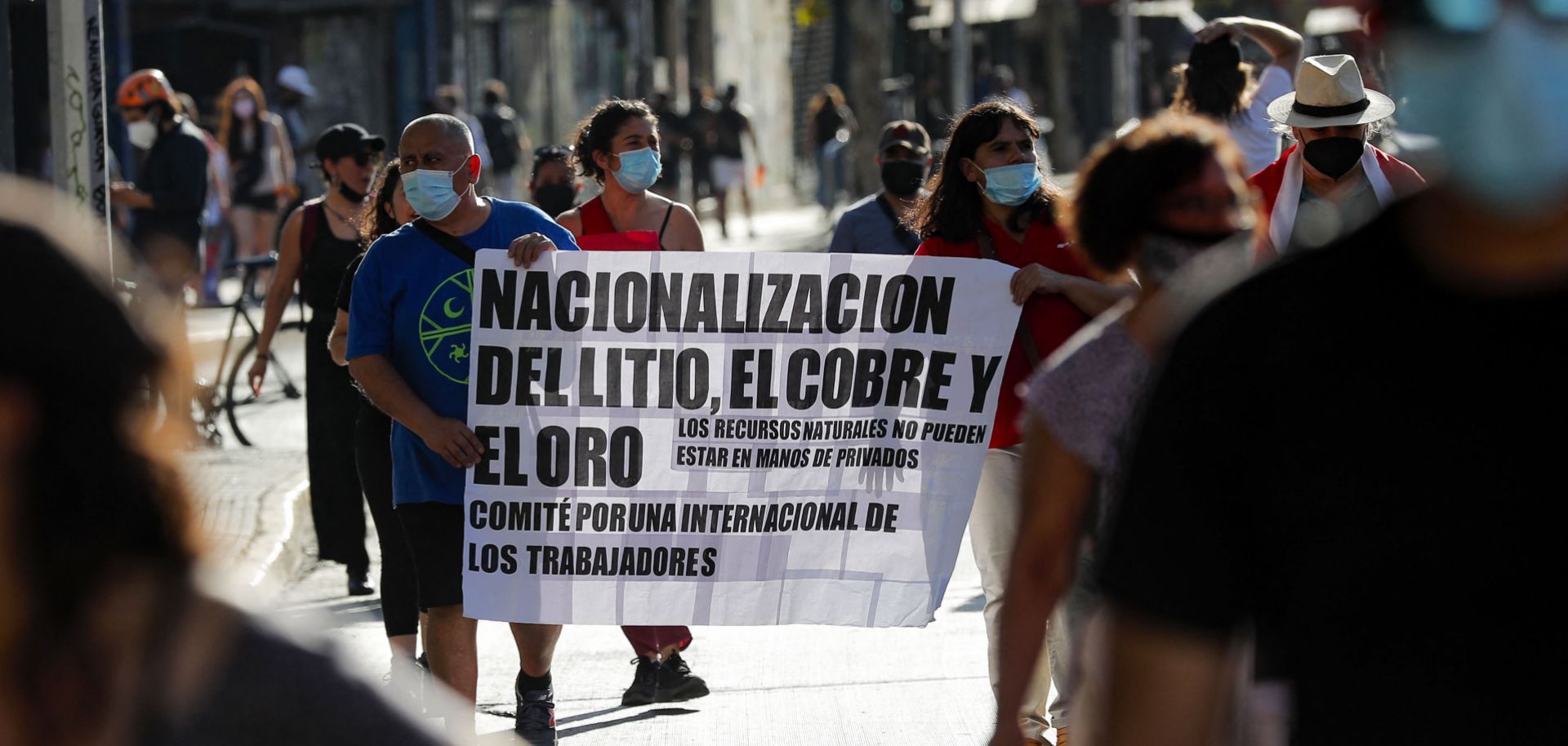
Demonstrators in Santiago take part in a protest against Chilean President Sebastian Pinera’s efforts to privatize the country’s lithium industry on Jan. 7, 2022.
Chile’s incoming left-wing government and constitutional convention will attempt to limit private-sector investment in lithium production while bolstering a new state-owned mining company, which could drive up the cost of the element and make the global energy transition more costly. Almost a week after new lithium concessions were announced, a Chilean appeals court suspended the bidding process at the request of local Indigenous communities. Two companies — China’s electric car maker BYD Co. Ltd. and Chile’s Servicios y Operaciones Mineras del Norte — were previously awarded contracts to produce a combined 80,000 metric tons of lithium over the course of 20 years, accounting for 1.8% of Chile’s known lithium. The auction was a last-ditch effort by outgoing center-right President Sebastian Pinera to reverse Chile’s steadily declining share of global lithium production before his leftist successor, President-elect Gabriel Boric, takes office on March 11.
- Chile is home to the world’s largest known reserves of lithium, a key mineral in producing the batteries that power electric vehicles. Demand for the element is slated to rise sharply in the coming decades amid the global transition to cleaner, less carbon-intensive energy sources.
- In 2016, Chile was the world’s largest producer of lithium, with 37% of the market share. But that share has since dropped to 32% and is forecast to decline to 17% by 2030 if the country fails to boost its lithium production. Chile’s mining sector, which currently is dominated by copper mining, generates roughly 10% of the country’s GDP and over 50% of its total exports.
- Current lithium extraction processes require significant amounts of water, which is used in an evaporation process to separate the element from salt flats. Local (mostly Indigenous) communities have complained of water shortages amid increased lithium mining operations.
Boric’s incoming administration will seek to block the new contracts, as well as increase the overall regulatory burden on lithium mining companies, in order to stem private exploration and production efforts, which will dampen the country’s business climate. The realization of the concessions will now play out in Chile’s court system, as the tenders will be debated legally. Even if the suspension is overturned, the two private firms awarded contracts must still obtain a variety of permits — including environmental ones — before beginning exploration and production efforts, which the Boric administration will likely be able to stall once it takes office. This means the Pinera administration only has until March 11 to push through regulatory approval and discussions with local communities for these specific concessions, which is unlikely as the process can take several months.
- In an attempt to block Pinera’s proposal to auction mining rights, opposition members in Chile’s National Congress introduced a bill on Jan. 5 to delay granting new lithium concessions until after Chile's new constitution is drafted, in an attempt to block Pinera’s proposal to auction mining rights.
While the full nationalization of Chile’s lithium sector is unlikely, the Boric administration and the like-minded delegates drafting the country's new constitution will likely still push to strengthen state control over mining projects, which could see increased discriminatory actions against private firms operating in the sector. Boric has pushed for the creation of a state-owned lithium company, carving out a market share of lithium production for the government. Members of Boric’s incoming administration, as well as members of the constitutional convention, have also suggested giving local communities increased rights over lithium production and water access, which is needed for the mining process. These actions would almost certainly curb Chile’s lithium output in the near term. They would also threaten Chile’s ability to achieve end-to-end lithium production (the ability to complete both the extraction and processing/refining in-country) — a feat that only China has achieved. Stalled lithium production in Chile could drive up global prices for the element, making it more costly for countries to undertake the global energy transition, as electric vehicles rely on lithium battery engines. There’s a chance, while slim, that Chile’s lithium production could be placed entirely under the public sector as well, which would almost certainly lower foreign direct investment inflows as mining companies shift their strategies away from Chile to avoid the risk of nationalization of lithium production assets.
- Under Chilean law, the private sector must work in partnership with a government entity named the Chilean Production Development Corporation to develop lithium, which is classified as a “strategic material.”
- Chile requires that firms sell 25% of their output at preferential rates to domestically-based downstream buyers. This has sparked market interest in creating refining facilities in Chile to manufacture battery components such as cathodes, hydroxide and electrolytes. While a majority of companies may still prefer to refine in China or the United States, Chile’s incentives program will likely force companies to consider refining in-country.
- The constitutional convention — composed of leftist and independent lawmakers — is currently debating whether the new draft constitution should fully nationalize lithium or allow private sector involvement via concessions. The new constitution will likely be ready in August 2022, when it will be put to a public referendum.
