
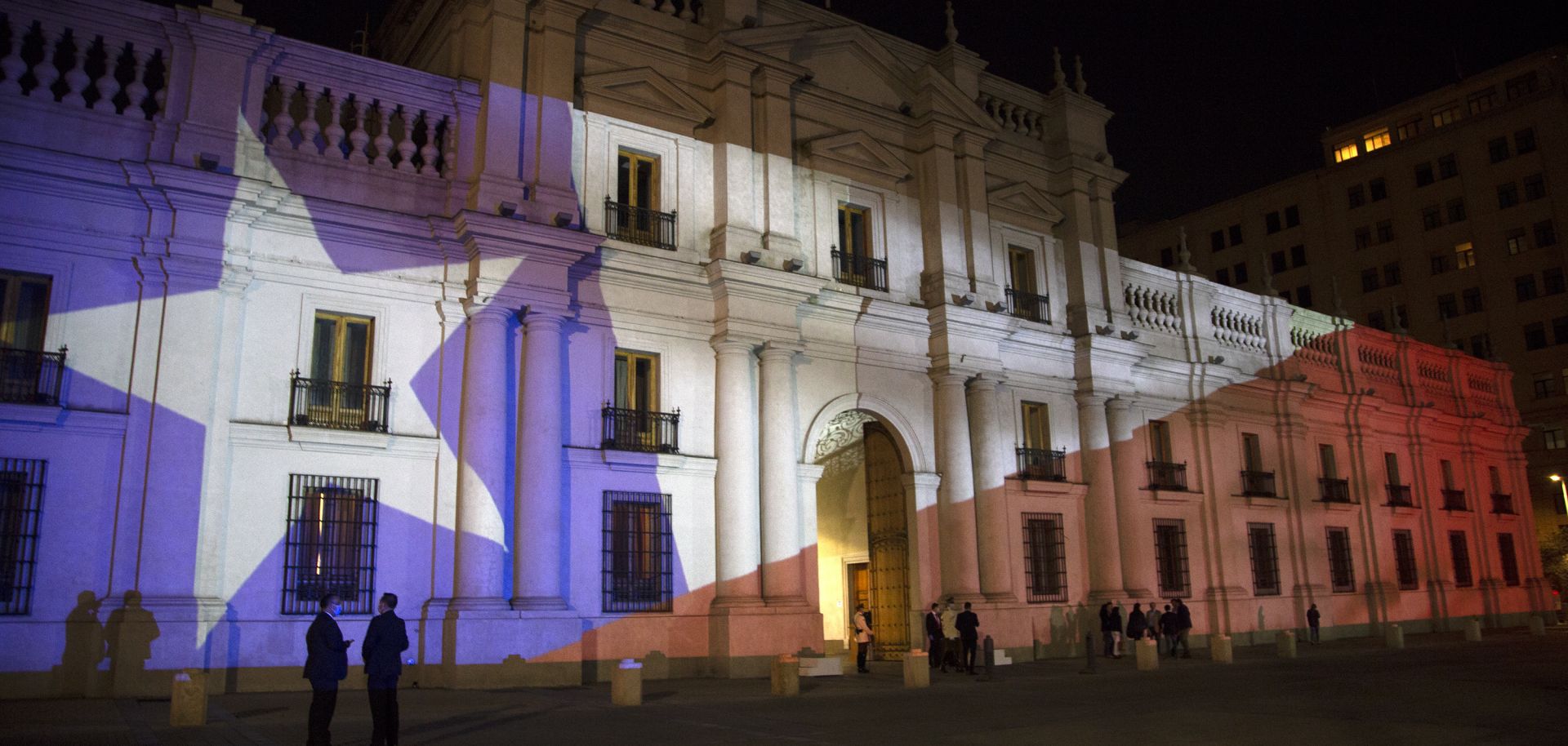
The Chilean flag is projected on the presidential palace in Santiago, Chile, on Oct. 25, 2020, after the country voted to create a new constitution.
Chile will face a period of economic uncertainty as the country moves forward with simultaneously creating a new constitution and navigating out of the deep recession generated by the COVID-19 pandemic. Balancing the objectives of incorporating pressing social demands in the new constitution, while preserving the policies that have provided long-term economic stability, will be key for Chile to maintain sustained economic growth. In an Oct. 25 referendum, a resounding majority of Chileans (78 percent) voted to create a new constitution that will be written by a newly elected constitutional convention, kicking off a long process that will occupy Chile’s attention through 2021.
- The 155 delegates of the new constitutional convention will be elected from lists presented by Chile’s political parties during scheduled municipal and regional elections in April 2021.
- Once installed in May 2021, the convention will have up to one year to draft the new charter and the final document, which will then need to be ratified by another popular referendum.
The recent referendum was a compromise to placate the anti-government protests that swept Chile in October 2019, which advocated for policies aimed at reducing income inequality by guaranteeing greater and more inclusive social services. As successful as Chile’s economy is, the public education and health services have tiered access, causing a majority of the population to consider them a source of unequal treatment instead of serving as social stabilizers. For the Chilean government, the challenge will be meeting these demands while maintaining its economic model based on solid public finances, which has given the country economic stability for decades.
- Over the past 30 years, Chile has averaged an annual GDP growth rate of 4.7 percent, compared to an average of 2.6 for the entire Latin America and Caribbean region. But over the past 10 years, growth has slowed down. Chile’s annual growth average was 3.3 percent between 2010 and 2019, compared with 6.6. percent between 1990 and 1999.
- Unlike most of its regional peers, Chile has not faced a balance of payments crisis in the past 30 years. Prior to the COVID-19 pandemic, Chile was one of the few countries in the region that had largely maintained healthy public balances during this period.
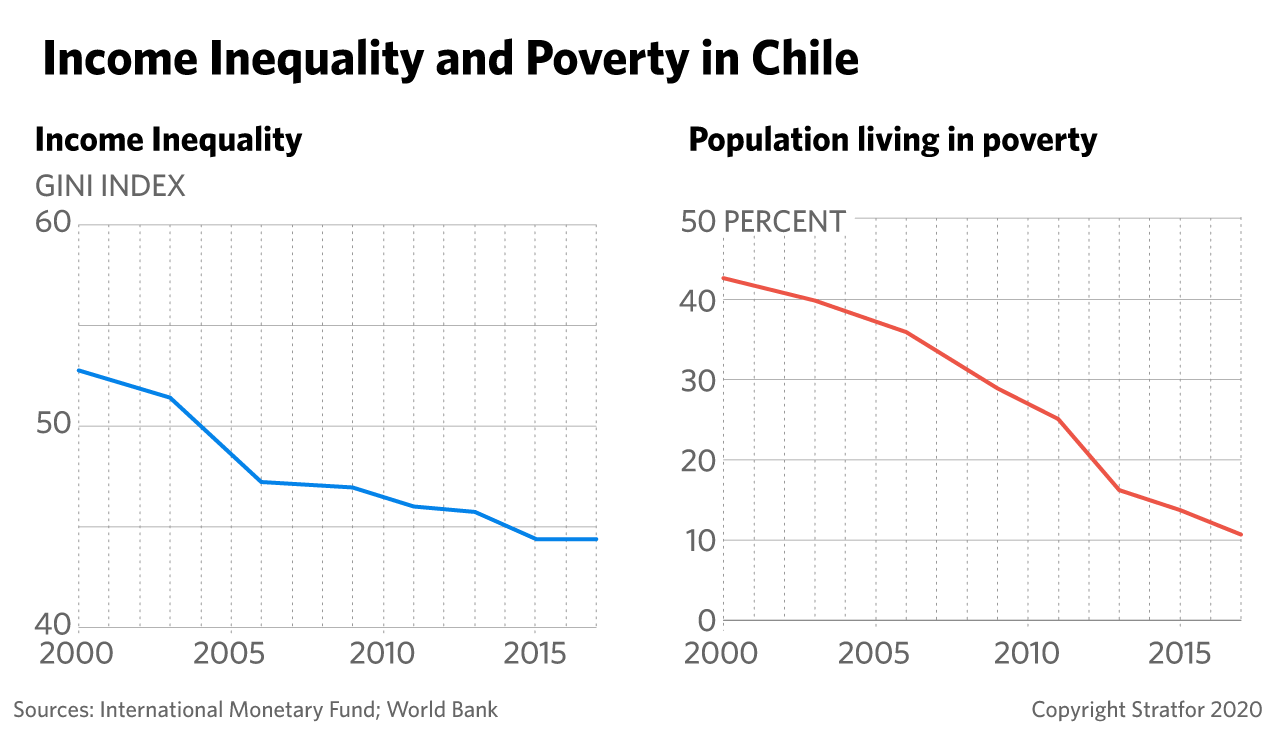
- Between 2000 and 2017, the rate of the Chilean population that was either living in poverty or extreme poverty fell from 42.6 to just 10.7 percent — marking one of the most dramatic improvements in poverty levels in the world.
- Levels of income inequality have also steadily fallen, albeit not at the same speed as overall poverty. Chile’s Gini index, one of the broadest measures of income inequality, fell from 57.2 in 1990 to 44.4 in 2017 — exceeding the pace of improvement in Brazil or Mexico over the same period, per World Bank data.
Due to the coincidental timing of the pandemic and the drafting of a new constitution, Chile’s COVID-19 stimulus measures risk becoming permanent features if they are popular enough to find a place in the new charter. The main demands of the October 2019 protests, and the impetus behind the call for a new constitution, included the redesign of and increase of public investment in Chile’s pension, public health, and education systems. In normal times, these are highly ambitious projects, and the onset of the COVID-19 pandemic is putting more pressure on the need to provide even more fiscal stimulus during the next few months than the already robust one implemented by the administration of President Sebastian Pinera. The World Bank estimates that due to the economic effects of COVID-19, Chile’s middle class — which during the past 10 years has grown from 36 percent of the population to nearly 67 percent — could be severely affected, sending almost 2 million individuals back into poverty.
- Chile’s government has provided fiscal stimulus measures since the beginning of the pandemic estimated to be in the magnitude of 10 percent of GDP, one of the largest responses in the region.
- The International Monetary Fund’s latest projection shows Chile’s total GDP declining by 6 percent in 2020.
There is a distinct possibility that different sectors and political actors might seek to push important policy shifts in the next few months under the current legal framework to address some pressing economic needs. During this time, markets will be watching Chilean politics closely, as any moves to create new social programs or modify current ones could come with a hefty price tag that breaks Chile’s long-standing macroeconomic stability.
- In July, opposition forces were able to force the authorization of the early withdrawal of up to 10 percent of any person’s funds in their individual retirement accounts, a measure that matches the economic needs of the moment but that could severely undermine the solvency of the country’s retirement system. On Oct. 27, opposition legislators announced that they were seeking to approve a second withdrawal authorization.
- The IMF already estimates that Chile’s public gross debt could go from 32.8 percent in 2020 (the highest since the early 1990s) to 48 percent in 2025, without any change to current programs.
- Chile has been working on transforming from mainly a commodity exporter to attract investment into value-added industries, solely attempting to move from solely lithium mining to battery manufacturing. Higher debt and more long-term permanent expenditures, however, might difficult Chile’s economic transformation and erode future growth and development.
