
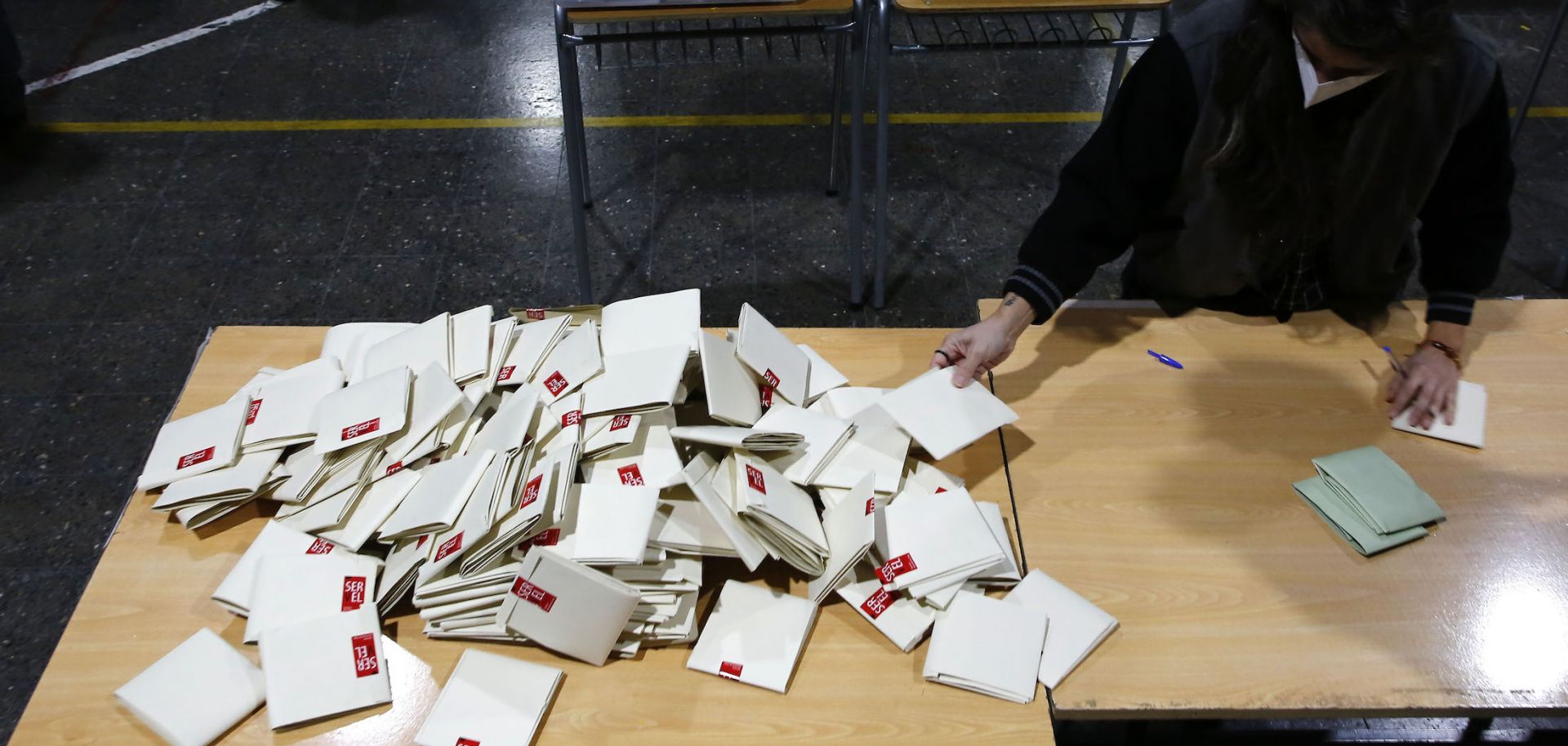
A poll worker counts votes cast for constitutional convention representatives in Santiago, Chile, on May 16, 2021.
After winning a majority of seats in the Chilean constitutional convention, left-wing factions will have the opportunity to introduce broad reforms that could undermine the country’s pro-business environment and increase economic risks. During Chile’s May 15-16 election for the representatives of the constitutional convention, center-right party Chile Vamos ended up with 37 seats, falling short of securing the one-third of seats needed to block proposals. The leftist vote was split between the Lista del Apruebo alliance (which received 25 seats) and other various far-left parties (which received a combined 28 seats). The remaining seats went to an assortment of 48 independent candidates, with 17 seats set aside for indigenous representation.
- Chile’s center-right government appeased massive protests in 2019 with the announcement of a plebiscite to change the Chilean constitution. In October 2020, the Chilean people voted in the national plebiscite to draft a new constitution.
- Roughly 43% of eligible voters participated — more than in recent municipal elections, but less than the amount that voted in the plebiscite. While this is not the majority of the country, the vote remains legitimate.
- The Lista del Apruebo alliance includes the center-left Christian Democrat party, along with the far-left Radical Party and Party for Democracy.
- With four exceptions, almost all of the independent candidates who won seats are left-leaning community organizers who campaigned on securing rights for their regions.
- After the draft constitution is ready, around August of 2022, Chile will hold a final referendum to reject or approve the draft.
The center-right Chile Vamos party’s failure to secure enough seats to block constitutional reforms will grant left-leaning lawmakers the opportunity to reform Chile’s traditionally pro-business economic model. Leftist factions will likely be able to push their ideas with minimal opposition, as the center-left is more likely to align with the far-left because of overlapping ideas on the type of rights the Chilean state should guarantee. While the government may be able to reach the 52 seats needed to form a veto by appealing to the center-left Party for Democracy and Socialist Party, it will likely be difficult to do so as these parties campaigned on mostly far-left platforms and will be inclined to appease voters. On the campaign trail, many members of the constitutional convention promised to expand education and healthcare services, which would require a higher level of government spending. Some initiatives may potentially include labor reforms, as well as changes to the country’s strong private land and water rights. Higher royalties on mining and extractive industries to fund high social spending are also a possibility. Additionally, the constitutional convention is highly likely to nationalize the country’s unpopular pension system, which is currently privately held.
- During the process of drafting the new constitution, new proposals will require the approval of two-thirds of the assembly’s 155 representatives. No one party or coalition has achieved the one-third of seats needed to veto a proposal. But the combined number of seats secured by center- and far-left parties, along with left-leaning independents, crosses this threshold. This means the overall leftist faction will be able to block any suggestions made by right-wing representatives.
The drafting of a constitution that fundamentally alters Chile’s political and economic systems would damage the country’s appeal to foreign businesses and investors. Should the constitution mandate increased social welfare spending to guarantee rights, the Chilean government would be forced to either raise taxes or threaten its free trade agreements by increasing tariffs on imports. Tariff hikes are unlikely to push China, Chile’s largest trade partner, to completely halt trade. Beijing may, however, choose to increase imports from countries with similar goods, such as Peru and Australia. Leftist potential constitutional changes would also pose a significant risk to investors and companies with a footprint in Chile by tarnishing the allure of the country’s traditionally free-market policies.
- Chilean markets have reacted negatively to the outcome of the constitutional convention election. The Chilean Peso has also depreciated significantly.
- In 2020, Chile exported 37.2% of total exports to China.
